Perspective

AI: A Study in Dependencies

By Kyle Harrison

Updated

November 15, 2025

Reading Time

3 min

The promise of AI has triggered a massive ripple effect. In pursuit of what feels like game changing technology, the world writ large has started tripping over itself to build out all the necessary components. What that revealed was just how interconnected all the pieces are.

On the one hand, you have talent. OpenAI’s original input was AI researchers. Now, you’re seeing the formation of “neolabs” at a rapid rate. Former OpenAI researchers who became former Anthropic researchers who became former Character AI spin outs and are now building their own lab. There are dozens of iterations of this. Many of these labs were started within the last 12 months. One of the most famous, Thinking Machines, founded by former OpenAI co-founder, Mira Murati, is rumored to be getting valued in at $50 billion.
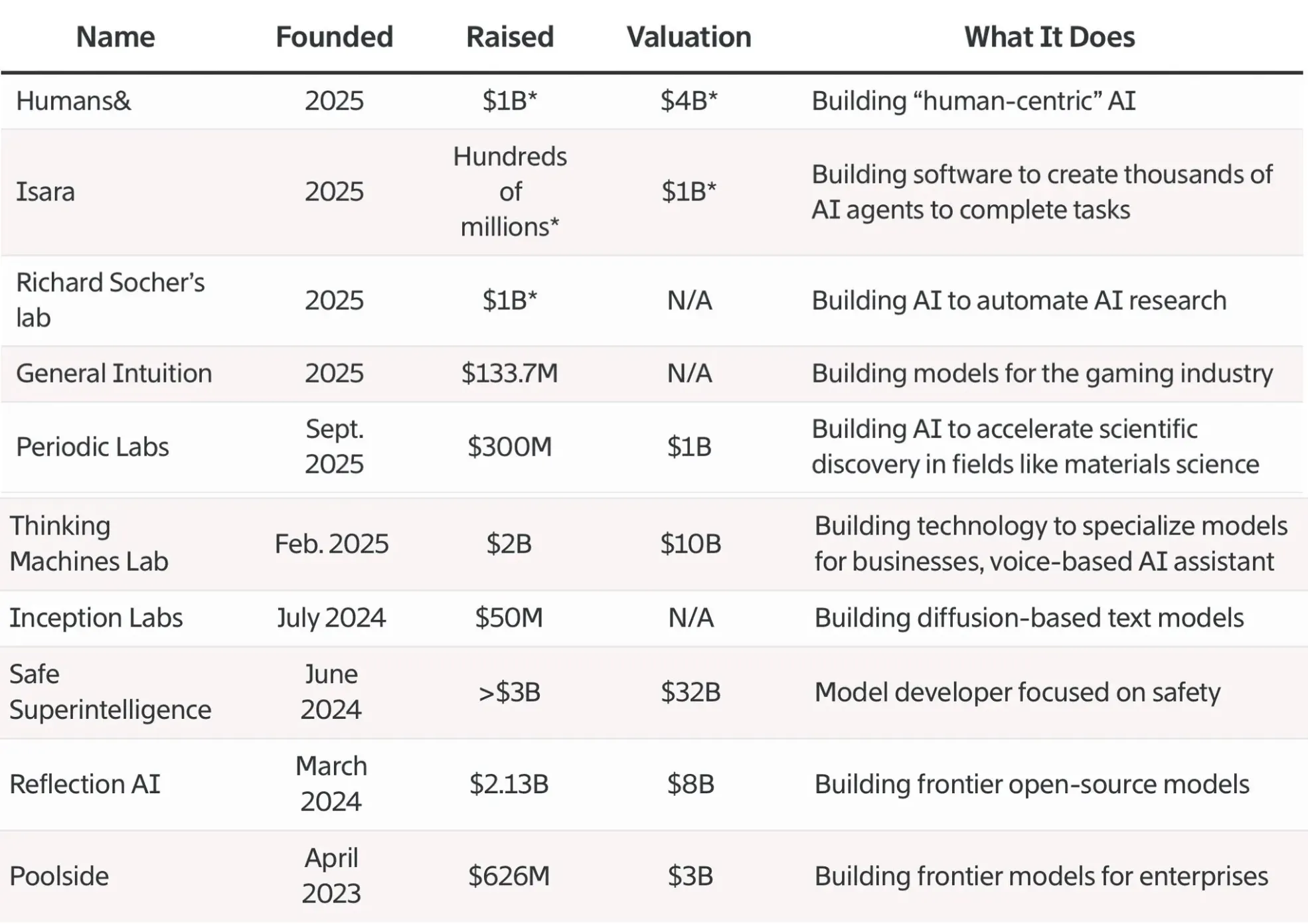
We saw a similar supply and demand strain on AI talent this past summer as Mark Zuckerberg was hoovering up AI talent for Meta, either with buyouts or massive bonuses. The atomic unit of AI breakthroughs felt like they were coming from AI researchers, so having the best of the best was worth any price (potentially up to, and including, $100 million payouts.)

But while the talent end of the spectrum races towards what everyone hopes will be continued breakthroughs, whether in the form of higher performance models, higher quality agents, or more efficient architectures, there is the other end of the spectrum racing to enable those breakthroughs: compute.

The AI boom triggered a commensurate infrastructure buildout that shadows everything that has gone before it. One report indicated that, without data center investments, US GDP growth in the first half of 2025 would have only been ~0.1%.
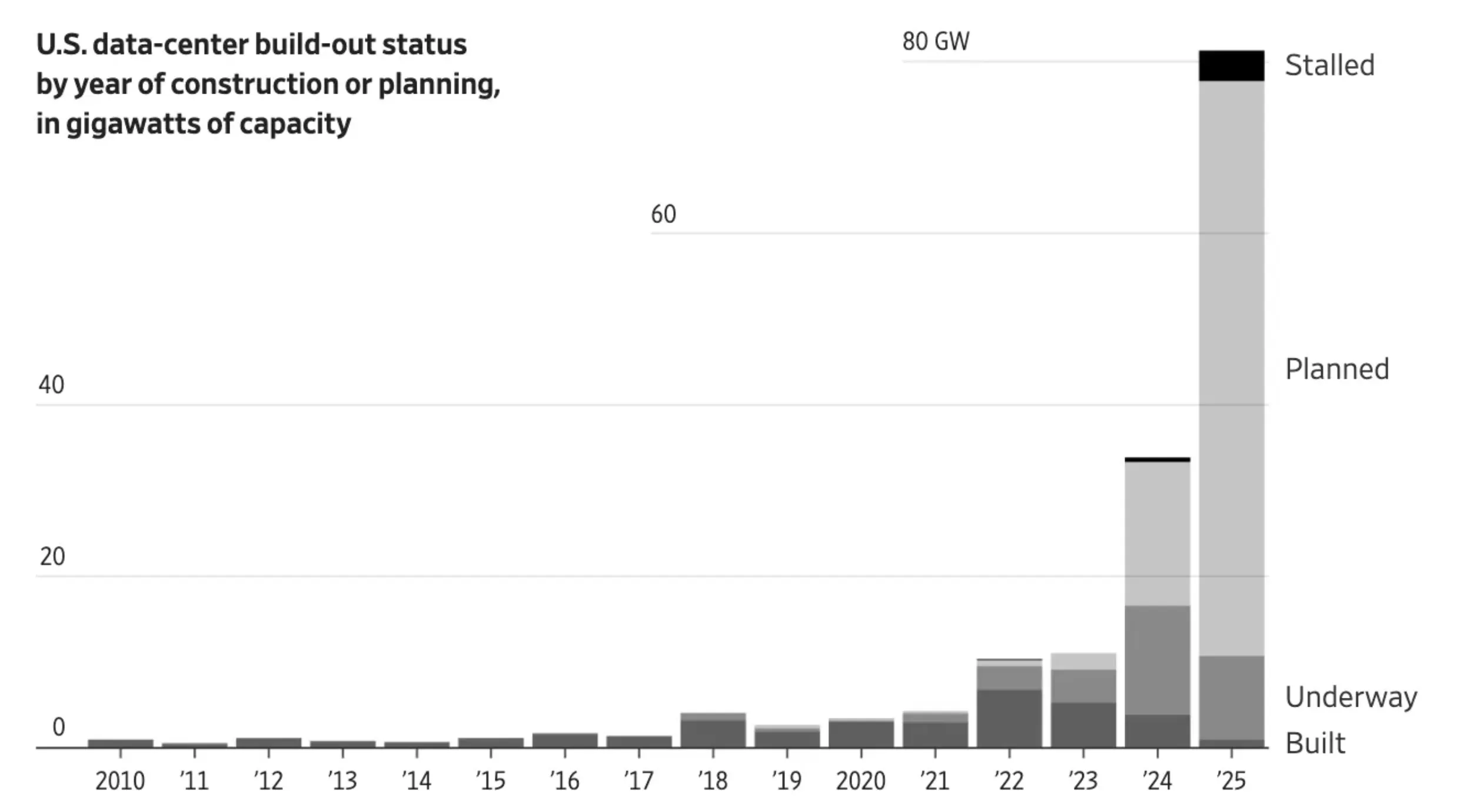
What we have is a massive cyclone of dependencies. More AI talent leads to more AI breakthroughs. More breakthroughs leads to more AI deployments, more inference, more data centers, more compute, not to mention the requirement for more water, and more energy.

And that cyclone is, increasingly, being fueled by debt. One report indicated that OpenAI alone may spend $75 billion in 2026 capital expenditures. Other companies, like Meta, are weaving complex debt deals together with private equity firms that, apparently, are making Zuckerberg feel inclined to promise his team that the bet probably won’t bankrupt the company. Granted, an unnerving promise that a company with $30 billion in quarterly cash flow needs to make.

Unfortunately, that same cyclone of dependencies is starting to run smack into the physical realities of the world around us. In terms of energy to turn on that compute, the CEO of GE Vernova, one of the largest suppliers of hardware for turning on new energy, has said that “nearly all of the company’s output is booked through 2028.” Without the energy to turn on those data centers, you can’t get more compute. Without more compute, you can’t get more inference, more AI deployments, more breakthroughs.

As a result, we will increasingly have to wait and see. We have a finite amount of AI talent. We have a finite amount of physical infrastructure. What will give out first? Our ability to find AI applications worth deploying? Or our access to physical infrastructure to actually be able to turn that AI on? In a cyclone of dependencies, something will ultimately be the bottleneck. We’ll just have to wait and see what it ends up being.


Important Disclosures

This material has been distributed solely for informational and educational purposes only and is not a solicitation or an offer to buy any security or to participate in any trading strategy. All material presented is compiled from sources believed to be reliable, but accuracy, adequacy, or completeness cannot be guaranteed, and Contrary LLC (Contrary LLC, together with its affiliates, “Contrary”) makes no representation as to its accuracy, adequacy, or completeness.

The information herein is based on Contrary beliefs, as well as certain assumptions regarding future events based on information available to Contrary on a formal and informal basis as of the date of this publication. The material may include projections or other forward-looking statements regarding future events, targets or expectations. Past performance of a company is no guarantee of future results. There is no guarantee that any opinions, forecasts, projections, risk assumptions, or commentary discussed herein will be realized. Actual experience may not reflect all of these opinions, forecasts, projections, risk assumptions, or commentary.

Contrary shall have no responsibility for: (i) determining that any opinions, forecasts, projections, risk assumptions, or commentary discussed herein is suitable for any particular reader; (ii) monitoring whether any opinions, forecasts, projections, risk assumptions, or commentary discussed herein continues to be suitable for any reader; or (iii) tailoring any opinions, forecasts, projections, risk assumptions, or commentary discussed herein to any particular reader’s objectives, guidelines, or restrictions. Receipt of this material does not, by itself, imply that Contrary has an advisory agreement, oral or otherwise, with any reader.

Contrary is registered with the Securities and Exchange Commission as an investment adviser under the Investment Advisers Act of 1940. The registration of Contrary in no way implies a certain level of skill or expertise or that the SEC has endorsed Contrary. Investment decisions for Contrary clients are made by Contrary. Please note that, although Contrary manages assets on behalf of Contrary clients, Contrary clients may take any position (whether positive or negative) with respect to the company described in this material. The information provided in this material does not represent any investment strategy that Contrary manages on behalf of, or recommends to, its clients.

Different types of investments involve varying degrees of risk, and there can be no assurance that the future performance of any specific investment, investment strategy, company or product made reference to directly or indirectly in this material, will be profitable, equal any corresponding indicated performance level(s), or be suitable for your portfolio. Due to rapidly changing market conditions and the complexity of investment decisions, supplemental information and other sources may be required to make informed investment decisions based on your individual investment objectives and suitability specifications. All expressions of opinions are subject to change without notice. Investors should seek financial advice regarding the appropriateness of investing in any security of the company discussed in this presentation.

Please see www.contrary.com/legal for additional important information.

Authors

Kyle Harrison

General Partner @ Contrary

Kyle leads Contrary’s investing efforts for companies from seed to scale. He’s previously worked at firms like Index and Coatue investing in companies like Databricks, Snowflake, Snyk, Plaid, Toast, and Persona.

See articles

© 2026 Contrary Research · All rights reserved

Privacy Policy

By navigating this website you agree to our privacy policy.

