Perspective

Tech M&A Shrinks to the Mid-Market

By Kyle Harrison

Updated

July 29, 2023

Reading Time

4 min

At Contrary Research, we have dozens of Research Fellows, a handful of collaborative writers, and the broader team at Contrary including engineers, data scientists, writers, investors, and more. Across that team, we’re constantly sharing what we’re reading and that’s what makes up some of the links that we share below.

However, this week there were three common news items that spoke to a larger trend going on. First, cyberinsurance startup Coalition acquired Jumbo, a mobile app for online privacy. Second, Crowdstrike is in talks to acquire Bionic.ai, a security posture management platform. And finally, Upgrade, a personal credit platform acquired Uplift, a BNPL startup. Several of these acquisitions were priced at ~$100 million - $300 million.

With the market correction we’ve seen over the course of the last 18 months, a lot has been said about the immense slowdown in tech M&A activity. PwC recently published a report highlighting the drop off.
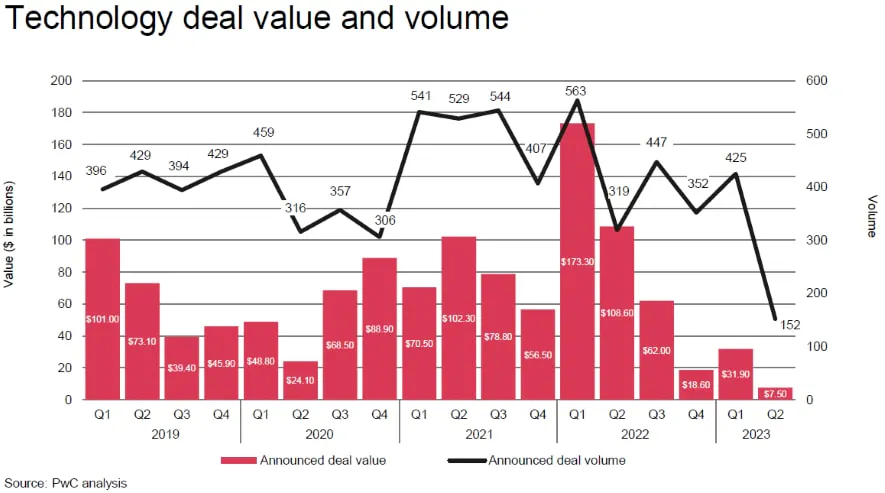
While the last 18 months have certainly seen a decline in the number of deals, but trends in the size of potential deals have even bigger implications for how the venture landscape is changing. Obviously, there are still mammoth acquisitions on the horizon like Adobe’s $20 billion acquisition of Figma, or Microsoft’s $69 billion acquisition of Activision. But those are exceptions, rather than the rule. And that may increasingly be the case. The same could be said about companies like Snowflake and Cloudflare trading at 15x forward revenue (or more). Exceptions, not the rule.

Sam Lessin, an investor at Slow Ventures, made an important point on this idea of adjusted expectations for how big company outcomes can be (whether through M&A or IPO). In May 2022, Lessin published an essay explaining how capital is effectively a supply chain. Early-stage investors invest in what later-stage investors want to buy, and later-stage investors want to buy what they buy because they believe that is what public market investors want to buy. But what happens when nobody knows what the other wants to buy?

This week, Lessin published another essays on the impact it has on seed investing when the public markets have decided that the average run-of-the-mill tech company isn’t worth very much. When I look at acquisitions from this week, like Bionic or Uplift, at $100 million - $300 million, you have to realize that those valuations fall in a typical Series B valuation range, even today after a lot of valuation correction. In 2021, Series B rounds were getting done at $300 million or even $1 billion valuations.

What about “run-of-the-mill” tech companies that went through IPO? Companies like Braze, Amplitude, or Expensify saw valuations in 2021 as high as $4 billion - $8 billion. Others like Asana were as high as $26 billion. Today? All four companies are between $600 million and $5 billion in market cap.

Of all the venture-backed startups out there, only ~11% go public or get acquired. So for early-stage investors, the math becomes a lot more difficult to make work if only 1 in 10 of your bets will make it, and of those bets that do make it the size of the outcome is, on average, probably $500 million to $1 billion outcomes. Those smaller outcomes mean investors need lower entry valuations, and higher ownership to justify the returns they’ve promised to LPs.

Will the exceptions continue to exist, like Databricks’ $1.3 billion acquisition of MosaicML? Definitely. But more outcomes may look like X1’s acquisition for $95 million, Mode Analytics’s acquisition for $200 million, Berbix’s for $70 million, or Paperspace for $111 million. Don’t get me wrong, those can be exceptional outcomes. But not if investors are investing at those prices to begin with. That’s why we may see big changes in which companies get funded, and at which prices.


Important Disclosures

This material has been distributed solely for informational and educational purposes only and is not a solicitation or an offer to buy any security or to participate in any trading strategy. All material presented is compiled from sources believed to be reliable, but accuracy, adequacy, or completeness cannot be guaranteed, and Contrary LLC (Contrary LLC, together with its affiliates, “Contrary”) makes no representation as to its accuracy, adequacy, or completeness.

The information herein is based on Contrary beliefs, as well as certain assumptions regarding future events based on information available to Contrary on a formal and informal basis as of the date of this publication. The material may include projections or other forward-looking statements regarding future events, targets or expectations. Past performance of a company is no guarantee of future results. There is no guarantee that any opinions, forecasts, projections, risk assumptions, or commentary discussed herein will be realized. Actual experience may not reflect all of these opinions, forecasts, projections, risk assumptions, or commentary.

Contrary shall have no responsibility for: (i) determining that any opinions, forecasts, projections, risk assumptions, or commentary discussed herein is suitable for any particular reader; (ii) monitoring whether any opinions, forecasts, projections, risk assumptions, or commentary discussed herein continues to be suitable for any reader; or (iii) tailoring any opinions, forecasts, projections, risk assumptions, or commentary discussed herein to any particular reader’s objectives, guidelines, or restrictions. Receipt of this material does not, by itself, imply that Contrary has an advisory agreement, oral or otherwise, with any reader.

Contrary is registered with the Securities and Exchange Commission as an investment adviser under the Investment Advisers Act of 1940. The registration of Contrary in no way implies a certain level of skill or expertise or that the SEC has endorsed Contrary. Investment decisions for Contrary clients are made by Contrary. Please note that, although Contrary manages assets on behalf of Contrary clients, Contrary clients may take any position (whether positive or negative) with respect to the company described in this material. The information provided in this material does not represent any investment strategy that Contrary manages on behalf of, or recommends to, its clients.

Different types of investments involve varying degrees of risk, and there can be no assurance that the future performance of any specific investment, investment strategy, company or product made reference to directly or indirectly in this material, will be profitable, equal any corresponding indicated performance level(s), or be suitable for your portfolio. Due to rapidly changing market conditions and the complexity of investment decisions, supplemental information and other sources may be required to make informed investment decisions based on your individual investment objectives and suitability specifications. All expressions of opinions are subject to change without notice. Investors should seek financial advice regarding the appropriateness of investing in any security of the company discussed in this presentation.

Please see www.contrary.com/legal for additional important information.

Authors

Kyle Harrison

General Partner @ Contrary

Kyle leads Contrary’s investing efforts for companies from seed to scale. He’s previously worked at firms like Index and Coatue investing in companies like Databricks, Snowflake, Snyk, Plaid, Toast, and Persona.

See articles

© 2026 Contrary Research · All rights reserved

Privacy Policy

By navigating this website you agree to our privacy policy.

