
Thesis
As of January 2026, there are over 1.3 billion websites worldwide competing with each other for attention. On average, a user will spend only 52 seconds on a website. This has driven businesses across all sectors to prioritize their web presence, recognizing that regular content updates and engaging design are essential for success in the digital age.
Demand for web development services has surged as a result, with the market projected to grow nearly 40% between 2025 and 2030, from $74.7 billion to $104.3 billion. In the US, there were 218K front-end developers in 2023, 60% of whom believed that cross-platform applications are the future of web development. This includes applications that work across different operating systems and devices. Some industry experts estimate that 95% of online content could effectively be served through front-end platform-as-a-service environments, reducing the need for complex back-end infrastructure for many websites. The rise of cross-platform complexity is driving demand for more agile, composable web development solutions that can integrate with existing toolchains and emerging technologies such as personalization systems, ERP platforms, and various ad services.
Vercel operates in this evolving landscape as a cloud-based platform for building, previewing, and deploying user-facing web applications. According to Guillermo Rauch, the founder of Vercel, the company’s vision is to become “an end-to-end platform where all software development on the web happens, from idea to production through getting your analytics on what to improve next, to the next idea.” The company's approach aligns with the growing trend towards more efficient, front-end-focused web development practices, aiming to address the needs of businesses across various sectors looking to establish and maintain a modern, performant web presence.
Founding Story
Vercel was founded in 2015 by Guillermo Rauch (CEO), Tony Kovanen (Vercel’s ex-CTO), and Naoyuki Kanezawa.
Rauch grew up near the outskirts of Buenos Aires, where he became fascinated with the internet as a teenager. At 16, he created an open-source project called “fancy menu” that was featured on a popular local blog. At 18, Rauch founded Socket.IO, a JavaScript event-driven library for real-time web applications, instant messaging, and real-time analytics, in 2010. Notable companies using Socket include Microsoft Office, Yammer, Trello, Notion, and Zendesk. Rauch’s future business partners, Kovanen and Kanezawa, were also core contributors to Socket. In addition, Rauch also co-authored Mongoose Node.js in 2012 and contributed to MongoDB, ODM, Node.js, and MooTools. In 2013, Rauch founded Cloudup, a cloud-based file-sharing platform. Automattic (the company behind WordPress) acquired Cloudup in 2013 for an undisclosed amount. Both Rauch and Kovanen worked at Automattic before launching Vercel.
Rauch first came up with the idea of Vercel when he was trying to build a website for his second startup using open-source technology. Yet, despite 15 years of front-end engineering experience, it took Rauch weeks to set up the website. "Every big idea on the internet starts with a web page," he recalled in 2024. "So I was like, how can it take so long?"
So, he built Next.js, the open-source web development framework for static and dynamic websites. As of January 2026, Next.js is used by major commercial and software enterprises, from Walmart.com to AI unicorns. At the same time, Rauch was inspired by how Google Docs and how it transformed collaboration. “I wanted to do that for applications,” he said. The result was the predecessor to Vercel, a real-time collaboration system for web application deployment, called Zeit. In April 2020, Zeit rebranded to Vercel.
Vercel’s initial success came from its open-sourced web-based application. Rauch said in 2025,
"If it wasn't open source and it wasn't web-based, if it wasn't for those two pillars, I would not be where I am. I tried everything else... but there's a longevity and a dopamine hit to being able to create something and share it as a URL."
After leaving Vercel in 2017, Kovanen went to work at Iglu, Gatsby Inc., Saulx, Based.io, and as an independent developer. In 2024, he was the CTO of an early-stage crypto startup called Token Terminal. In February 2025, he joined the TypeScript AI agent framework Mastra (which builds on top of Vercel AI SDK) as a founding engineer.
While Kovanen has left, Vercel has had new additions to its board. In July 2023, Marten Abrahamsen was appointed as Vercel’s CFO. Abrahamsen was previously the CFO of a small business capital solutions provider, and since joining Vercel, he has led the company through its Series E funding round and bolstered its financial, legal, and corporate development teams.
In December 2024, Stripe CFO Steffan Tomlinson was appointed to the board of directors as Vercel seeks to scale its enterprise presence and expand its generative AI practices. Rauch said regarding Tomlinson’s appointment:
“What Stripe did for payments, Vercel is doing for the cloud: building a scalable, secure, developer-first platform. Steffan’s experience leading developer-focused companies from startup to public markets makes him an ideal addition.”
In March 2025, Former Stripe Chief Business Officer Jeanne DeWitt Grosser joined Vercel as its Chief Operating Officer. When she first joined, she said that Vercel is at the same inflection point Stripe was when she first joined the fintech company. A few months later, in June 2025, Keith Messick joined Vercel as the Chief Marketing Officer. Messick was previously at Redis and LaunchDarkly and led marketing at DialPad and Lucidworks.
Product
Source: Vercel
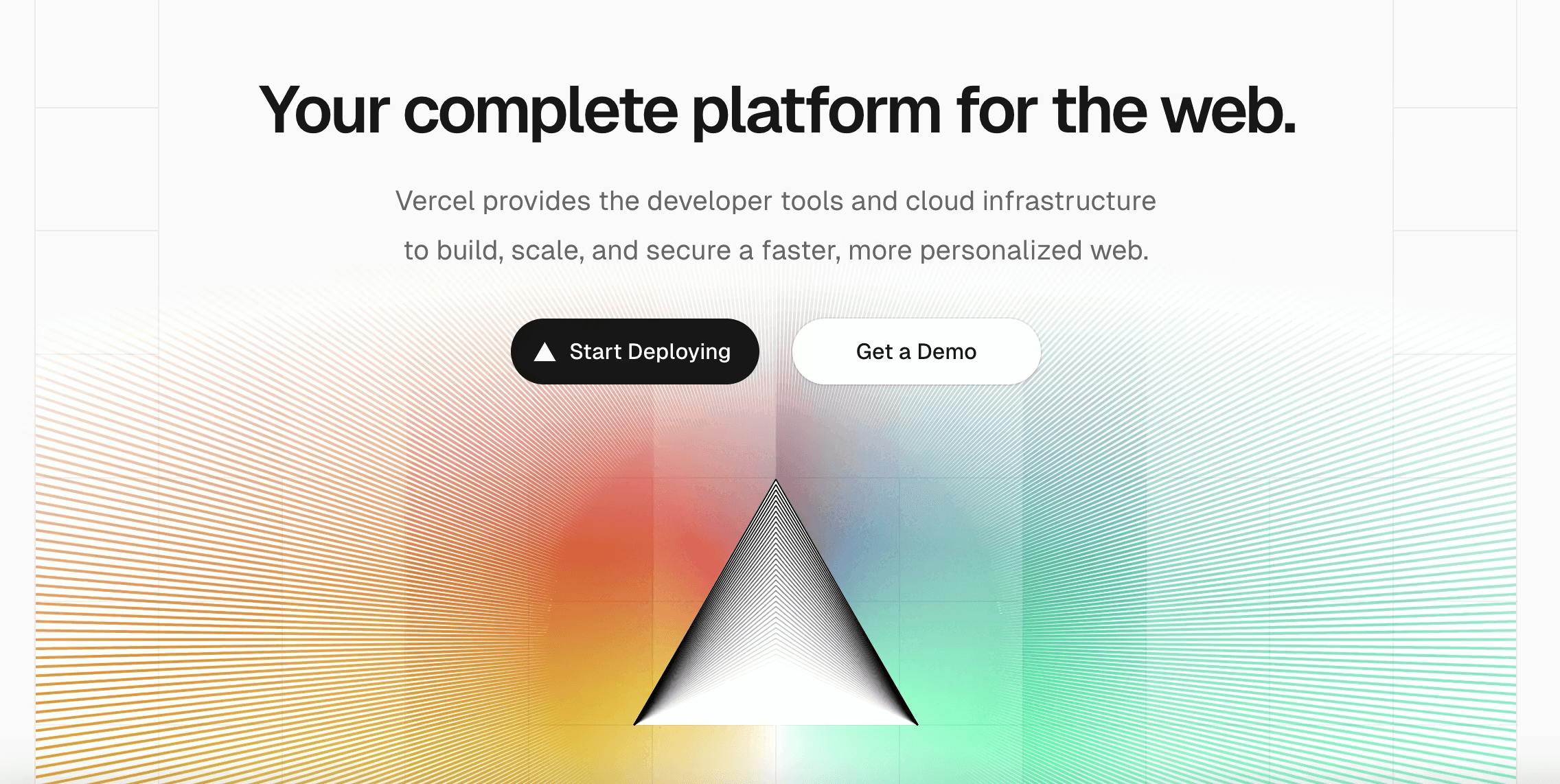
Vercel helps developers build, preview, and deploy fast and scalable web applications, with a focus on frontend frameworks like Next.js. The platform is built around technologies like serverless technologies that accelerate web development, like edge compute and JAMstack. Jamstack is an architecture that aims to make the web faster, more secure, and easier to scale using serverless design. Serverless design allows developers to run and build web apps without having to manage the underlying servers.
Before Vercel, the standard web development process included research, design, content creation, development, beta testing, review, quality assurance, launch, and maintenance. Deployment takes 12 to 28 weeks, or even longer for large sites.
With Vercel, developers can make changes to websites by editing their GitHub repository and deploy those changes almost instantly. Runway build times fell from seven minutes to 40 seconds, Leonardo.ai saw a 95% reduction in page load times, Zapier saw 24x faster builds, Adobe saw 6x faster builds and deployment.
Every website includes a front end and a back end. The front end directly interfaces with the user and leverages the backend for data once the user clicks or makes any request on a website. The backend handles the core data, logic, API, and database architecture. Vercel’s product provides the core infrastructure for the front end, but it also provides required elements for the back end. Vercel’s product stack is meant to be end-to-end, in that it addresses functionality around developing, previewing, and deployment for developers.

Source: Vercel
AI
As the company expands, it has also focused on backend structures that include AI SDK and AI Gateway, which can integrate with any AI model or tool. Vercel provides tools for deploying AI applications compatible with various frameworks, including React, Next.js, Vue, Nuxt, and SvelteKit.
Source: Vercel
AI SDK
The AI SDK is divided into two pillars: UI and core. The company’s UI pillar offers framework-agnostic hooks for chat, completion, and assistants that enable developers to build functional chatbots with minimal code and in minutes.
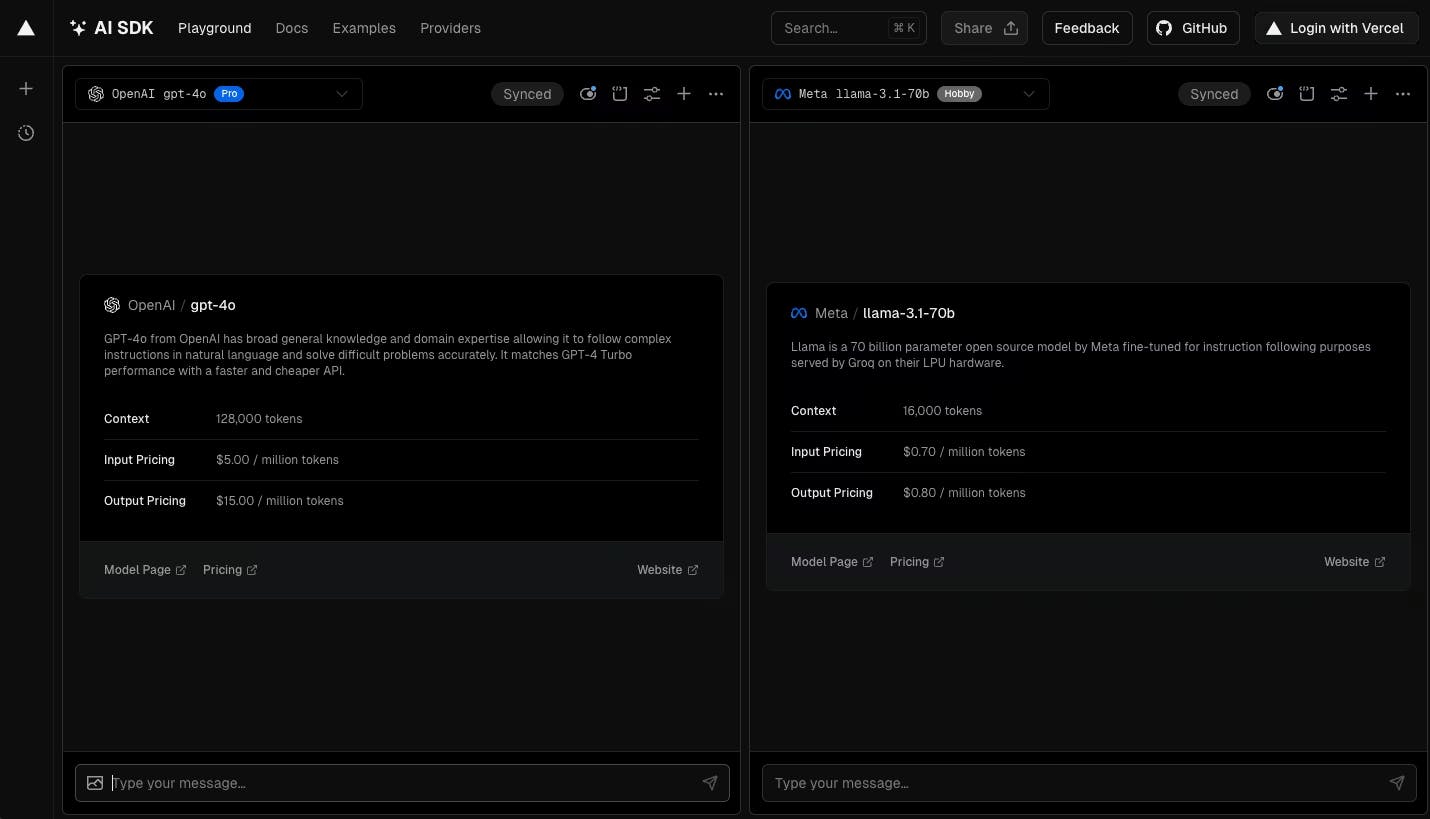
In May 2024, Vercel acquired ModelFusion.dev, expanding the AI SDK's capabilities beyond UI. Vercel considers this its core pillar, which provides a unified API that abstracts the complexities between different AI providers. The toolkit supports various AI providers: Cohere v2 for tool-calling, OpenAI for context-aware completions and prompt caching, Google Generative AI for file support, Amazon Bedrock for embedding models, alongside newer providers like Groq and xAI Grok. All the supported models are available in their AI Playground, which allows developers to compare performance for specific tasks.
The company’s AI SDK 5.0, introduced in July 2025, also features a redesigned chat, agentic loop control, speech generation and transcription, and tool improvements. The introduction of the Agentic Loop Control indicates that Vercel is building for complex, multi-step workflows and sees autonomous AI agents as the next major wave.
The 5.0 SDK is open-source and supports PDF support, computer use integration, code interpretation, and stream resumption, making AI conversations resilient to network connectivity issues and reloading chat mid-generation. These features are especially valuable for long responses (e.g., Deep Research) and those that depend on extracting information from PDF documents. With over 2 million weekly downloads, AI SDK is the leading open-source AI application toolkit as of December 2025.
AI Gateway
To simplify access, the company’s AI Gateway provides a single unified API endpoint to access more than 100 AI models, eliminating the need to manage multiple API keys and rate limits. By changing one line of code in the API, developers can switch between model providers.
AI Cloud
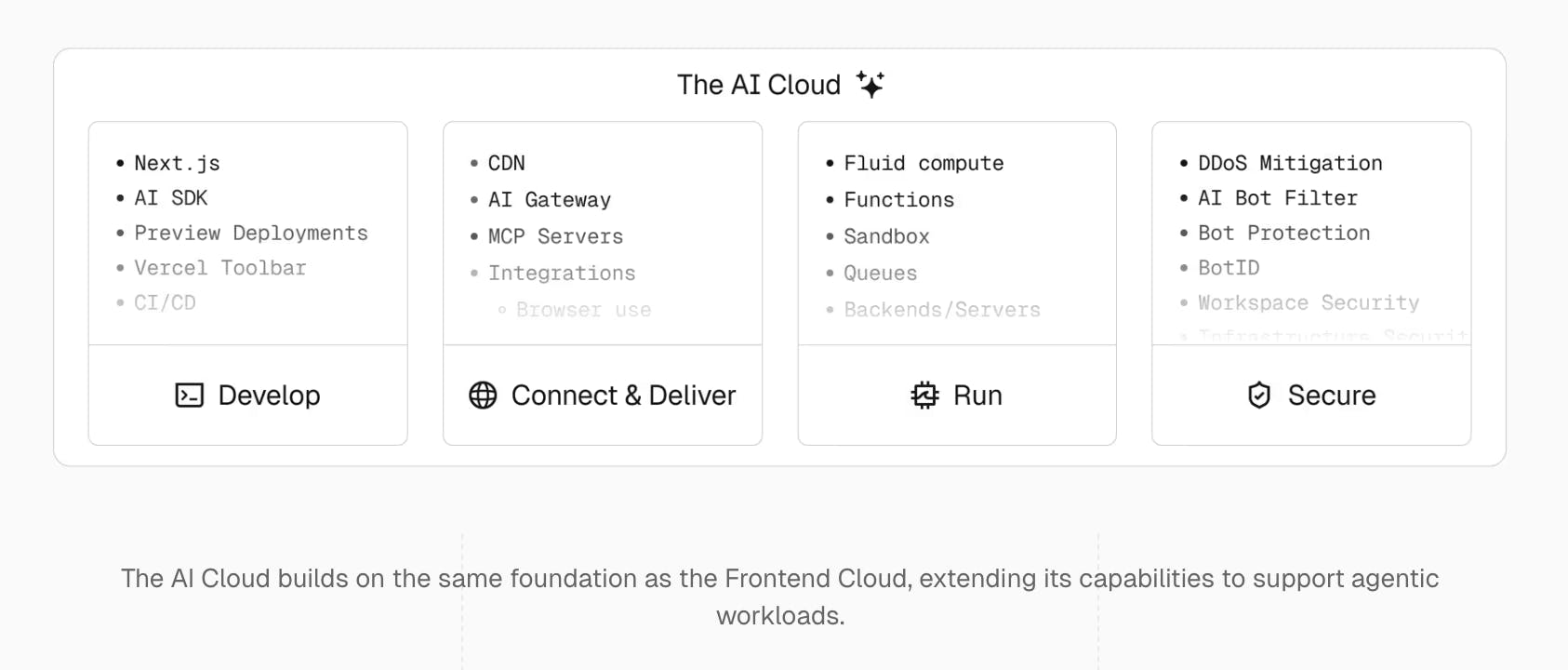
Additionally, Vercel has introduced the AI Cloud, which extends its frontend platform to support AI and agentic applications. The platform helps developers manage infrastructure so that they can focus on shipping products rather than web hosting.
Source: Vercel
Previews
Source: Vercel
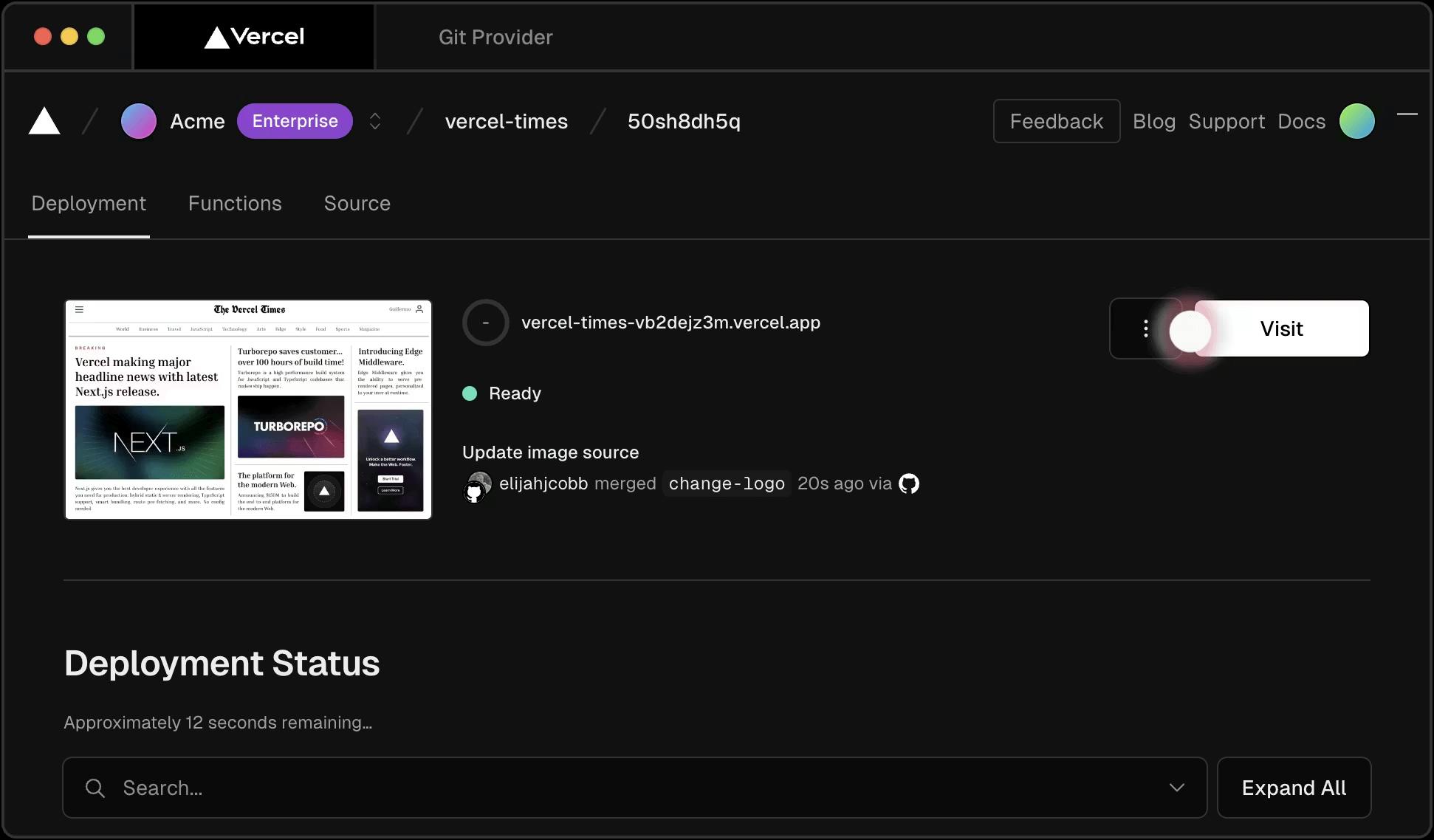
Vercel Previews is a collaborative development and deployment platform. It was designed to streamline the process of pushing, reviewing, and iterating on code changes before deployment to production. This command center consolidates various tools and functionalities essential for development workflows.
The platform integrates with major version control systems, including GitHub, Bitbucket, GitLab, and Azure DevOps, while also offering a command-line interface (CLI) for direct interactions. When developers push code to a connected repository, Vercel automatically generates a preview deployment, combining staging and environment setup to provide an instant, live view of the changes. This supports an iterative development approach, allowing teams to push and test frequent, small updates with ease.
To enhance control over new feature releases, Vercel Previews supports the implementation of feature flags for gradual rollouts and A/B testing. In case there are issues, the platform offers quick rollback functionality to revert to a previous stable version, reducing potential disruption to the development process. Leveraging edge computing technology, Vercel deploys previews with low-latency access for users worldwide. A notable feature of the platform is its bidirectional sync capability, where changes made in the preview environment, including modifications to CMS content, can be automatically pushed back into the main codebase. This ensures that all changes are captured in the version control system, maintaining a single source of truth for both code and content throughout the development lifecycle.
Rendering
In May 2023, Vercel expanded its offerings by introducing back-end services, providing clients with a serverless architecture for web applications. This infrastructure is designed to automatically detect and optimize deployments for over 40 frameworks, including popular choices such as JavaScript, TypeScript, Tango, Elixir, and Go. Vercel manages the necessary compute resources across 18 regions worldwide.
To enhance performance, Vercel has built its own Content Delivery Network (CDN) on top of hyperscaler infrastructure. This proprietary CDN integrates with Vercel's routing and dispatch logic, which is particularly optimized for the Next.js framework. The platform offers flexible deployment options, allowing users to deploy multiple versions of their site simultaneously and intelligently route users to the correct version at runtime.
Vercel Rendering offers an isolated bridge to on-premise backends or services, enabling clients to use a secure integration with existing infrastructure while leveraging Vercel's global deployment capabilities. Their serverless solution allows developers to focus on building applications while Vercel handles the complexities of deployment, scaling, and global distribution.
Observability
Source: Vercel
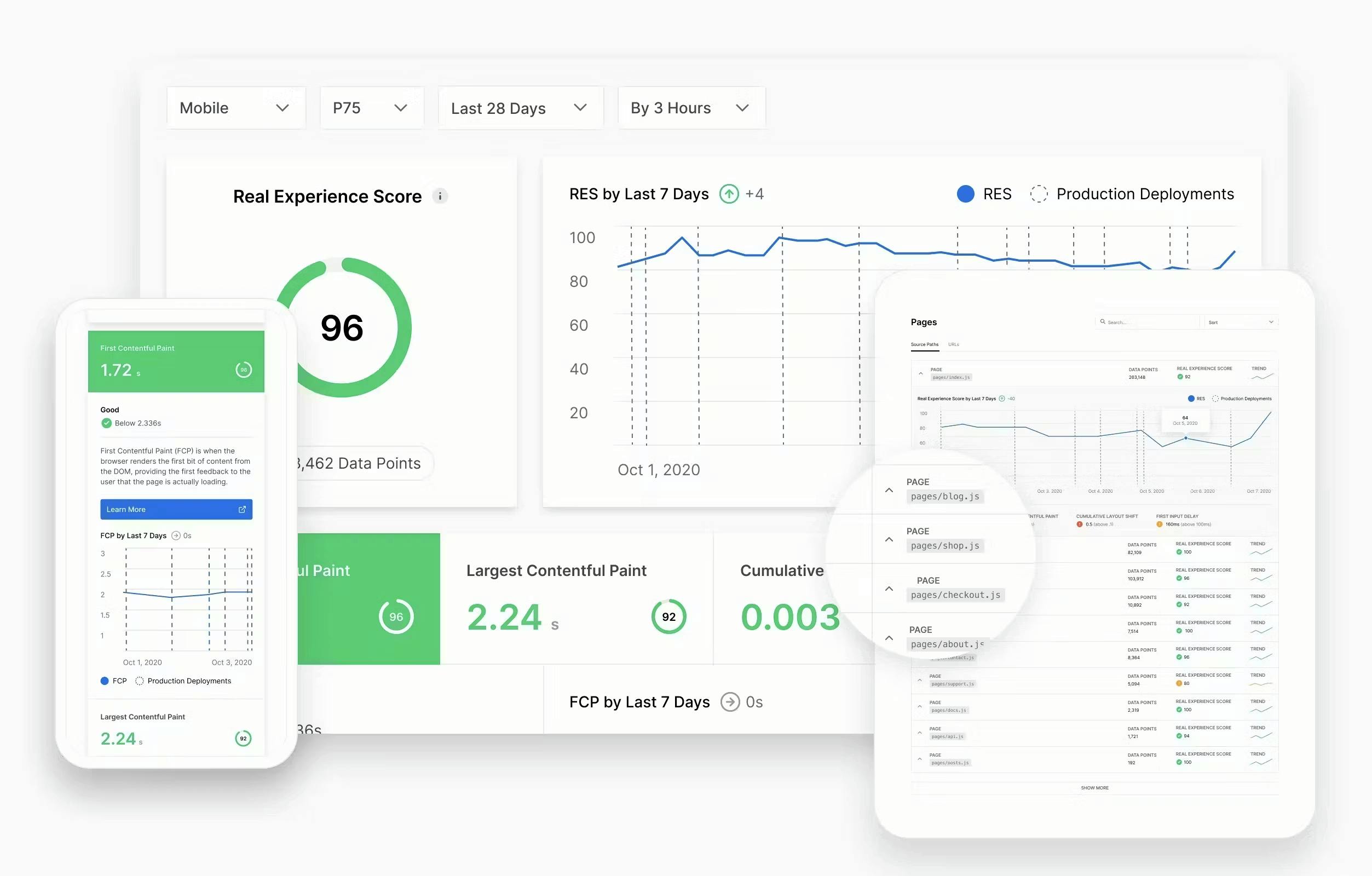
In October 2022, Vercel announced the acquisition of Splitbee, an analytics and conversion tool that enables clients to understand the experience users go through on their site. Splitbee’s functionality was integrated into Vercel’s Observability dashboard. First-party data is collected through the domain, avoiding ad blockers and providing developers with a clearer picture of their audience.
Vercel's dashboard serves as a hub for real-time infrastructure and traffic insights. Developers can leverage this platform to detect and diagnose application issues, analyze performance metrics, and run queries. It provides insights for diagnostics, performance optimization, bandwidth analysis, and bot detection. The centralization of runtime logs generated by Vercel's infrastructure across all environments enhances the platform's ability to provide a holistic view of application performance.
Recognizing the diverse needs of its users, Vercel implemented analytics integrations that allow data to be sent to third-party systems. This provides more advanced analysis, alerting capabilities, and seamless integrations with existing monitoring and analytics stacks. By offering this flexibility. Teams can maintain their preferred workflows while benefiting from the platform's native capabilities.
By consolidating these critical functions, Vercel aims to reduce the complexity of managing multiple tools and platforms, allowing developers to focus more on innovation and less on operational overhead.
Next.js
As a native Next.js platform, Vercel offers out-of-the-box support for Next.js and React applications, requiring no additional configuration. This integration forms the foundation of Vercel's DX Platform, specifically designed to empower front-end developers to ship faster, more efficient user interfaces. Vercel’s Next.js integration contains a suite of tools and optimizations that enhance the development workflow, streamlining the process from code creation to deployment.
At the core of Vercel’s platform is Next.js's approach to routing. By leveraging the file system for route creation, Next.js simplifies the development process while supporting advanced routing patterns and UI layouts. This system boosts developer productivity while promoting better code organization, resulting in more maintainable and scalable applications. Next.js enables developers to build APIs directly within Vercel’s applications, eliminating the need for separate API services.
Vercel's platform also focuses on performance optimization through its support for server-side rendering (SSR). This feature enables faster initial page loads.
For content-heavy websites, such as those in retail, consumer packaged goods, media, and blogging, Vercel's implementation of Static Site Generation (SSG) offers advantages. By pre-rendering and automatically caching generated pages, and then distributing them across Vercel's Edge Network, SSG enhances both performance and SEO. This approach is particularly beneficial for sites with a large amount of static content that don’t require frequent updates.
Recognizing the need for dynamic content updates without compromising the benefits of static generation, Vercel's Next.js platform includes Incremental Static Regeneration (ISR). This feature allows for content updates from a Content Management System (CMS) without necessitating a full site redeployment. ISR strikes a balance between the performance benefits of static generation and the flexibility of dynamic content, enabling websites to stay current and relevant while maintaining optimal loading speeds and SEO advantages.
Security
Vercel offers a security suite designed to safeguard applications deployed on its platform. With six certifications, including ISO 27001, SOC 2, PCI DSS, HIPAA, GDPR, and DPF, Vercel demonstrates its commitment to maintaining high standards across various industries and regulatory frameworks.
At the core of Vercel's security offering is its DDoS mitigation system, powered by the Vercel Firewall. This system provides real-time threat monitoring, API request frequency control, and a custom rule engine for tailored security policies. Firewall changes are implemented across Vercel's global network within 300 milliseconds, ensuring rapid response to emerging threats.
For Enterprise clients, Vercel offers a managed ruleset for OWASP Top 10 protection, guarding against the most common web application security risks. Vercel's security measures are implemented at the edge networks, providing threat mitigation without adding latency to applications. The platform also offers private and dedicated environments, allowing for enhanced security through isolation of resources and data. To ensure continuous operation, Vercel implements automatic failovers, routing traffic to the nearest available region in the event of an outage. Additionally, static assets are replicated and cached across the network, contributing to uptime and availability.
Vercel's Security product extends to code management, allowing for the establishment of code owners to ensure appropriate individuals are responsible for reviewing and approving changes to specific parts of the codebase. This addresses concerns from network-level attacks to code-level vulnerabilities and access control. The edge-based implementation of security features allows for threat mitigation while maintaining optimal performance.
As of January 2026, Vercel is building an autonomous infrastructure that can diagnose vulnerabilities in real time. Its AI agents can handle detailed quality checks that previously required human intervention, from matching Safari theme colors to optimizing load times. Its BotID is also an invisible bot detection system that defends against automated attacks. In 2025, according to Vercel CEO Rauch, v0 prevented approximately 1K vulnerabilities per day. In May 2023, Vercel announced Vercel Firewall and Vercel Secure Compute and expanded its platforms’ security capabilities.
Turbo
Turbo, a collaborative development environment made possible by Vercel’s acquisition of Turborepo in December 2021, is designed to streamline the development process for monorepos. This tool enables teams to work within a single repository containing multiple projects or applications, addressing the unique challenges of monorepo structures.
At the heart of Turbo's functionality is its project analysis system. By automatically determining the correct build order based on inter-project dependencies, Turbo optimizes the development workflow from the start. Vercel enhances this capability with parallel execution, allowing build tasks to run simultaneously.
One of Turbo’s features is its remote caching capability. This system automatically shares build artifacts among team members, reducing duplicate work. When a developer completes a build, Turbo stores the resulting artifacts in a remote cache. Subsequent builds by other team members can then retrieve these cached artifacts instead of rebuilding from scratch, leading to time savings and efficiency across the entire development team.
To help teams quantify the benefits of using Turbo, Vercel provides performance-tracking tools. These analytics offer insights into time saved, cache performance, and build speed improvements, allowing teams to measure and optimize their development processes continually.
As a part of the Vercel ecosystem, Turbo integrates with other Vercel products and services. Projects built with Turbo can be deployed to Vercel's hosting platform without additional configuration, streamlining the path from development to production. Furthermore, Vercel's global edge network can automatically cache and serve static assets generated by Turbo builds.
v0
Source: Vercel
When ChatGPT first launched, Vercel CEO Rauch noticed that AI was exceptionally good at writing React and Tailwind code, the building blocks of web development. This observation prompted Rauch to create v0. "Instead of perhaps the typical reaction, you either ignore it or you're in fear of it, we really deeply embraced it," Guillermo explained in August 2025.
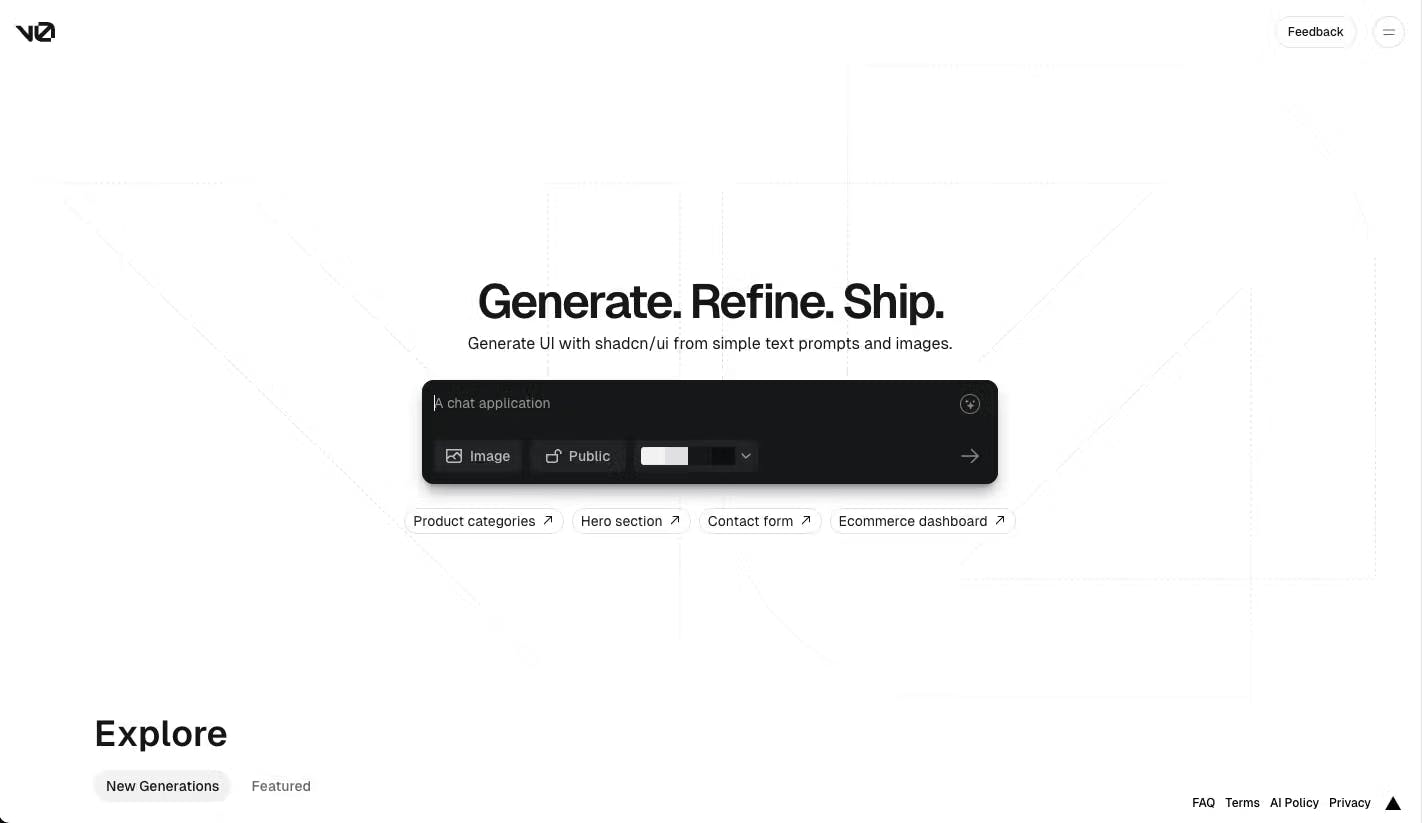
v0 is Vercel's vibecoding tool that transforms prompts or images into functional websites. It generates UI with React components and Tailwind CSS, bringing each generation to life with client-side JavaScript. The platform aims to streamline the process of creating user interfaces by leveraging AI to generate code that developers can use in their projects. It’s primarily used for prototyping, design inspiration, code generation, and learning.
At its core, v0 allows users to input a prompt describing their desired UI component or upload an image as a reference. The system then generates three different UI design options based on the input. Users can select individual parts of the designs for more precise adjustments through the v0 chat. It provides developers with a way to debug, answer development questions, and generate more code after the initial prompt.
v0 includes a feature that allows users to explore UI components generated by other users. This community-driven aspect serves as inspiration and can speed up the design process by leveraging existing ideas. One month after the launch of its community, there were over 20K submissions, with individual submissions receiving up to 6K forks. The company hopes to create a GitHub-like environment for “social product building.”
Vercel emphasizes that v0's AI models are trained on a mix of custom code written by their team, open-source datasets, and synthetic data. The company explicitly states that no Vercel customer data or code has been, is being, or will be used to train, improve, or fine-tune v0.
With the rise of “vibe-coding,” the tool doesn’t only serve traditional developers, but also caters to designers and marketers who can now create functional prototypes in a simple sentence. Developers can also connect to the popular AI code editor Cursor via MCP.
In May 2025, the company announced that it had also created an AI foundational model that excels at full-stack web development. Currently in beta, it requires a premium or team plan to access. The model claims it can “auto-fix” common coding issues and is compatible with other tools and SDKs.
As of August 2025, the v0 team operated as an independent business unit of around ten people within Vercel. Despite its lean team, the product has exploded in popularity. In under a year, v0 generated over 100 million applications and doubled Vercel’s entire user base. Every second, seven applications are generated. In October 2024, v0 generated more UI components than in the previous 12 months combined. In 2025, there have been record-breaking days where the company has hit GPU limits across its cloud providers. There are over 3 million users of v0, with more than 1.3 million confirmed active users of v0. According to third-party research, as of 2025, v0 makes up about 21% of Vercel’s total revenue, with traditional web hosting taking up about 79%
Vercel COO Grosser said that just as legal AI startups like Harvey hope to beat OpenAI on legal applications, “We’ll probably be the best at producing the future’s web applications.”
Enterprise
Vercel Enterprise is designed to help large organizations focus on shipping features instead of managing infrastructure. It integrates with clients' existing git workflows and scales automatically with traffic, allowing companies to maximize their web development capabilities without requiring a full-stack team.
By abstracting away complex infrastructure management, Vercel allows developers to plug and play with the latest web technologies. The platform supports easy integration with modern frameworks, headless CMS systems, and serverless databases.
Vercel Enterprise was designed to enable less technical users, such as marketing content creators, to contribute to web projects without depending on engineering resources. The company announced in 2025 that it is targeting companies building AI applications that need rapid prototyping.
Market
Customer
Source: Vercel
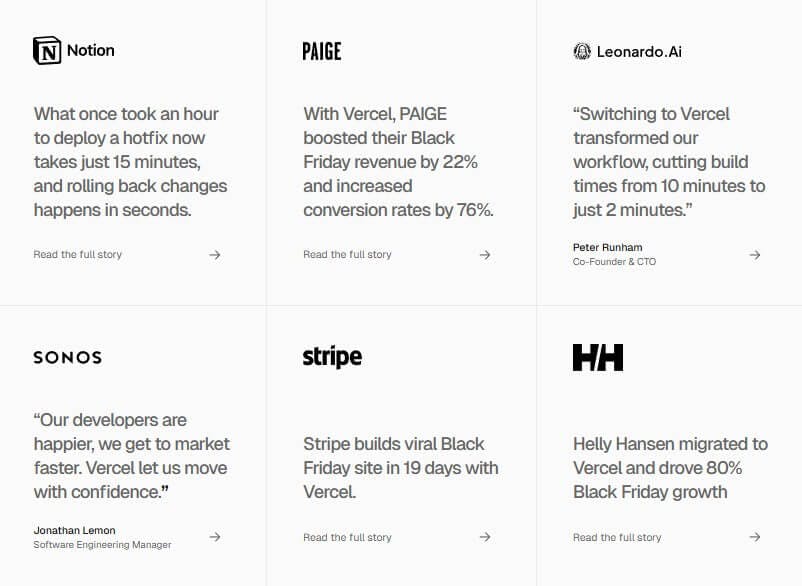
Vercel makes products for front-end developers working at agencies, SMBs, and enterprises. Vercel simplifies the deployment process, with a particular focus on customers within the JavaScript and TypeScript ecosystem. In the future, the company hopes to transition from “developer tools” to a “post-framework era” where it is serving not just the 10-20 million developer market but also hundreds of millions of builders.
In terms of large enterprises, Vercel powers the websites for startups like OpenAI, Pika, Granola, Cursor, Stripe, Decagon, Exa, Ramp, Polymarket, as well as traditional companies like Walmart, Apple, Nike, Netflix, TikTok, Uber, Lyft, and Starbucks. Vercel prototypes are now replacing pitch decks for early-stage startups. The platform serves companies across the commercial and retail, consumer packaged goods (CPG), online retail, media, and brand content industries.
Market Size
The global public cloud services market was projected to reach $805 billion in 2024 and double in size by 2028. The three largest industries utilizing global public cloud services (banking, software and information services, and retail) are expected to represent $190 billion in public cloud services spending in 2024.
Platform-as-a-Service (PaaS) and Infrastructure-as-a-Service (IaaS) each account for nearly 20% of all public cloud spending in 2024. Artificial intelligence platforms within PaaS are expected to experience the fastest growth with a five-year CAGR of 51.1%.
As of January 2026, the US is anticipated to be the largest public cloud services market in the near future, with spending expected to exceed $432 billion in 2024. In markets like the US, 91% of people use the internet and engage daily with online applications. The serverless market, a subset of cloud services particularly relevant to Vercel's offerings, is projected to reach $36 billion by 2028.
Vercel aims to expand its user base from the 5 million React developers to the 20 million JavaScript developers, to finally target the 100 million product builders. Based on Slack’s 100 million monthly active user base, the company hopes that anyone with an interest in building digital products will use Vercel.
Competition
Front-end developers can leverage a number of different tools to create their websites. For static websites with incremental updates, people will often use no-code website builders like Webflow or Squarespace. But for dynamic applications that are more complex and require a developer to be able to more closely manage scaling, performance, and updates, web developers focus on front-end platforms instead. The market can be broadly categorized into front-end-centric deployment, traditional deployment, hybrid deployment solutions, and generative user interface development platforms.
Front-End Centric Deployment
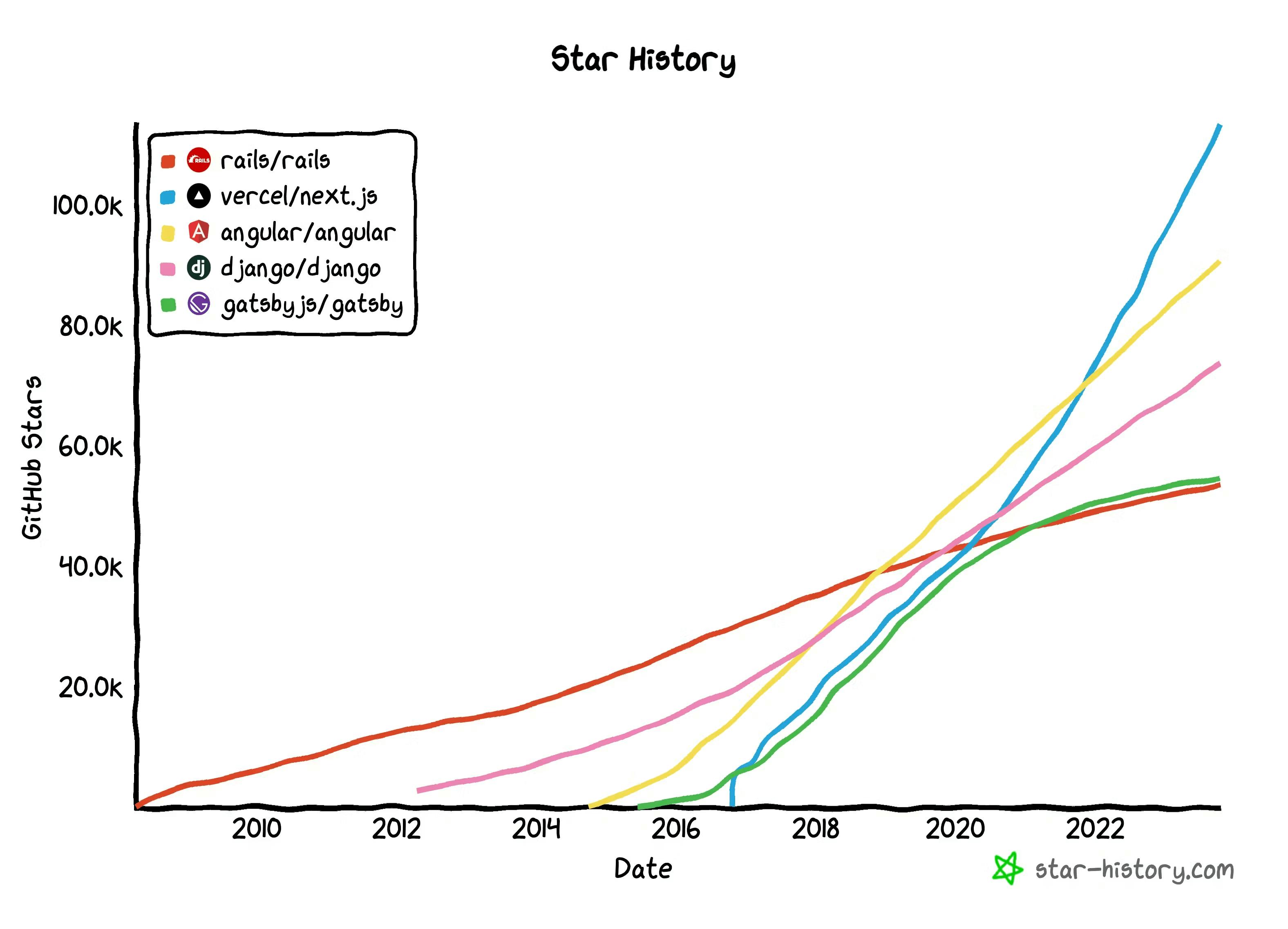
Source: Star History
Netlify: Founded in 2014, Netlify is a cloud platform that simplifies the process of building, deploying, and managing modern web projects. As of January 2026, it had raised $212.1 million over seven funding rounds with support from Kleiner Perkins, Bessemer Venture Partners, a16z, and HubSpot Ventures, and was valued at $2 billion as of 2021. Netlify offers a suite of tools and services for developers, including continuous deployment, serverless functions, and a global content delivery network. The company has made acquisitions like Stackbit and parts of Gatsby to enhance its offerings. Netlify tends to be more framework-agnostic and caters to a broader, more mature market compared to Vercel. A former Vercel employee said Netlify aims for an 80% traditional developer, 20% non-developer user base, but is rapidly shifting towards capturing more of the non-traditional developer market.
Cloudflare Pages: Cloudflare, founded in 2009, is primarily a CDN-focused company that has expanded into the web development space with Cloudflare Pages. As a public company, Cloudflare has a market cap of $65.8 billion as of January 2026. Cloudflare has an advantage in WebAssembly (Wasm) deployment, which allows for deploying various programming languages optimized for edge environments. While Vercel uses Cloudflare for its edge functions, Cloudflare's own offerings compete directly with Vercel in this space.
Traditional Deployment
GoDaddy: Founded in 1997 and best known as the world’s largest domain registrar (over 84 million registered domains as of 2024), GoDaddy also offers basic web hosting and managed WordPress services. Compared to developer-focused platforms like Netlify or Vercel, GoDaddy caters primarily to small businesses and non-technical users who want a simple way to get online, rather than advanced developer tooling or serverless deployments. While it does provide general-purpose hosting, it lacks the composability, CI/CD integration, and modern developer workflow focus of Vercel, Netlify, or Fly.io. GoDaddy is a publicly traded company with a market cap of $14.9 billion as of January 2026.
Heroku: Founded in 2007 and acquired by Salesforce in 2011 for $212 million, Heroku was the first product in the Platform-as-a-Service (PaaS) category. It provides a fully managed container-based environment with integrated data services, allowing developers to focus on writing code rather than managing infrastructure. Heroku supports a wide range of programming languages and focuses more on backend services compared to Vercel's front-end specialization.
AWS ECS: Launched in 2014, Amazon Elastic Container Service (ECS) is a fully managed container orchestration service that allows easy deployment, management, and scaling of containerized applications on AWS. While ECS provides more granular control and deep integration with other AWS services, it lacks the streamlined, developer-friendly experience that Vercel offers for frontend and serverless deployments.
Google Cloud Platform (GCP): Launched in 2008, GCP is one of the “Big 3” hyperscale cloud providers, alongside AWS and Azure. It offers infrastructure (VMs, Kubernetes/Anthos, networking, storage) and higher-level services like Firebase Hosting (for static sites and apps) and Cloud Run (for serverless containers). While Vercel or Netlify abstract away infrastructure for front-end teams, GCP is typically chosen when companies need enterprise-scale flexibility, AI/ML integration, or data analytics alongside deployment. It competes directly with AWS ECS/EKS but also underpins some higher-level services (for example, Firebase Hosting can be seen as GCP’s closest analog to Netlify).
Microsoft Azure: Founded in 2010, Azure has become second largest global cloud provider after AWS in terms of revenue, generating over $75 billion in cloud revenue in 2024. Similar to GCP, Azure provides a full spectrum of infrastructure and PaaS services: Azure App Service (for web apps), Azure Functions (serverless compute), and full Kubernetes support. Its main strengths are enterprise adoption, integration with Microsoft’s ecosystem (Active Directory, GitHub, Office), and hybrid‑cloud offerings. Compared to Vercel or Netlify, Azure appeals more to large enterprises modernizing existing IT stacks, though GitHub Pages and Actions (owned by Microsoft) bring it closer to the developer‑friendly “Jamstack” market.
Hybrid Deployment
Fly.io: Founded in 2017, Fly.io represents a middle ground between traditional PaaS and front-end-focused platforms. As of January 2025, it had raised $115 million over five funding rounds and was valued at $450 million as of 2023 from notable investors like a16z, Intel Capital, Dell Technologies Capital, and Y Combinator. Fly.io allows developers to deploy applications globally without managing complex infrastructure, offering a network of data centers that run containerized apps close to end users. This approach provides low-latency performance and easy scaling across multiple regions, differentiating it from Vercel's primary focus on frontend and serverless deployments.
Generative User Interfaces
Vercel CEO views the market in two categories: platforms for creating other platforms (Vercel) and tools for creating individual apps. For Vercel, the two skills are complementary. Similar to how Bolt can benefit from StackBlitx’s browser-based environment or how Lovable benefits from its ability to move fast on AI-driven product innovation, v0 benefits from Vercel’s expertise in UI generation and seamless deployment.
Figma: While not a direct competitor in the deployment space, founded in 2012, Figma is worth mentioning due to its advancements in AI-generated UI layouts. Figma's AI capabilities allow for the generation of UI layouts and design mockups based on text prompts as of June 2024, competing with the frontend development process that Vercel caters to with v0. Vercel now integrates with Figma, where users can upload designs into v0 for website generation.
Bolt: Built by the StackBlitz team in 2017, Bolt leverages the company's expertise in browser-based development environments to offer full-stack prototyping capabilities. Unlike v0's focus on components, Bolt generates complete applications with both frontend and backend functionality. The platform benefits from StackBlitz's existing infrastructure for running development environments entirely in the browser, eliminating setup friction. Bolt has gained traction, particularly among developers who need rapid full-stack prototypes rather than isolated components. As of January 2026, Stackblitz has raised $113.4 million across two funding rounds
Lovable: Founded in 2023 as an independent startup, Lovable positions itself as the most accessible tool for non-technical users. The platform emphasizes speed and simplicity, generating functional prototypes quickly. However, Lovable's independent status means it lacks the infrastructure advantages of its competitors: it relies on third-party services like Supabase for backend functionality and faces challenges in maintaining consistent uptime and feature development velocity. As of January 2026, Lovable has raised $552.5 million and is valued at $6.6 billion.
Business Model
Source: Vercel
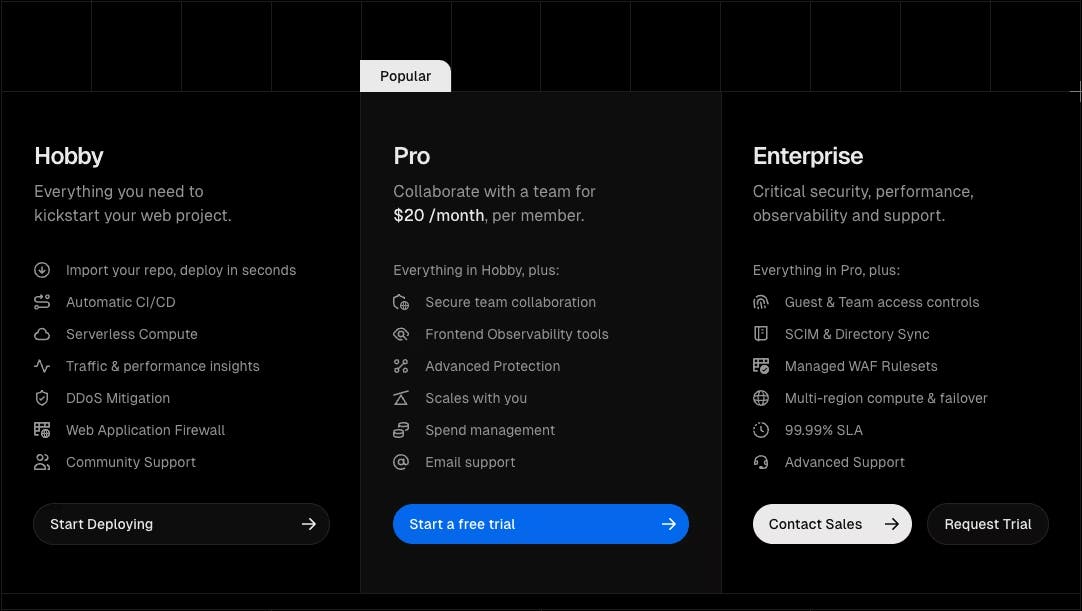
Vercel has both a freemium and an open-source business model. It monetizes by offering a hosted serverless platform for front-end applications. There are three key product categories: Hobby (free), Pro ($20 per user/month), and Enterprise (custom solutions and pricing for larger enterprises).
This pricing structure supports a land-and-expand product-led growth (PLG) strategy, with a significant portion of sales coming from inbound leads. The company's margins are reported by a former employee to be around 70%. In addition to its core platform, Vercel has introduced v0, an AI-powered developer tool. v0 follows a similar freemium model:
Free: Allows users to explore the tool with limited credits
Premium: $20 per month with an option to purchase more credits for generation
Enterprise: Custom pricing based on usage
The v0 Premium plan is separate from the Vercel Pro plan. For example, a user with a Vercel Pro team (one member at $20) and a v0 Premium plan ($20) would pay a total of $40 per month.
Traction
Source: ApeVue
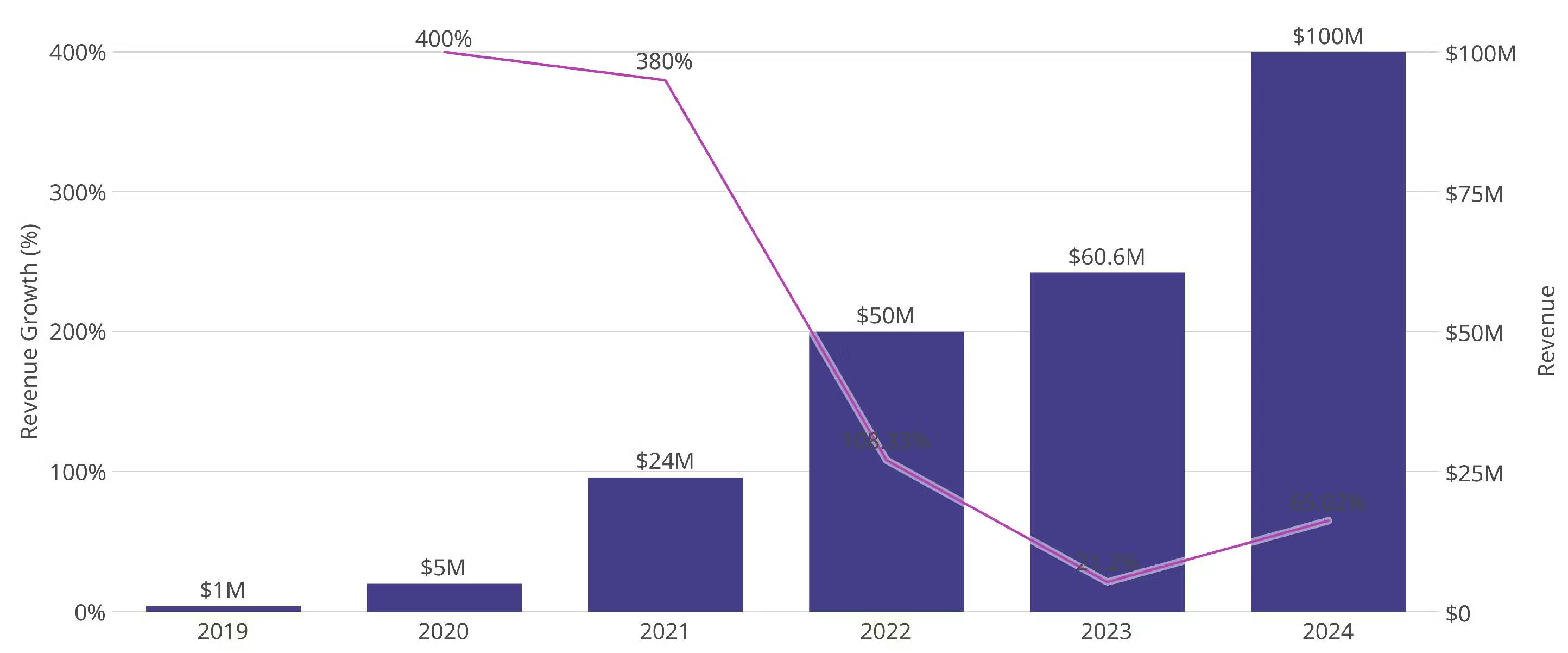
In a June 2023 interview, Guillermo Rauch shared that Vercel grew in revenue from $1 million in 2019 to $5 million in 2020. By June 2023, the company had $50 million in revenue. In March 2024, Vercel surpassed $100 million in ARR. In May 2025, the company crossed $200 million in ARR, doubling its ARR from only 15 months prior. A large part of the revenue growth came from the surge in popularity for its v0: more than 3 million builders have generated over 100 million applications in under a year using v0. The revenue for just v0 grew from $100 million to more than $180 million from 2024 to 2025.
From April 2020 to May 2023, the number of websites powered by Next.js grew from 35K to 4 million, including the websites of companies like Walmart, Apple, Nike, Netflix, TikTok, Uber, Lyft, and Starbucks. In 2023, the company had also partnered with numerous leaders in the serverless and digital experience spaces, such as Neon and Sitecore. As of August 2025, there are 32 million active domains served on Vercel, 140 billion weekly requests processed, and over 1 trillion invocations on Fluid Compute.
At the announcement of its Series C funding round in June 2021, Vercel had seen significant growth in traffic to all sites and apps on its network, nearly doubling from October 2020. The number of sites among the world’s largest 10K websites that use Next.js grew 50% in the same time frame between 2020 and 2021.
One source estimates that Vercel is generating about $16.7 million in subscription revenue per month, higher than the non-recurring annualized revenue of other software providers. Its gross margins for its main hosting product were roughly 76% in 2025 (Cloudflare has around 75%). At the end of the 2025 first quarter, the company burned through roughly $11 million, implying that Vercel could burn around $44 million for the 2025 year.
Given Vercel’s management of the Next.js framework, Vercel sees an increase in growth when more developers use Next.js. The company’s user base has grown to over a million software developers using its Next.js technology monthly in May 2024. The company's freemium model attracted approximately 100K new sign-ups each month in 2024 and was downloaded 7.9 million times in December 2024, compared to 4.5 million downloads in 2023.
Vercel’s AI SDK software toolkit for AI agents and chatbots has also been downloaded more than 700K times in December 2024.
Valuation
In September 2025, Vercel raised a $300 million Series F round led by Acceland GIC, valuing the company at $9.3 billion. This brought Vercel's total funding to $863 million. Previous investors included Bedrock, Greenoaks, Tiger Global, 8VC, and individual investors like Nat Friedman (CEO of GitHub), Jordan Walke (Creator of React), and Matias Woloski (Founder/CTO of Auth0).
Key Opportunities
Full Stack Infrastructure Product Suite and Expansion
In its 2025 Vercel Ship conference, it rebranded itself from a frontend hosting platform to a platform that can “build and deploy on the AI Cloud.” The conference also featured dedicated workshops on “Building Agents with the AI SDK,” underscoring the company’s continued investment in AI tools and commitment to support full-stack AI applications and agentic workloads.
The company’s Vercel AI Cloud represents a further shift from traditional cloud infrastructure by implementing self-healing infrastructure, automatic incident response, Fluid compute platform for AI workloads, AI Gateway, Vercel Sandbox for secure AI-generated code, and MCP servers for AI communication.
The company has also expanded its serverless computing to remove complexity and simplify developers’ work. Previously, when a customer visited a website, the server had to wait for the database to respond, the AI to generate texts, and another server to send the data back. Serverless infrastructure enables developers to build and run code without managing servers or incurring costs for unused cloud infrastructure.
In 2025, Vercel introduced Fluid: a web application infrastructure model that blends both servers and serverless features at reduced costs. It enables a local region to handle multiple requests concurrently, similar to traditional servers, while maintaining the elasticity of serverless systems. With Fluid, the computer runs closer to the data instead of an “unrealistic replication across every edge location,” according to Vercel product manager Mariano Cocirio. Fluid helps make website load times faster and hosting costs 85% cheaper with its Active CPU pricing (explained in the Business Model section) that only charges for the time the code is actually running. This additional functionality allows customers to take more control over their own infrastructure.
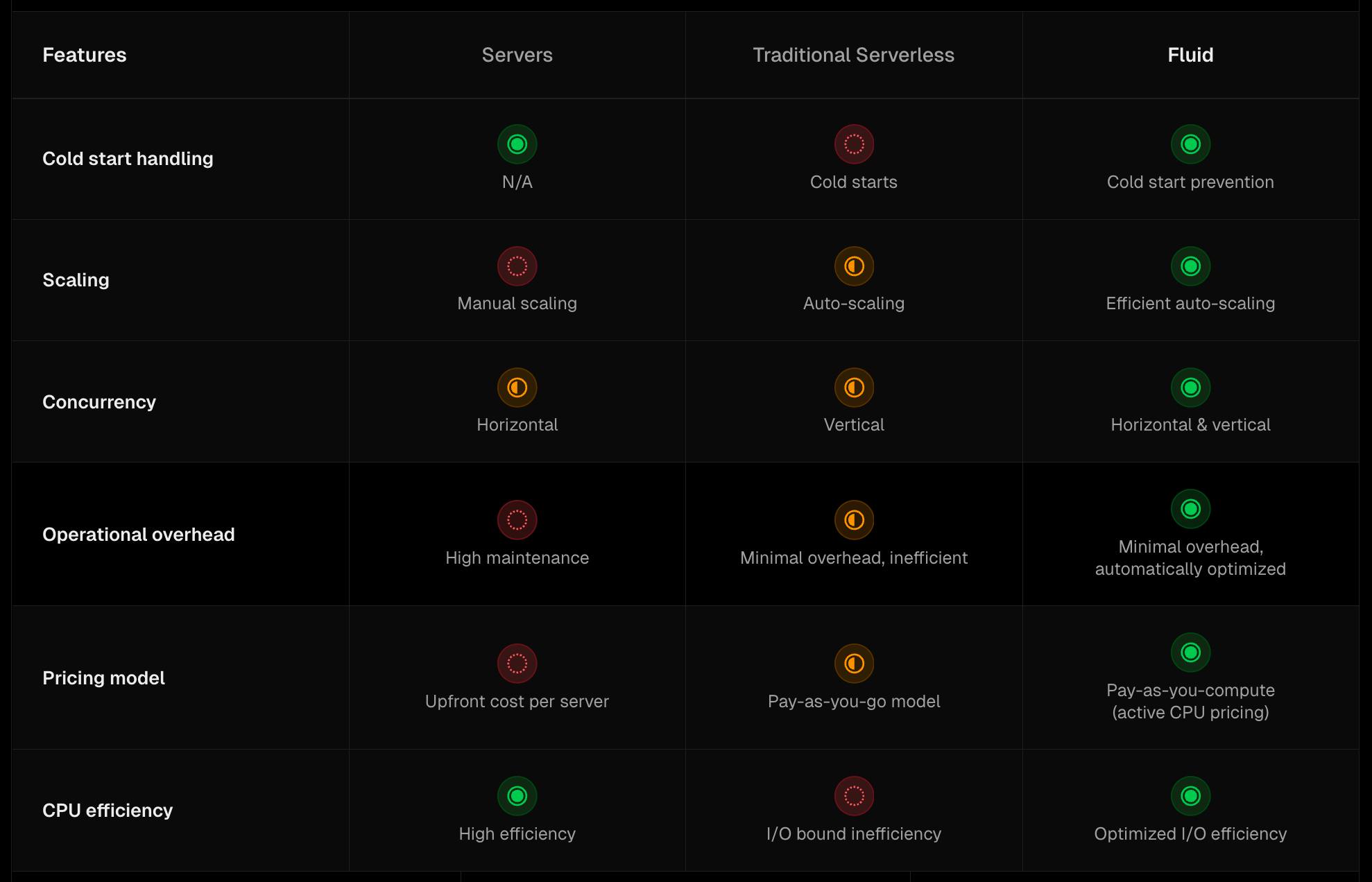
Source: Vercel Fluid
The company is also moving beyond frontend to integrate with databases (e.g., Supabase) and e-commerce platforms (e.g., Salesforce Commerce Cloud), and Git to encourage collaboration between vibe coders and traditional developers.
Additional security and cost management features allow Vercel to build a more expansive set of infrastructure offerings. As web development continues to move towards scalability, performance, and cross-platform, the ability to bundle as much infrastructure in one platform as possible can be a critical opportunity for Vercel.
V0 and Expansion to Non-Developer Users
Between 2024 and 2025, Vercel 82% revenue growth, largely driven by the use of the vibe-coding tool v0. With v0’s expansion, Vercel has an opportunity to capture a larger market share by making its platform more accessible to non-traditional developers. In 2023, a former employee estimated that the company's user base is 75% traditional developers and 25% non-developers.
However, Vercel’s CEO hopes to expand beyond just vibecoding. v0 seeks to bridge between vibecoding and agentic engineering (technical work for critical infrastructure) through Git integrations — it transforms vibe-coded projects to traditional development workflows. The company also hopes to expand into mobile app development soon, according to an August 2025 interview.
Similar to how Firebase Studio uses Google Services, v0 is optimized for Vercel and allows the company to sell a tech stack. Their goal is to create a successful economy around v0, similar to Apple’s App Store.
By continuing to develop and improve collaborative editing environments and marketer-friendly tools, Vercel can attract more non-technical users and expand its total addressable market beyond just frontend developers to designers who can ship fully-baked products, product managers who can prototype, back-end engineers who can complete end-to-end vision, and anyone with a product idea.
In the future, the company hopes to transition from “developer tools” to a “post-framework era” where it is serving not just the 10-20 million developer market but also hundreds of millions of builders.
This shift aligns with industry trends, as competitors like Netlify are also moving in this direction. Vercel's early entry into this space with its collaborative editing environment and v0 positions it to capitalize on this opportunity.
Design-Centric Approach
Vercel's heavy focus on design, with three distinct design teams (brand creative, product design, and design engineering), presents an opportunity to differentiate itself in the market. By leveraging design as an essential resource, Vercel can create more intuitive and visually appealing products that cater to both technical and non-technical users. This design-centric approach could be a key factor in attracting and retaining customers, especially as the company expands its reach to non-traditional developers who may place a higher value on user experience and aesthetics. v0 prototypes, which drastically lower the cost and time of creating a mockup, are now replacing traditional pitch decks for startups.
Corporate Strategy and Capitalization
Vercel has expanded its C-Suite, acquired competitors, and hinted at a future IPO, strategically positioning itself for future growth and payout for investors. In January 2025, Vercel acquired Tremor to invest in open-source React frameworks. Less than six months later, it also acquired NuxtLabs, creators of the server runtime engine Nitro and the full-stack web framework Nuxt, which has more than 1 million downloads weekly. Both of these investments underscore Vercel’s continued commitment to open-source communities, from its open Next.js framework to these acquisitions.
Vercel’s CEO said that it is highly likely that the company will IPO in the future. The company has expanded its board members to include Stripe's CFO, amongst others, so that “one day, we are ready to be a public company.” CEO Rauch said, “We have been working towards public company readiness,” but noted that there’s no “definitive timeline.”
Key Risks
Technological Shifts in Web Development
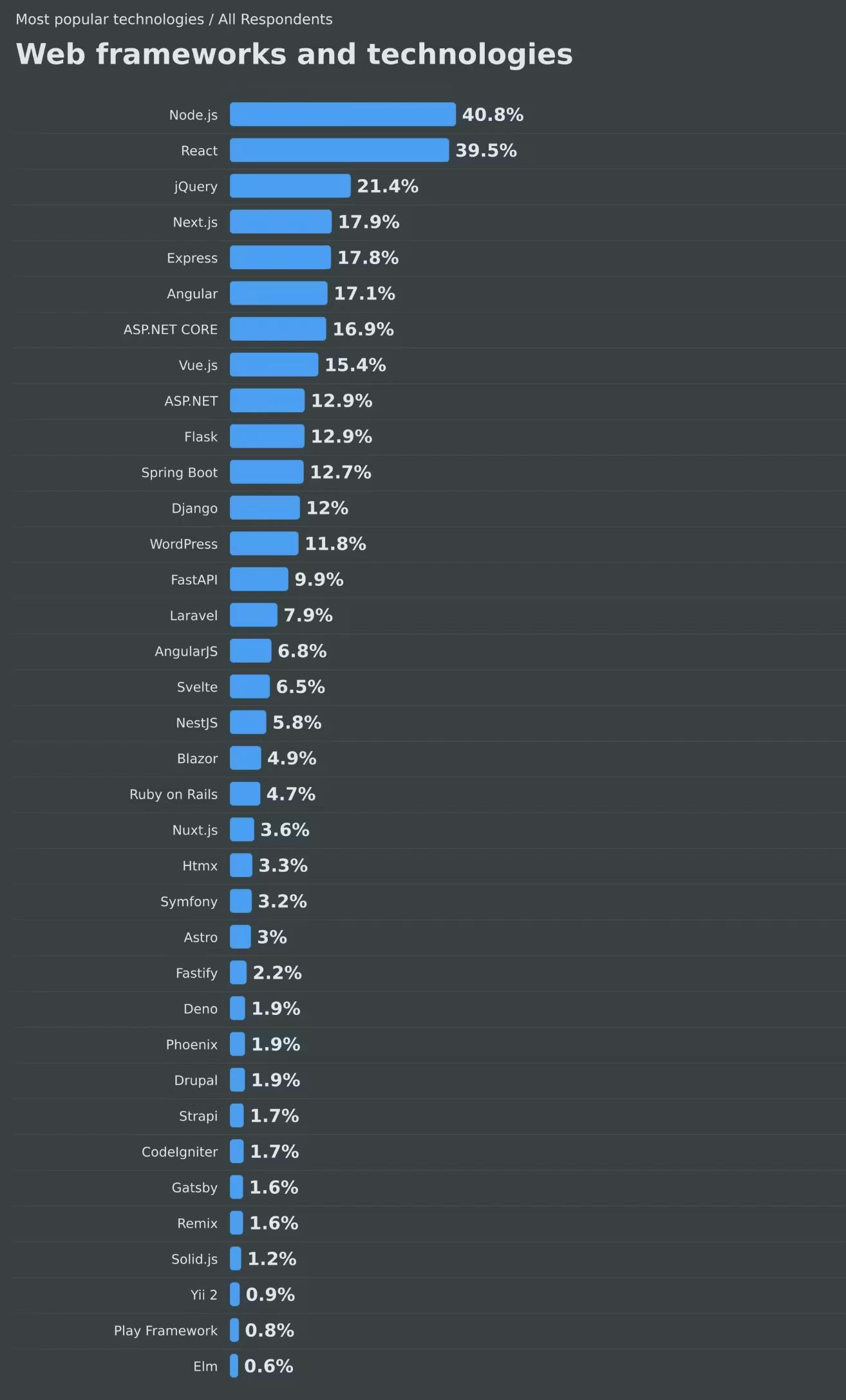
Source: Stack Overflow
Full-stack web frameworks like Django and Ruby on Rails were popular before front-end frameworks like React and Vue.js took over. React gained popularity in 2017 due to its simplicity and flexibility. The growth of Vercel has been somewhat dependent on the growth of the React and Next.js frameworks. If developers begin favoring a simpler alternative to Next.js, it would be a negative for Vercel.
Increasing Competition
Vercel faces intense competition in the Platform-as-a-Service (PaaS) market from companies like Netlify. These companies are vying for dominance in the developer ecosystem, employing high-cost acquisition strategies to capture market share. As both Vercel, Netlify, and other platforms continue to evolve their offerings, Vercel must differentiate itself and demonstrate a clear path to profitability to maintain its competitive position.
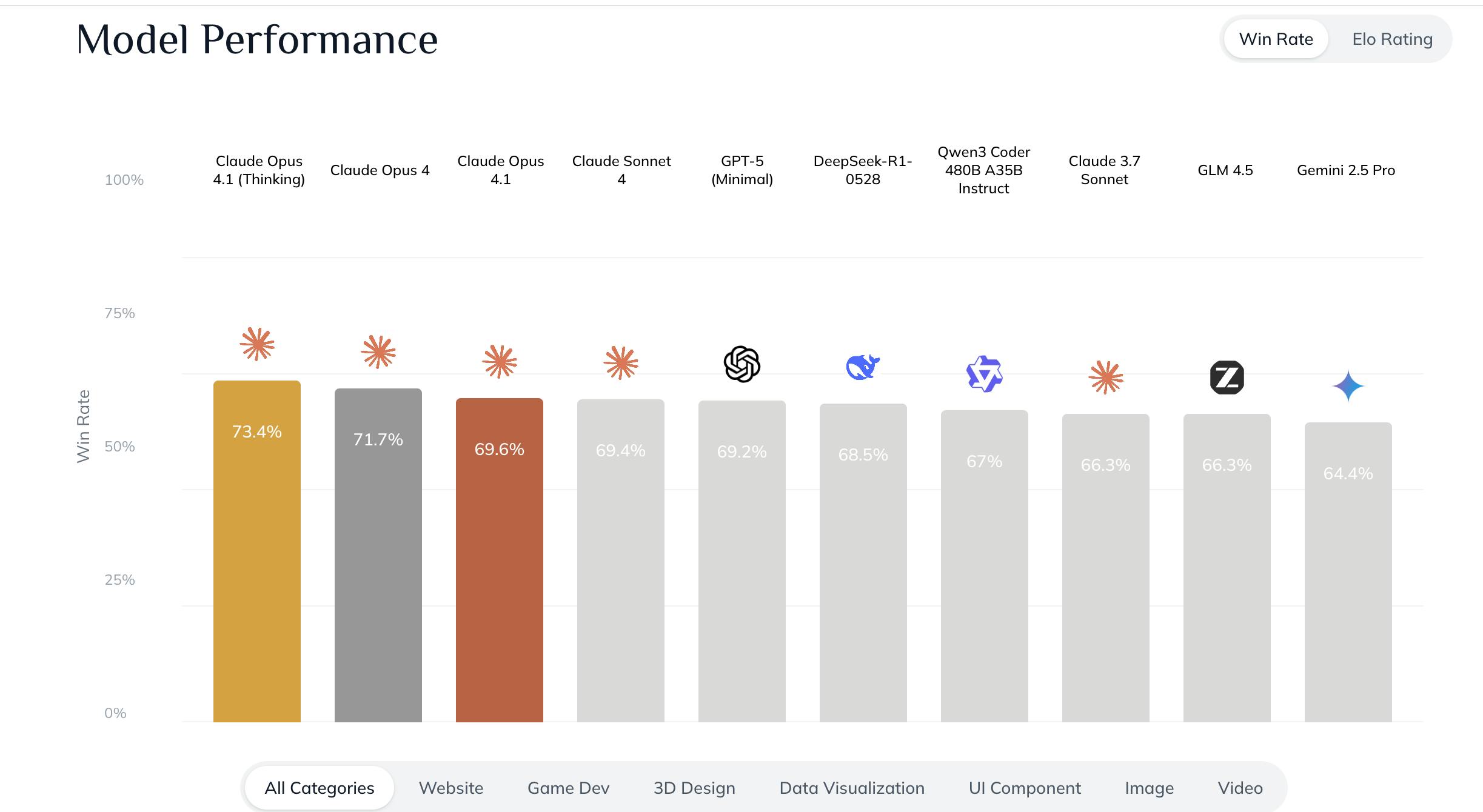
At the same time, the popularity of v0 puts Vercel in competition with some of its AI customers, including OpenAI. While Vercel has tried to develop its own model for v0 website generation, it still lags behind OpenAI and Anthropic. In addition, many web development-specific apps like Orchids are also appearing that directly compete with v0.
Source: Design Arena
Security
Despite Vercel’s commitment to security measures, it has faced multiple vulnerabilities. Scammers have used the technology to develop convincing replicas of login pages, and the company has also faced criticisms for its handling of vulnerabilities (where it tried to hide and then spin the incident without providing customers with clarity and transparency). As vibe-coded apps become more prevalent, security configurations are frequently incomplete, and nontechnical developers often lack awareness of potential vulnerabilities.
Summary
Vercel is a cloud-based platform for building, previewing, and deploying front-end web applications. Founded in 2015, the company has focused on developer experience and performance optimization. Vercel's product suite includes AI-powered tools, enterprise solutions, and the popular Next.js framework. The company serves a wide range of customers from individual developers to large enterprises like Walmart and Netflix.
Vercel operates in the growing public cloud services market, which is estimated at $805 billion in 2025. The company faces competition from both front-end-focused platforms like Netlify and traditional deployment solutions like Heroku. Vercel's business model combines freemium and open-source approaches, with revenue coming from Pro subscriptions and Enterprise solutions. Key opportunities for the company include expanding its infrastructure product suite and attracting non-developer users. However, Vercel faces risks from intense competition in the PaaS market.