
Thesis
Traditional customer service contact centers rely on a vast global workforce of more than 17 million representatives, with labor typically accounting for 60-80% of total operating costs. The average inbound call costs $10-20, considering wages, overhead, and turnover, while annual attrition rates still exceed 20% even among top-performing contact centers. As of April 2026, the industry is heavily dependent on human labor, where billions in operating spend are consumed managing repetitive tasks that machines can now complete autonomously.
The rise of autonomous AI agents, however, is expected to transform traditional customer service. Within customer service, the call and contact center outsourcing market is expected to grow from $97.3 billion in 2024 to $163.9 billion by 2030 as conversational AI takes the place of traditionally human roles. Global spending on conversational AI is projected to reach $49.8 billion by 2031, up from $17.1 billion in 2025, prompting enterprises to reshape their workforces around this shift: Telstra, Australia’s largest telecommunications provider, has signaled that AI will help drive substantial operating cost reductions by 2030, particularly in customer service. In India, generative AI chatbots are beginning to replace traditional call-center teams as of April 2026, with some startups claiming automation of thousands of jobs as the companies target 95% AI coverage of routine customer interactions. Meanwhile, incumbents like Salesforce are betting their future on agentic platforms such as Agentforce and investing heavily to make autonomous AI a core layer of customer engagement.
Despite these ambitions, the operating model of traditional customer service organizations, both in-house and third-party, is misaligned with this model. Legacy interactive voice response (IVR) menus and scripted chatbots often confine customers to rigid interaction flows. Even modern language-model chatbots with too much bandwidth can hallucinate or misstate policy information, exposing enterprises to compliance and brand risks. Overly constrained implementations run the risk of alienating users or being unhelpful; Research shows that 76% of consumers become frustrated when their experiences lack personalization. Despite these hurdles, model efficiency has advanced rapidly: costs for systems performing at the level of GPT-3.5 have fallen 280-fold between 2022 and 2024. Combined with retrieval-augmented architectures that ground responses in enterprise data, these advances mark an inflection point where autonomous agents can execute reliably at scale.
Sierra is an AI customer service startup positioned to enable this shift. Its Agent OS allows enterprises to design, deploy, and govern agents that resolve high-stakes customer workflows across voice and digital surfaces, integrated to systems of record for refunds, plan changes, and account updates. The commercial model pays only on successful resolution, aligning spend with realized savings and making expansion straightforward when automation rates improve. The platform’s emphasis on auditability and policy control targets the governance requirements that now determine vendor selection. As enterprises replace labor-driven support with governed, outcome-linked automation, Sierra’s Agent OS can serve as the operating layer for resolution across voice and digital channels.
Founding Story

Source: Sierra
In 2023, Bret Taylor (CEO) and Clay Bavor co-founded Sierra to bring AI automation to enterprise customer support. The founders shared expertise in enterprise software and applied AI to build agents that automate resolution work typically handled by labor-heavy contact-center operations.
Bavor, who graduated from Princeton with a bachelor’s degree in computer science, had spent 18 years at Google leading design and product development for Workspace (Docs, Drive, and Gmail) and later directing initiatives for Google’s Project Starline and Labs organizations.
Taylor earned bachelor’s and master’s degrees in computer science from Stanford University, and began his career as an engineer at Google, building Google Maps (where he was known for rewriting the entire Maps codebase over a single weekend). In 2007, he left Google to found FriendFeed, the social platform that was first to introduce the “like” button. Facebook acquired FriendFeed in 2009, and Taylor became CTO of Facebook. After three years leading Facebook’s shift to mobile, he left to found Quip, a productivity software company, which Salesforce acquired for $750 million in 2016. Taylor then spent six years at Salesforce, rising from President/COO to Co-CEO alongside Marc Benioff.
In 2022, when LinkedIn founder Reid Hoffman introduced Taylor to early previews of GPT-4, Taylor became convinced large language models would change the world and committed to working on them. Over lunch with Bavor, a longtime friend he’d met working at Google, Taylor realized the two were equally obsessed with the technology. By the end of the meal, they had agreed to start a company without a fixed product in mind, but with a shared belief that generative AI would create new enterprise opportunities and reshape how software is built.
In early 2023, Taylor and Bavor left their roles, with Taylor announcing his resignation from Salesforce in November 2022, the same day ChatGPT became publicly accessible. After taking a few months off, they began speaking with leaders across industries to see where generative AI could deliver immediate impact, before deciding to build Sierra.
According to Taylor, many companies cannot afford to talk to their customers directly, as contact centers cost $10–20 per call, often exceeding the revenue from the customer calling. He noted that large language models can reduce those costs “by two orders of magnitude,” making conversational support economically viable at scale and unlocking meaningful savings for enterprises. With that insight, they set Sierra’s focus on enabling enterprises to develop and deploy AI agents for customer experience, with the belief that conversational agents will become more important than traditional company websites are today.
Sierra employs a team including many veterans from Salesforce and Google with experience in enterprise AI. Taylor also serves as Chairman of the Board at OpenAI, providing firsthand insight into the rapid evolution of large language models. In 2025, Sierra recruited former Netflix and Uber Chief Communications Officer Rachel Whetstone to lead global positioning and communications as the company scales.
Product
Source: Sierra
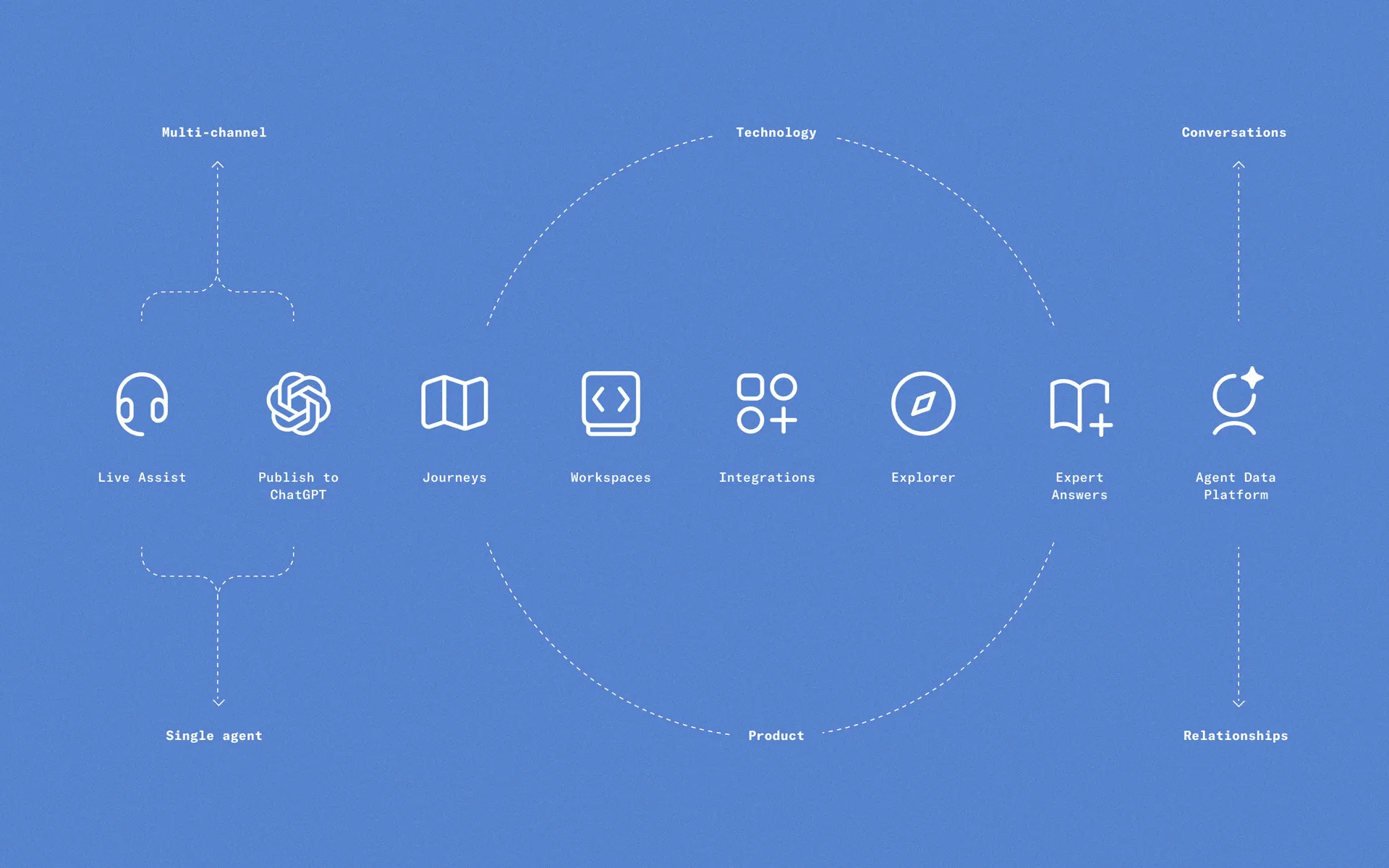
Sierra is an AI operating system for customer experience that enables businesses to deliver support, sales, and service that feel human while scaling to millions of customers. Where most organizations still maintain separate tools and teams for phone, chat, email, and messaging, Sierra replaces this fragmentation with a single AI agent that operates across every channel, grounding responses in a company’s systems, policies, and brand.
Sierra’s model aims to replace the traditional life cycle of a customer issue, in which a customer begins on a website or in an app, searches a help center, fails to find an answer, and then dials a call center. They wait through long interactive voice response (IVR) menus, repeat their information to a human agent who is juggling multiple tabs and systems, and if their problem cannot be resolved immediately, they are routed again, often retelling the same story. Each channel (phone, chat, email, SMS) operates with its own scripts, tools, and information about the customer. This fragmented process slows resolution, introduces inconsistency, and makes it difficult to improve performance in a systematic way.
Sierra addresses this fragmentation with its flagship platform, Agent OS. Agent OS is a unified orchestration and data layer for AI agents that connects channels, systems of record, and knowledge sources in real time. This platform allows a business to build a single agent that can meet customers wherever they are: on the phone, in chat, via SMS, by email, inside messaging applications, and even through surfaces like ChatGPT, while maintaining a consistent understanding of customer context, brand voice, and business goals. Rather than treating each channel as a separate experience, Sierra treats every conversation as an entry point into the same underlying system.
Agent OS
Agent OS is an operating system that defines how the agent should behave, connects it deterministically to the systems and data it needs to act, and turns every interaction into a source of learning. It coordinates a constellation of third-party large language models through supervisory layers that enforce security, reliability, and brand constraints. It standardizes how agents access customer data, billing records, inventory, and policies, so that taking action on behalf of a customer is controlled, auditable, and reversible, avoiding inconsistency and ambiguity across channels. Whether a customer is speaking on the phone, sending a text message, or chatting in a mobile app, the same underlying agent is interpreting intent, consulting the same knowledge and data, and executing the same workflows.
Across these channels, the agent combines the response time and scalable logic of AI with the nuance of human communication. It can recognize frustration or confusion in a customer’s language, adjust its responses while staying aligned to brand tone, and resume a conversation where it left off if a customer steps away and returns later. Multilingual capabilities allow the same agent to support customers in many languages without duplicating scripts or flows.
Sierra agents are designed to solve problems, not just answer questions. The agent is grounded in a company’s knowledge base, policies, and standard operating procedures, and is connected to systems such as order management, subscription billing, and CRM platforms. This allows it to take actions on the customer’s behalf, such as processing an exchange, changing a reservation, updating an address, or adjusting a subscription. When an issue falls outside the agent’s scope, it gathers key details, summarizes the full context, and routes the interaction to the appropriate human team through the existing contact center stack. This reduces average handle time and repeat contacts, while allowing human agents to focus on the most complex, sensitive, or high-value interactions.
The same “build once, run everywhere” principle extends beyond a company’s properties. Through its integration with platforms like ChatGPT, Sierra allows businesses to publish their agent as a first-party experience inside new ecosystems. Interactive forms, maps, and charts defined in Agent Studio can be rendered directly in ChatGPT, while the company retains precise control over which journeys, data, and capabilities are exposed.
Agent OS includes two primary workflows for enterprises: building and configuring the agent via Agent SDK and Agent Studio, and optimizing performance through agent Insights.
Agent SDK
Historically, companies faced a tradeoff between fully custom, code-heavy implementations that could express complex logic but required dedicated engineering teams, and limited no-code tools that worked for simple FAQs but could not support regulated workflows, subscription churn management, or multi-step sales processes.
Sierra bridges this gap with two tightly integrated development surfaces: Agent SDK and Agent Studio. Agent SDK allows engineers to define an agent’s goals, guardrails, and orchestration in code. Developers can express complex customer journeys as composable skills and decision steps, control the degree of flexibility or determinism in each workflow, and integrate with any internal or external system. This ensures that use cases like mortgage origination, healthcare intake, or retention flows can be modeled with the same specificity as purpose-built production software.
Agent Studio
Agent Studio extends these capabilities to non-engineering teams. With Agent Studio 2.0, customer experience and operations leaders can describe journeys in natural language, specifying how the agent should handle scenarios from first greeting to final resolution, including when to ask clarifying questions, when to call tools, and when to escalate. Sierra workspaces, launched in December 2025, bring structured collaboration into this environment: teams can make changes in isolated spaces, run simulations against historical or synthetic conversations, and promote updates through QA, staging, and production with full version history and instant rollback. The Integration Library exposes pre-built connections to systems of record and contact center platforms; configuring a new integration can often be done in minutes, rather than weeks of custom development.
Used together, Agent SDK and Agent Studio turn agent development into a shared practice across engineering, CX, and operations. Engineers retain deep control over the most complex logic and integrations, while non-technical teams gain the ability to iterate on journeys, copy, and policies on their own, allowing more of the organization to shape the behavior of their agent without compromising safety or performance.
Sierra users also have the option to use Ghostwriter, a tool released in March 2026, to create agents using plain English prompts by inferring from interaction logs and company resources how an agent should work. Ghostwriter is Sierra’s headless agent design architecture.
Insights
Source: Sierra
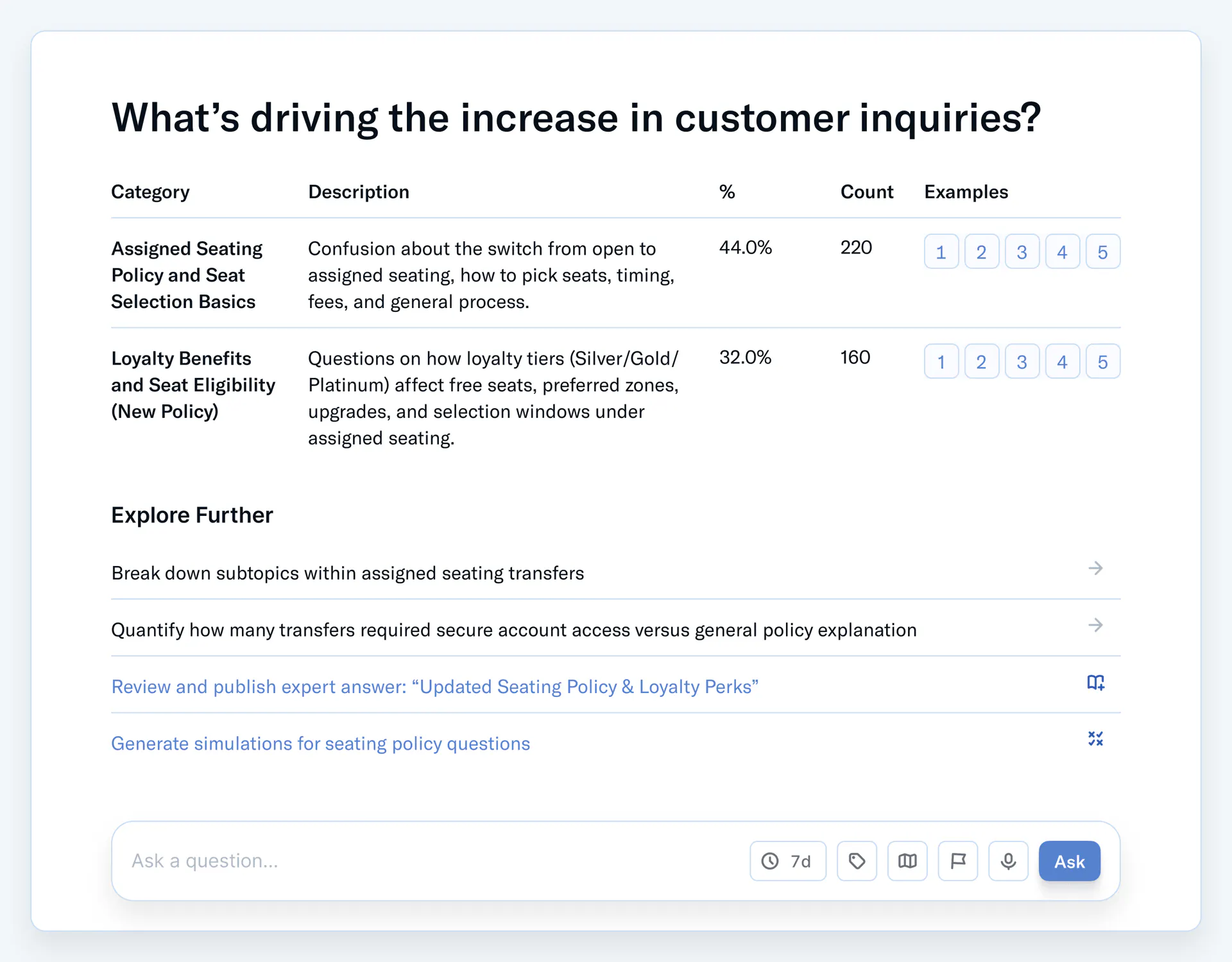
Within Agent Studio, teams can use Insights to monitor how the agent is performing against key metrics such as case resolution, first-contact resolution, and customer satisfaction. Live summaries of conversations highlight emerging patterns, allowing teams to identify issues before they become widespread. Automated tagging and categorization of conversations reveal what customers care most about at any moment, from spikes in “Where’s my order?” messages for a retailer to increased questions about loyalty benefits or billing changes in media and telecommunications.
Insights 2.0, launched in November 2025, deepened this feedback loop by turning conversation data into a full-fledged research surface. Explorer, a chatbot feature integrated into Insights 2.0, allows teams to ask natural language questions about their customer interactions and receive data-backed analyses, without requiring a separate data science project. It can scan large volumes of transcripts to uncover the root causes behind trends, such as confusion after a policy change or friction in a particular workflow. When Explorer identifies topics that the agent cannot yet handle confidently, the Expert Answers tool reviews how human agents have successfully resolved similar issues and drafts grounded, review-ready knowledge articles. Once approved and published, these articles become part of the agent’s knowledge, turning human expertise into durable improvements.
The Agent Data Platform (ADP) underpins these optimization efforts by giving the agent both memory and intelligent decisioning. ADP unifies unstructured conversation data with structured records from CRM systems, billing platforms, and data warehouses, creating a single, contextual view of each customer across channels and time. With this context, the agent can remember prior interactions, recognize patterns in behavior, and tailor actions to balance customer needs with business objectives. The decisioning layer allows companies to define strategies for different audiences and outcomes, such as retention, upsell, or service recovery, while Sierra’s models select and present the right action for each individual customer.
Human-in-the-Loop and Voice
Source: Sierra
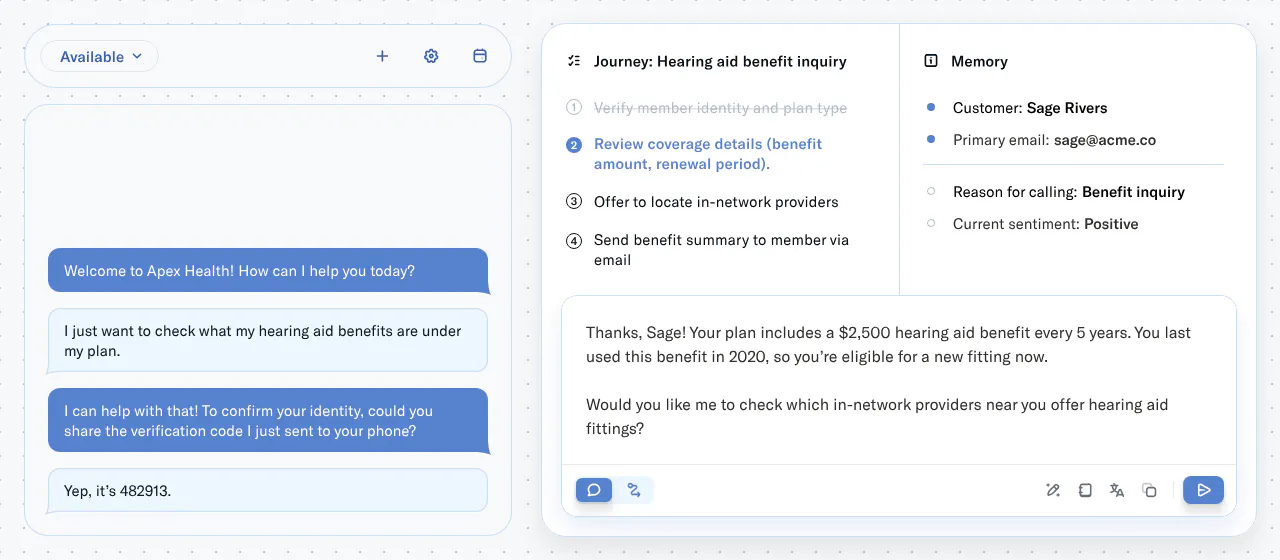
Sierra’s product system is not limited to fully autonomous support. Embedded directly in the tools representatives already use, Live Assist listens to conversations in real time, captures the important details, suggests next steps aligned with company policies and past resolutions, and drafts responses or call scripts that are ready to send. It can initiate the same workflows the autonomous agent uses, such as processing returns or updating accounts, with a single click. This reduces cognitive load on human agents, shortens handle times, and raises the floor of performance across the contact center. Each assisted interaction also feeds back into Agent OS and ADP, improving both the human playbook and the autonomous agent’s performance.
Voice is treated as a first-class channel rather than an add-on. Sierra voice replaces rigid IVR menus with natural, real-time conversation. The voice agent speaks with a lifelike cadence, can handle interruptions and corrections gracefully, and is capable of parsing complex inputs such as email addresses, order numbers, or policy identifiers. It connects to major call center platforms and compliance tools, handing calls to human agents when appropriate, along with AI-generated summaries and skills-based routing. The same configuration and monitoring surfaces that govern chat and messaging apply to voice, ensuring that customers receive a consistent experience regardless of where they start their journey.
Trust and Reliability
All of these workflows sit inside a trust and security framework that is central to Sierra’s product design. Data governance policies ensure that a customer’s data is used solely to power that company’s agent and is never shared across tenants or used to train shared foundation models. Personally identifiable information is encrypted and masked by default. Filters and monitors enforce topic and keyword restrictions in line with each customer’s policies and regulatory environment. Sierra’s certifications include ISO/IEC 27001:2022, ISO/IEC 42001:2023, SOC 2, HIPAA, PCI DSS 4.0.1, GDPR, CCPA, CSA STAR, and EU AI ACT. In April 2026, Sierra introduced the first Level 1 PCI-compliant payment capability for AI agents across chat and voice, letting agents handle full transactions within one conversation without holds or transfers.
Under the hood, Sierra operates on a constellation of models rather than a single provider. Different models are used for understanding user messages, making decisions, and generating responses, and the platform can automatically switch between providers to maintain continuity and optimize performance in the event of an outage or degradation. Supervisor models wrap every interaction, reducing hallucinations and abuse and providing an audit trail that shows which knowledge sources were consulted, which systems were accessed, and why a particular decision was made.
Market
Customer
Sierra primarily serves large B2C enterprises with high-volume, resolution-oriented support across telecom, financial services, healthcare, retail/consumer goods, and consumer services industries. These brands handle millions of complex inquiries where cost-to-serve and customer expectations are rising in parallel. The base is intentionally concentrated at the top end of the market: over half of customers generate $1 billion in revenue, and over a fifth generate $10 billion. This concentration gives Sierra exposure to the highest-volume service operations, where automation delivers the greatest cost and speed gains.
Sierra sells through enterprise motions with multi-stakeholder reviews and deep integrations into CCaaS (contact center as a service), CRM, and internal systems, a process that is typically slow for vendors. By tying revenue to successful resolutions, Sierra assumes performance risk but captures greater upside as automation rates improve, a structure that incumbent CCaaS and CRM vendors anchored to seat-based pricing struggle to match.
Most enterprises rely on human or outsourced contact centers with IVR, chatbots, and point automations inside CCaaS and CRM platforms like NICE, Genesys, Five9, and Amazon Connect. These tools manage FAQs but break on policy or account-specific issues and fragmented back-ends. Companies either overstaff or accept long handle times and churn, while incremental AI inside existing suites marginally improves resolution economics. Sierra targets enterprises themselves, not the contact-center outsourcers or platform vendors who fill these third-party roles.
Sierra’s customer base reports significant improvements in automation rates. Ramp resolves about 90% of support cases without human intervention, while CLEAR maintained a 4.7/5 CSAT even as its agents handled identity verification workflows once thought too sensitive to automate. Brands such as OluKai and Madison Reed show similar outcomes: 70% automated resolution, 4.5/5 satisfaction, and a 50% drop in cancellations, demonstrating that Sierra can improve customer experience as well as efficiency. The roster of adopters confirms Sierra’s appeal to mainstream consumer franchises rather than early adopters alone.
Market Size
Sierra operates at the convergence of three markets: conversational AI, contact-center software, and outsourced CX labor. Conversational AI platforms were about $11.6 billion in 2024 and are projected to reach $41.4 billion by 2030 (23.7% CAGR). Contact-center software was $33.4 billion in 2023, projected to hit $149.6 billion by 2030 (23.9% CAGR). CX outsourcing is the largest pool of automatable spend, with over 17 million agents globally and leaders like Teleperformance and Concentrix producing multi-billion dollar revenue run rates.
Adoption signals show that spend is already shifting. 85% of customer-service leaders plan to pilot customer-facing gen-AI in 2025, and gen-AI capabilities are expected in 75% of new contact centers by 2028. McKinsey estimates $2.6 - $4.4 trillion in annual value from generative AI, with customer operations among the largest buckets. 55% of companies already outsource some customer care, and 47% plan to increase it, creating significant labor exposure to automate.
Even a single-country proxy illustrates scale. The US employs 2.7 million customer-service representatives at an average salary of $42K, or about $120 billion in annual wage spend that resolution automation can address.
The shift toward resolution-grade AI may expand this market further. Historically, contact-center volume scaled linearly with headcount. When AI resolves account-specific issues, enterprises can offer more support, across more channels, at more moments of the customer journey, converting service interactions from a pure cost center into a driver of retention and product attachment. Like advances in software development, increased demand for software, and improved resolution abilities, increase demand for customer assistance. As Sierra enables this transition from labor economics to intelligence economics, it participates in a market that grows as automation improves.
Competition
Competitive Landscape
Sierra competes in the contact-center automation landscape, in which AI-native agent platforms and incumbent CCaaS suites are converging. In this market, buyers evaluate vendors on resolution performance, voice capability, and governance, while incumbents lean on distribution and channel footprint. Startups typically lead in reasoning and iteration speed, while incumbents lead in telephony and operational scale. Enterprises often keep incumbent tools for simple flows and run AI agents in parallel to judge autonomy and compliance before shifting more traffic.
Incumbents pose the greatest threat through distribution and data proximity, and startups compete on velocity. Sierra’s defensibility comes from enterprise resolution wins, deep production integrations, and expanding distribution through ChatGPT. Taylor’s role as Chair of OpenAI may deepen Sierra's competitive advantage in distribution via the ChatGPT platform. As agents automate and optimize revenue-sensitive workflows, they create embedded switching costs that strengthen Sierra’s moat.
AI-Native Platforms
Decagon: Founded in 2023, Decagon offers enterprise AI agents orchestrated through natural-language Agent Operating Procedures. Similar to Sierra, it targets large enterprises with multi-step support. Decagon emphasizes orchestration and developer flexibility but focuses less on outcome-based pricing or deep governance controls compared to Sierra’s approach. Decagon has raised a total of $481 million in funding, including a $250 million Series D at a $4.3 billion valuation in January 2026.
Ada: Founded in 2016, Ada automates digital chat support and offers strong no-code tooling for CX teams. The platform primarily resolves simpler digital flows across web and messaging channels. Ada has raised a total of $193 million in funding, including a $130 million Series C at a $1.2 billion valuation as of May 2021.
PolyAI: Founded in 2017, PolyAI is a voice-first agent provider focused on inbound telephony with strong multilingual speech performance. The platform remains limited to outside voice channels and typically bills on usage rather than resolution outcomes. PolyAI differentiates itself through voice specialization, while Sierra distinguishes itself with cross-channel coverage and compliance-grade policy governance. PolyAI has raised a total of $202 million in funding, including a $86 million Series C at an estimated $664 million valuation in October 2025.
Incumbents
Agentforce by Salesforce: Introduced by Salesforce in September 2024, Agentforce extends the Salesforce ecosystem into autonomous AI agents for enterprise customer engagement. Deeply integrated with the Salesforce data and workflow stack, it benefits from massive distribution across more than 150K companies that use Salesforce CRM. Agentforce offers credit-based pricing similar to Sierra’s outcome-based pricing. Salesforce has raised a total of $65.4 million and has been publicly traded on the New York Stock Exchange since 2004. As of November 2025, Salesforce has a market cap of $230 billion.
Genesys: Founded in 1990, Genesys offers an omnichannel, cloud-native platform used by thousands of large enterprises globally. It delivers AI-powered routing, journey orchestration, workforce management, and voice + digital telephony in a unified stack. While highly reliable at scale and trusted in enterprise voice operations, the platform’s AI remains largely assistive (routing, analytics) rather than end-to-end autonomous resolution, a gap Sierra targets. Genesys has raised $3 billion in funding, including a $1.5 billion corporate round with participation from Salesforce in July 2025.
NICE: Founded in 1986, NICE is a major cloud contact-center suite known for strong performance in regulated sectors (finance, healthcare) thanks to its reliability, compliance credentials, and broad channel support. However, despite embedding AI-infused routing and agent-assist capabilities, NICE still focuses on human-in-the-loop workflows and traditional licensing structures, leaving an opening for platforms like Sierra that aim for truly autonomous resolution. NICE has been publicly traded on the Nasdaq since 1996 and has a market cap of $7.8 billion as of November 2025.
Business Model
Source: Sierra
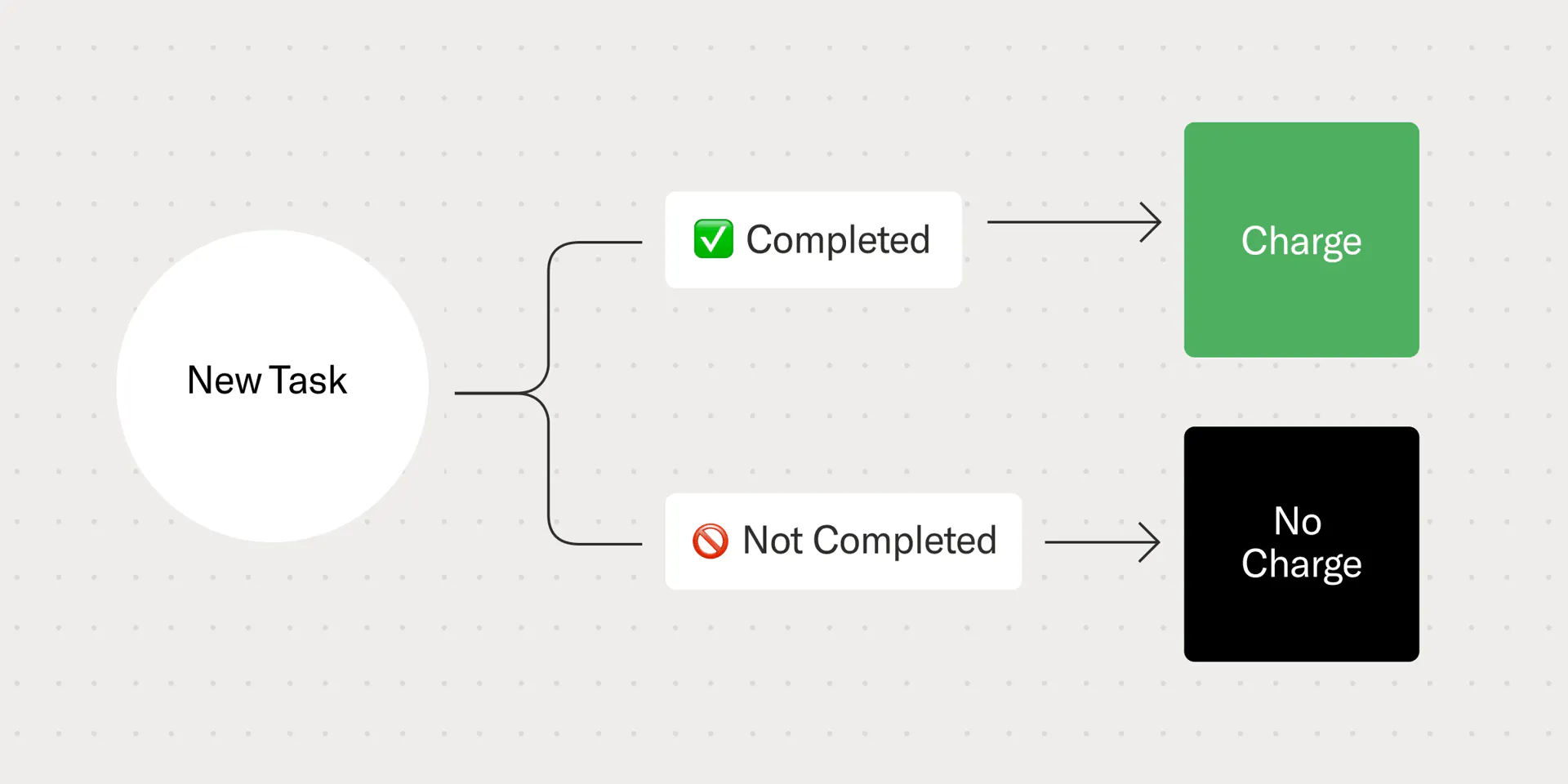
Sierra monetizes through outcome-based automation pricing, where enterprises pay only when agents complete a defined resolution, such as a refund, plan change, or subscription update. This ties spend directly to labor eliminated rather than seats or API calls. Contracts are custom-quoted based on interaction volume and resolution definitions, positioning Sierra as an ROI-driven platform rather than traditional seat-based software. As Sierra automates a greater share of inquiries over time, revenue expands within existing accounts without growth in human headcount or seat licenses.
The company's COGS is tied to inference and voice usage rather than owned infrastructure. Major cost drivers include foundation-model inference, real-time voice telephony, speech services (ASR/TTS), and testing/observability workloads that simulate production behavior before deployment. As Sierra automates a greater share of agent volume and optimizes model and telephony utilization, software-like operating leverage improves margins over time.
By replacing a portion of the global contact-center labor spend, Sierra captures value from the operating expenses it reduces, creating a direct linkage between platform adoption and enterprise cost savings.
Traction
Source: Sierra
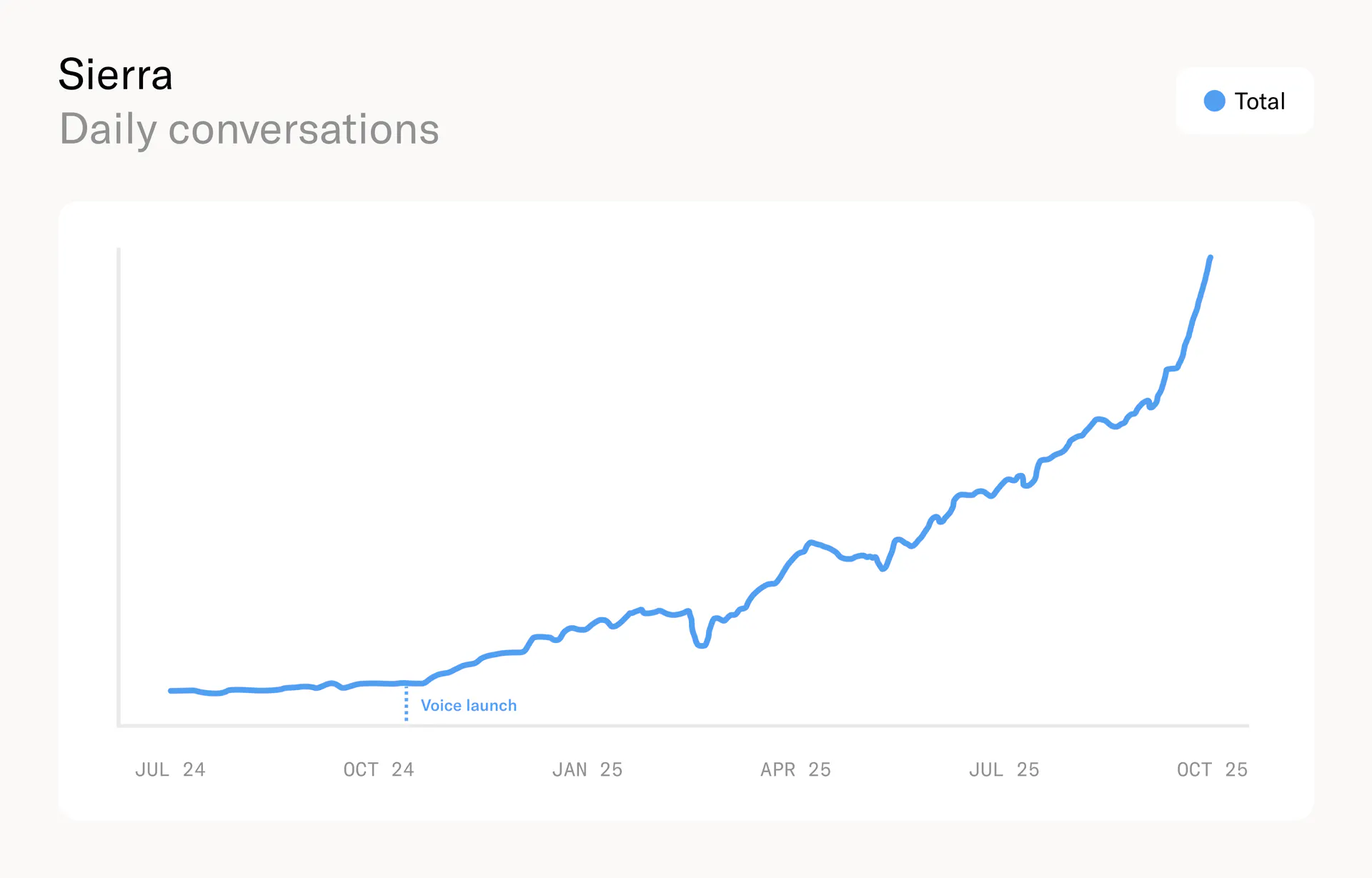
As of October 2024, Sierra had already exceeded $20 million in annualized revenue. By November 2025, the company had surpassed $100 million in ARR, reflecting significant acceleration among large B2C buyers. Sierra will power hundreds of millions of conversations in 2025. To support scale, Sierra hired Rachel Whetstone, formerly Chief Communications Officer at Netflix and Uber, to lead communications in March 2025.
The customer base includes hundreds of enterprises across Sierra’s priority industries, including financial services, retail/CPG, telecommunications, media, and healthcare. Notable customers include SoFi, Ramp*, Brex, ADT, Rivian, CLEAR, SiriusXM, Wayfair, Rocket Mortgage, and WeightWatchers, collectively handling millions of customer inquiries every month. These brands operate in high-volume, compliance-sensitive environments with complex business logic.
Sierra’s customer base increasingly includes customers outside the US. In December 2025, Sierra secured a strategic investment from SoftBank and announced expansion into Japan, with SiriusXM adopting the new Agent Data Platform to give the SiriusXM Harmony support agent a fuller subscriber context. Sierra opened offices in Tokyo, Singapore, Madrid, Paris, London, and Sydney between late 2025 and early 2026, including a Madrid office announced in March 2026.
Valuation
Sierra has raised $635 million across three funding rounds as of November 2025. In February 2024, it announced a $110 million round backed by Sequoia Capital and Benchmark. Bloomberg reported the round valued the company at around $1 billion, though this was not officially confirmed. Eight months later, in October 2024, Sierra raised an additional $175 million led by Greenoaks at a $4.5 billion valuation. One year after that, in September 2025, it raised $350 million, also led by Greenoaks, valuing the company at $10 billion. In March 2026, Sierra acquired Opera Tech, a Tokyo-based enterprise AI startup, with co-founders Keita Morikawa and Kiyohito Kunii joining to lead Sierra in Japan. The terms of the acquisition were not disclosed.
Sierra surpassed $100 million in ARR in November 2025, seven quarters after its launch, reflecting rapid adoption among large B2C enterprises. At a $10 billion valuation in September 2025, Sierra trades at a premium to legacy CCaaS and CX software multiples, consistent with investor expectations for labor automation and high-margin scale.
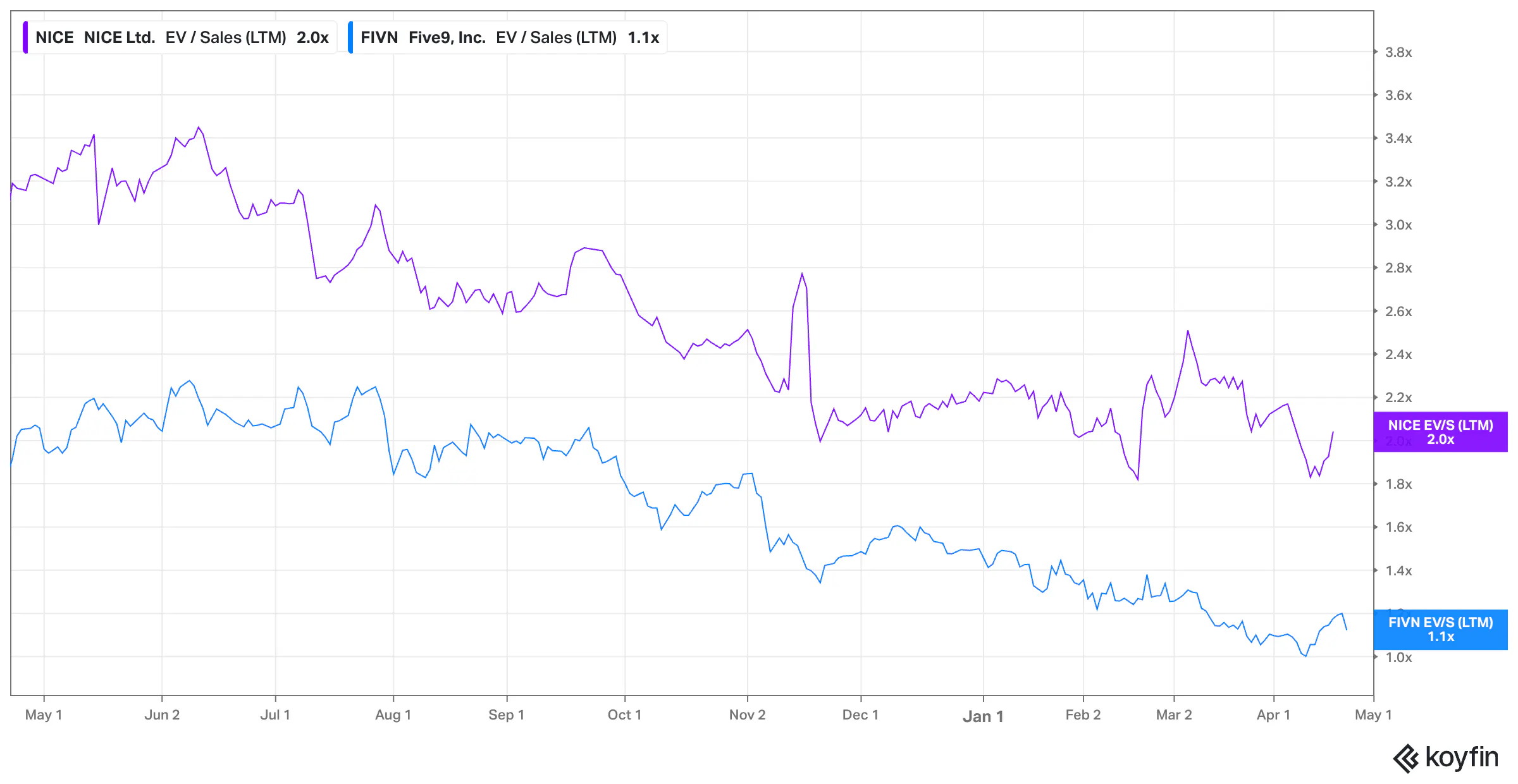
Public CCaaS peers Five9 and NICE traded at ~1.8x–2.5x revenue multiples as of 2025, down from ~3.4x–4.4x at the end of 2024, reflecting the category’s multiple compression as conversational AI shifts from an abstract threat to real enterprise adoption.
Source: Koyfin
Sierra’s valuation assumes that outcome-based AI agents will unlock a step change in customer-experience margins by directly reducing the annual global contact-center labor spend. Investors are underwriting Sierra as an enterprise automation platform rather than a traditional support software vendor.
Key Opportunities
Shift From Support Cost to Revenue Protection
As Sierra’s agents take over basic FAQs and transactional inquiries, more automation is moving into revenue-linked customer actions like plan changes, downgrade and cancel flows, win-back offers, and identity-gated upgrades. Sierra’s own positioning increasingly emphasizes “customer retention” rather than simple ticket deflection, framing AI agents as a way to intervene at the “wobble moments” where a customer is deciding whether to stay or churn. In this model, contact centers are no longer treated purely as a cost center, but as a channel for protecting ARR and reducing churn.
Customer examples show this shift in practice. Madison Reed’s “Madi” agent, built on Sierra, is designed explicitly to reduce churn and make it easier to discover products and book appointments, early results include a 50% reduction in subscription cancellations alongside higher engagement and more bookings. Other brands use Sierra for membership retention, loyalty management, and device or subscription troubleshooting where the economic stakes are measured in lifetime value, not cost-per-contact. By handling high-intent flows while driving CSAT, Sierra agents demonstrate that automation can improve both experience and revenue outcomes rather than forcing a trade-off.
Outcome-based pricing amplifies this opportunity. Sierra already charges when an agent achieves a defined outcome, such as a resolved support case, a saved cancellation, or an upsell, rather than on seats, tokens, or generic usage. As automation moves into revenue-protective flows (saves, upgrades, reactivations), the value per resolution rises materially. Because Sierra’s contracts are already custom-quoted, the company can charge more for revenue-protective interactions that have a measurable financial impact. This shifts the platform from a cost-efficiency tool to a margin-protection and growth lever, aligning spend with top-line preservation and bringing Sierra into the budgets of revenue and retention leaders as well as CX teams.
Agents as a Primary Touchpoint and ChatGPT
Sierra is building for a world where the default way customers interact with brands is through agents, not websites or IVR menus. Its voice and digital agents already power hundreds of millions of conversations annually, replacing tree-based phone systems and scripted chatbots with free-form, policy-aware dialogues across phone, web, in-app, SMS, and email. Because Sierra runs a single behavioral definition across channels, each new surface becomes another entry point into the same governed resolution engine rather than a separate bot or workflow to maintain.
ChatGPT’s emergence as a mainstream consumer interface accelerates this shift. OpenAI now reports over 800 million weekly active users on ChatGPT, making it one of the largest global attention platforms and a de facto operating system for everyday AI interactions. Sierra has responded by adding one-click publishing of enterprise agents directly into ChatGPT Apps via the Model Context Protocol, allowing brands to expose selected journeys, like order issues, subscription changes, or account troubleshooting, inside ChatGPT while retaining control over which data and actions are available. Over time, owning the Agent Data Platform across both first-party and foundation-model surfaces could prove as strategically important as owning the CRM in the last generation of enterprise software.
Key Risks
Incumbent Platforms Could Absorb the Category
Large CCaaS and CRM vendors are embedding autonomous AI directly into their existing workflows. These incumbents control the routing, data, and reporting layers enterprises already use. If their AI features approach Sierra’s resolution quality, buyers may standardize on native tools instead of adopting a separate platform. Incumbents can distribute faster than even more nimble startups through bundled upgrades and existing contracts. Additionally, if enterprises view Sierra as redundant or higher-risk to integrate, its platform could be limited to niche deployments, capping ARR and reducing long-term strategic relevance.
High Stakes for Trust and Error Tolerance
Sierra’s agents perform sensitive tasks where small errors carry disproportionate downside. Even with policy enforcement and audit controls, AI models can misinterpret edge cases or produce incorrect actions.
If reliability issues emerge at scale, enterprises may restrict Sierra to low-value use cases or require human verification for key actions, limiting automation rates and outcome-linked revenue. Sustained trust and consistent accuracy are prerequisites for Sierra’s expansion into high-stakes, revenue-protective workflows.
Reputational and Ethical Concerns
Sierra’s agents represent major consumer brands, making the company responsible for how AI behaves in customer interactions. Offensive, biased, or misleading outputs, even if caused by customer configuration, can damage Sierra’s reputation and trigger enterprise reviews or regulatory scrutiny. As AI oversight rules tighten, Sierra must document how its agents reason and enforce policy. A single widely publicized failure could slow enterprise adoption and undermine Sierra’s positioning around trust and governance.
Summary
Sierra is an enterprise AI company pioneering autonomous customer-service agents that replace manual contact-center workflows across voice and digital channels. Through its Agent OS, Sierra integrates directly with enterprise systems of record to securely authenticate users, process refunds, and update accounts with full auditability and policy enforcement.
Its proprietary voice runtime and trust governance layer ensure accuracy, compliance, and brand safety that outperform legacy CCaaS and contact-center platforms. Sierra’s outcome-based pricing links cost directly to resolved cases, while distribution through ChatGPT and first-party surfaces expands reach as customer interactions move to generative interfaces. Sierra serves hundreds of major B2C enterprises, including SoFi, ADT, Sonos, and CLEAR, achieving automation rates up to 90%, annualized revenue over $100 million, and a $10 billion valuation as of September 2025. Sierra competes with AI-native automation platforms and incumbent CCaaS suites. Its trajectory depends on sustaining advantages in voice, governance, and execution as enterprises accelerate the shift from human-staffed workflows to autonomous resolution.
*Contrary is an investor in Ramp through one or more affiliates.