
Thesis
Modern legal work still relies on junior attorneys and paralegals to spend hours reading, marking, and reconciling dense documents. Surveys highlight time savings as the primary draw of AI usage within the legal industry, with 54% of legal professionals citing efficiency as the top benefit as of May 2025. Demand on corporate legal teams continues to outpace staffing, with 79% expecting higher workloads and 67% anticipating flat or smaller teams as of February 2025. A 2025 Goldman Sachs report estimated that roughly 17% of legal jobs were at risk due to AI, down sharply from the 44% that the company predicted in 2023, but still a significant figure. The legal industry has nonetheless been slow to adopt AI due to relatively high risk aversion.
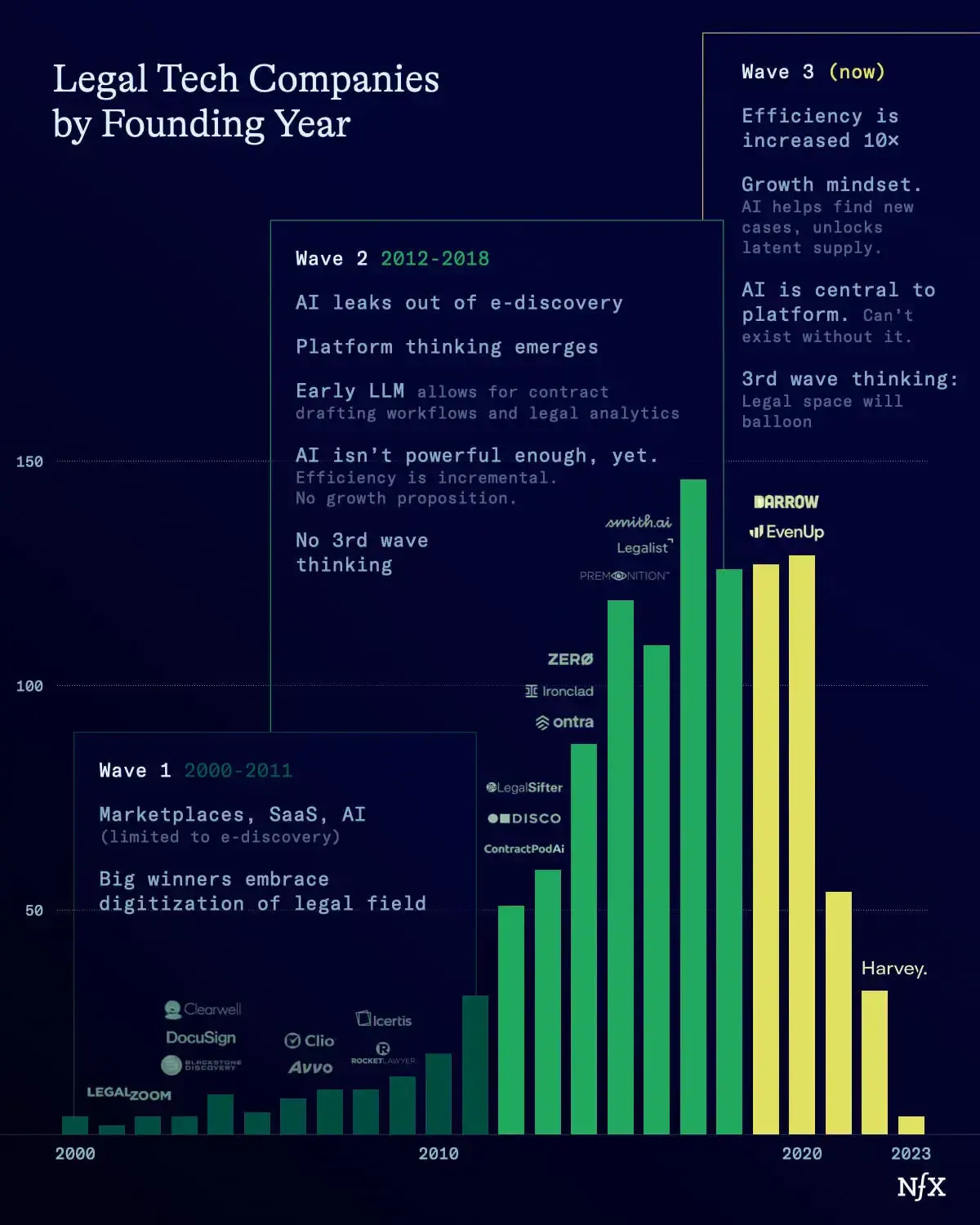
The legal industry’s adoption of technology more broadly has come in waves. The first era focused on digitization, with platforms like DocuSign and LegalZoom improving access without changing how legal reasoning happens. A second era pushed toward workflow automation in contracting, as products such as Ironclad, ContractPodAI, and Ontra extended lifecycle management with modest gains.
The generative AI boom of 2022 marked the start of a new wave. For the first time, AI systems could interpret and draft complex documents, delivering order-of-magnitude productivity improvements rather than marginal gains. Legal AI investment from the start of 2024 to February 2025 alone surpassed $2.2 billion, with platforms like Harvey and Clio leading adoption. Buyers began formalizing budgets, with 43% of Am Law 200 firms setting dedicated GenAI allocations and 90% expecting higher investment over the next five years in 2024.
The legal industry is especially well-suited to AI because legal output is text, and contracts, precedents, and regulatory filings follow standardized patterns that can be parsed, compared, and summarized at scale. Decision-making is rule-bound and playbook-driven, which aligns with systems that ground recommendations in source material and show their work. Accuracy and auditability are mandatory, which favors approaches that cite provenance and defer when confidence is low.
Within this shift, Luminance offers a proprietary legal pre-trained transformer (LPT) trained on over 150 million legal documents, while many competitors rely on AI-enabled platforms that sit on top of general-purpose models. The company’s architecture aims for tighter control, higher accuracy, and auditability, attributes that are critical in a field where error tolerance is minimal. Its primary customer base is in-house legal teams, which face intense volume and cost pressure and have stronger incentives to automate than traditional firms. The thesis is that Luminance can capture the third wave of legal tech by embedding legal reasoning systems directly within enterprise workflows rather than enabling individual lawyers. The company uses a domain-specific model stack designed for the accuracy and auditability that general-purpose foundation models still struggle to deliver.
Source: NFX
Founding Story
Adam Guthrie (Chief Technical Architect) and Dr. Graham Sills (Director of AI) founded Luminance in 2015. Guthrie holds an MA in Mathematics from the University of Cambridge and brings more than 17 years of software engineering experience, including leading product development at Aurasma and Neurence, where he applied machine learning to real-world problems. Sills earned a PhD in Computational Number Theory from Trinity College, Cambridge, previously worked in AI research for a global FTSE 100 company, and built augmented-reality applications to track and augment objects. At Luminance, Guthrie leads customer-facing architecture while Sills runs the R&D group and the “mixture of experts” approach that underpins the platform, having developed the core algorithms and much of the mathematics behind its AI.

Source: LinkedIn
Guthrie and Sills met through Cambridge’s research circles and collaborated on computer vision and augmented-reality projects, including attempts to put AR on early iPhones, before turning to law after watching friends in large firms spend nights marking up contracts by hand. Advances in optical character recognition (OCR) made reliable text capture practical, and the pair saw that contracts sit in a sweet spot between structured and unstructured data, narrative enough to be messy yet repeating enough structure to be encoded and well-suited to pattern-recognition methods.
Early off-the-shelf NLP approaches proved too general for legal language, so Sills wrote a clause-extraction algorithm that hunted for the smoking gun of a clause and kept results traceable to source text, which became a core building block of the product. The team produced a prototype in 2015 and, after live demos in 2016, secured pilots with leading firms such as Slaughter and May, whose expert feedback and high-quality corpora helped convert the prototype into a commercial product by hardening accuracy and recall.
Transformers changed the trajectory again. After the Google transformer paper “Attention Is All You Need” was published in 2017, the team began to incorporate transformer-based methods for multilingual understanding and legal entailment. In internal runs, they watched a multilingual model cluster semantically equivalent clauses from different European languages into similar regions of representation space, which opened the door to cross-lingual review without bespoke rules. Generative techniques followed in specific sub-tasks. One example was legal entailment, where rule-based systems struggled to tell when two clauses were equivalent or contradictory if only a few tokens differed. Transformers materially increased accuracy on that task and reduced false positives during comparison.
As Sills described in the company’s own retrospective, the early positioning required care:
“This Luminance was AI but we couldn’t really market it as that because it [AI] was still quite fringe, it wasn’t mainstream. People weren’t using AI in their day-to-day work. In the early years we described ourselves as a machine learning and signal processing company. And if we called ourselves an AI company, we probably wouldn’t have been taken seriously. So we were a machine learning and signal processing company that could help automate lawyers.”
The public release of ChatGPT accelerated adoption and clarified product boundaries. General models normalized chat interfaces and pushed executives to budget for AI. They also exposed a risk that legal buyers were already attuned to, which is hallucination without provenance. Luminance responded by pairing generative components with grounding and auditability. It launched an evidence-citing chatbot and automated negotiation capabilities that keep edits aligned to an organization’s positions while deferring when confidence is low.
In 2021, Eleanor Lightbody (CEO) joined Luminance from Darktrace, where she was one of the first 30 employees and scaled go-to-market across regions, founding the Africa operation and running the Industrial Division before moving to Luminance. Under Lightbody’s leadership, Luminance expanded into in-house legal teams and accelerated its growth in North America. Lightbody also guided Luminance’s transition from a focus on M&A diligence to becoming a broader legal brain for organizations after seeing corporate customers use the platform not only for M&A due diligence but for all contract-related processes across their organizations. The company subsequently repositioned itself as an enterprise platform for contract intelligence across workflows. Guthrie and Sills continue to anchor model and research development from Cambridge, while Lightbody pairs their technical depth with commercial execution.
Product
In November 2025, Luminance shifted from marketing its products through three separate lenses (Corporate, Diligence, and Discovery) to a single unified platform. What began as a point solution for M&A due diligence has evolved into a legal-grade agentic platform that spans the entire contract lifecycle. The system retrofits to an organization’s existing workflows, serving as both a centralized repository for contractual data and a conversational interface through which users can query documents, extract insights, and generate new work product.
The platform underpins every stage of legal work from drafting and negotiation to compliance and internal investigation, creating an operating system for legal teams that connects in-house counsel, outside firms, and other business units. By consolidating these functions into a single environment, Luminance provides enterprises with a single system of record for every contract, enabling institutional memory, data-driven oversight, and scalable workflow automation across the organization. The design reflects a vertical approach to legal, combined with horizontal deployment across business units.
Platform
Luminance’s platform centralizes enterprise contract intelligence in a single workspace, replacing fragmented point tools across six functions: Draft, Negotiate, Analyze, Comply, Investigate, and Collaborate.
Draft
Source: Luminance
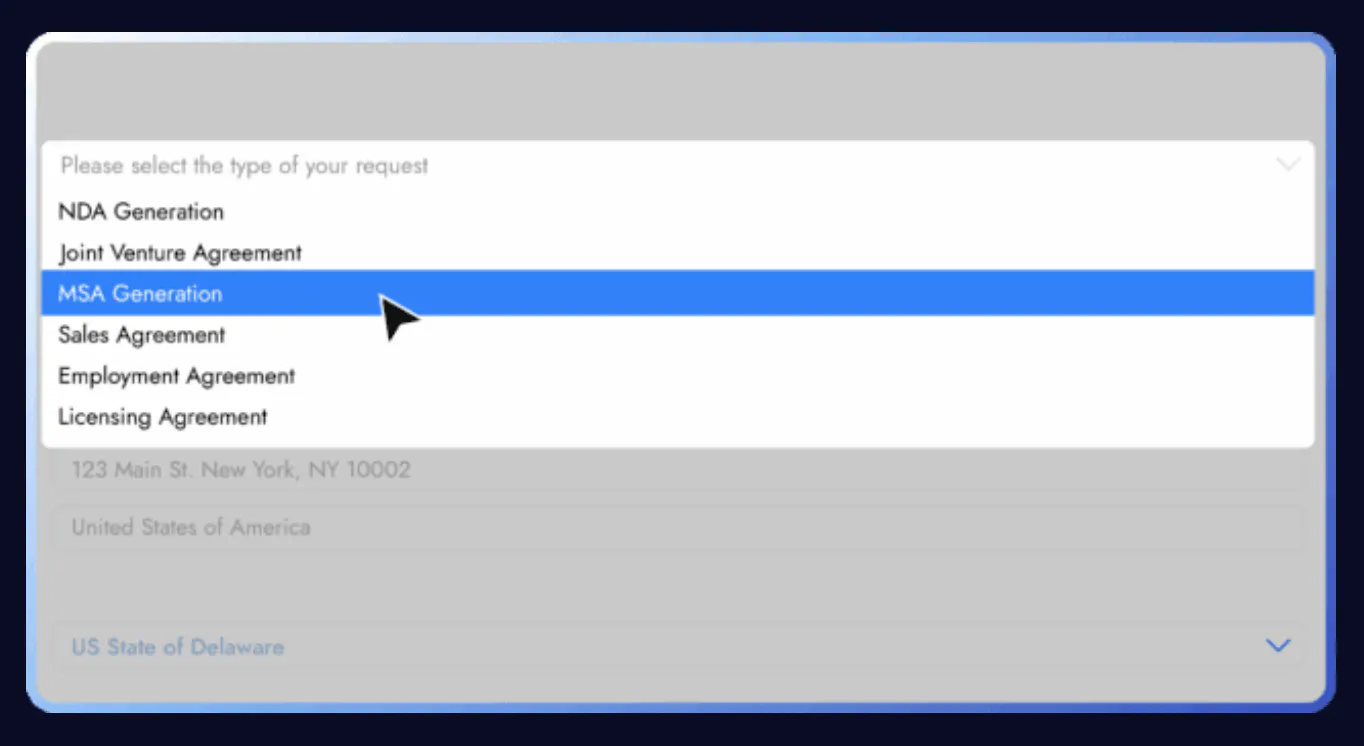
The Draft function automates contract creation by generating bespoke agreements from pre-approved templates and business rules such as governing law, term length, and counterparty type. Users complete key fields, and the AI assembles a compliant draft within seconds, applying the organization’s preferred language and formatting. The system guides users through a step-by-step drafting workflow, ensuring that required terms and approvals are incorporated before completion. For repetitive agreements such as NDAs or MSAs, legal teams can configure self-serve templates that allow business users in sales, finance, procurement, or marketing to generate compliant contracts autonomously. In practice, this shortens turnaround time for routine documents and enforces house style at scale, reducing the operational burden on legal teams.
Negotiate
Source: Luminance
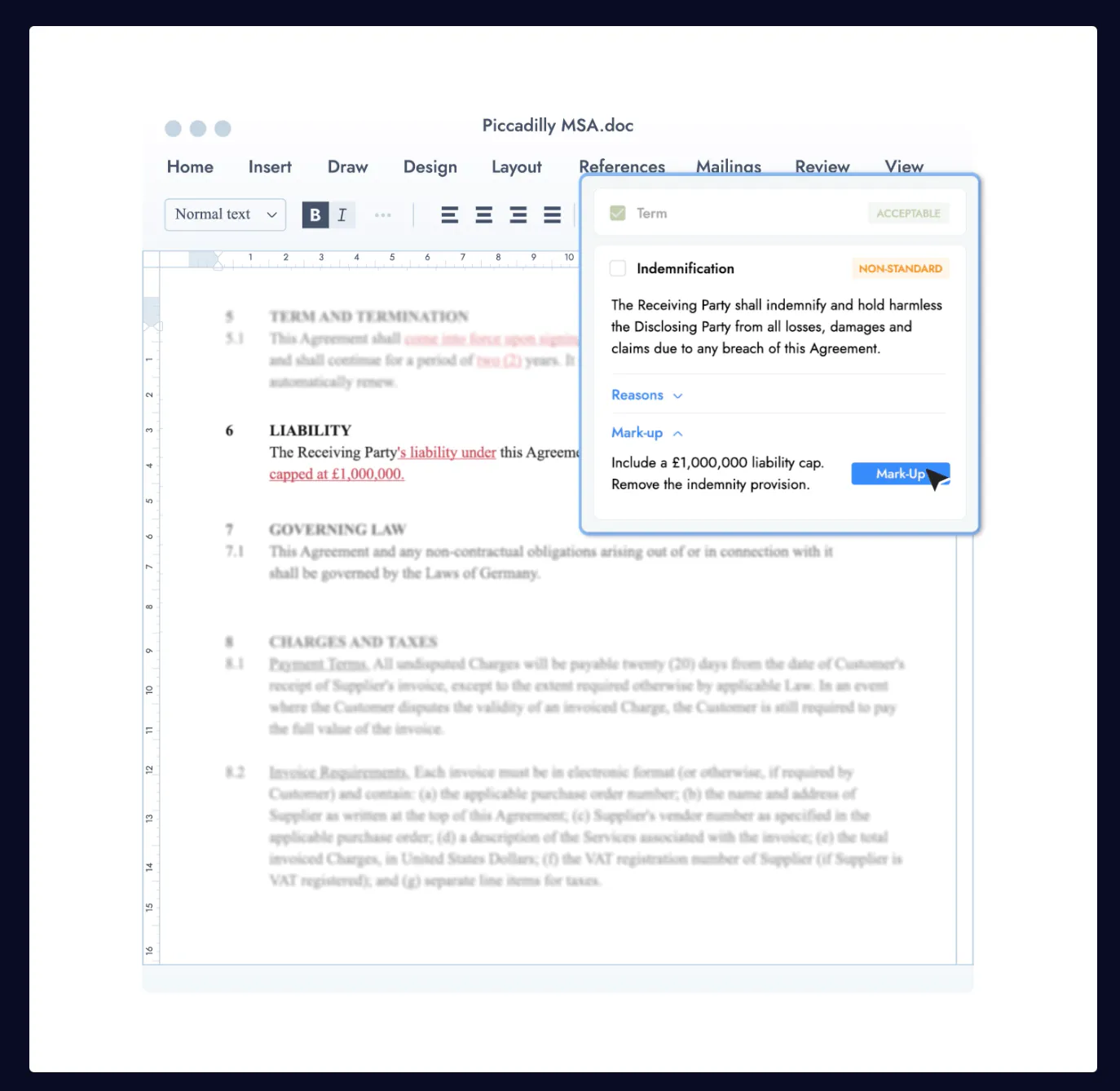
The Negotiate function embeds Luminance’s AI directly into Microsoft Word, allowing users to review, redline, and finalize contracts within their native workspace. As soon as a document is opened, the system detects the clause structure, surfaces non-standard or missing terms, and color-codes them by risk level according to the company’s gold standard. For each flagged clause, the sidebar provides an executive summary, rationale, and suggested markup aligned with the organization’s playbook. Users can insert approved, preferred, or fallback language with a single click, and every edit is automatically logged into the central repository for future reference. Luminance’s AI can also auto-negotiate routine agreements with counterparties on a user’s behalf.
In practice, this transforms what was once a manual review into an AI-augmented workflow. When reviewing a services agreement, a user can ask Lumi to summarize key terms (e.g., parties, purpose, and duration) or generate an email outlining risks before reading the contract. If a payment clause deviates from policy, the AI explains why and inserts the approved fallback. By capturing negotiation data across thousands of documents, Luminance standardizes decision-making and accelerates deal execution, turning negotiation into a repeatable, data-driven workflow.
Analyze
Source: Luminance
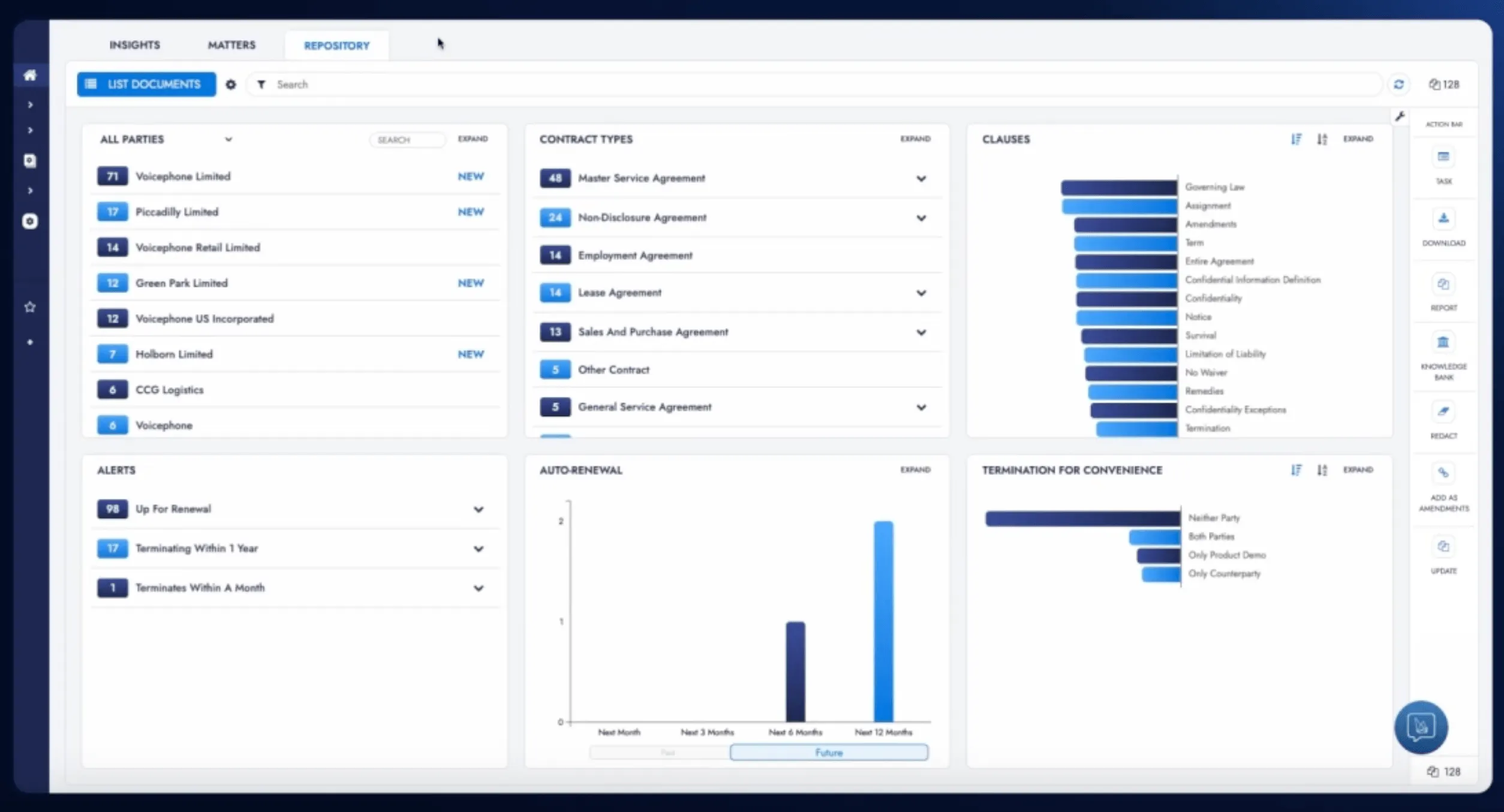
The Analyze module converts an organization’s entire contract corpus into a searchable, AI-powered database, surfacing over 1,000 legal concepts for nuanced insight into obligations, risks, and trends. The system enables natural-language queries and delivers dashboards that visualize exposures by counterparty, term, jurisdiction, and clause deviation. Dashboards expose risk concentration and clause frequency so teams can refine playbooks and forecast exposure. Organizations use Analyze for contract management, M&A due diligence, risk assessment, knowledge management, regulatory compliance, and trend analysis. By structuring previously static contract text into operational data, Luminance delivers enterprise-wide visibility and enables proactive rather than reactive contract management.
Comply
Source: Luminance
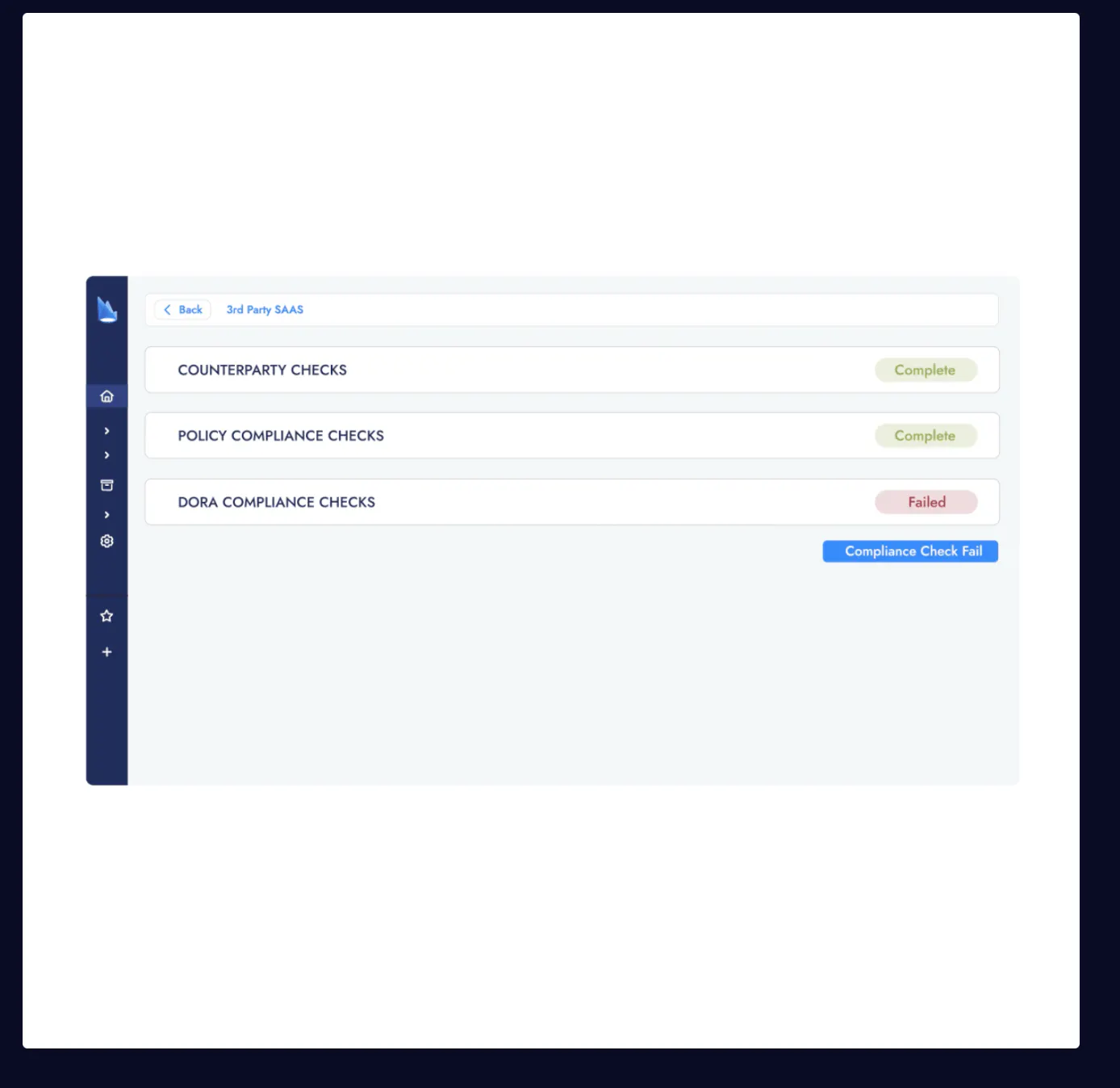
The Comply function builds on Luminance’s analytics layer to continuously track contractual and regulatory obligations across an organization’s portfolio. When a contract is executed, it is added to the central repository, where the system monitors renewal windows, expiration dates, and compliance requirements. The AI cross-references sanctions lists, screens counterparties by geography and industry, and flags clauses that may conflict with current regulations or company policy. Dashboards display exposure by counterparty, region, and risk type, while automated alerts highlight contracts requiring review. Organizations use Comply to maintain adherence to evolving regulatory standards, update internal templates when new requirements emerge, and ensure high-risk counterparties are reviewed promptly.
Investigate
Source: Luminance
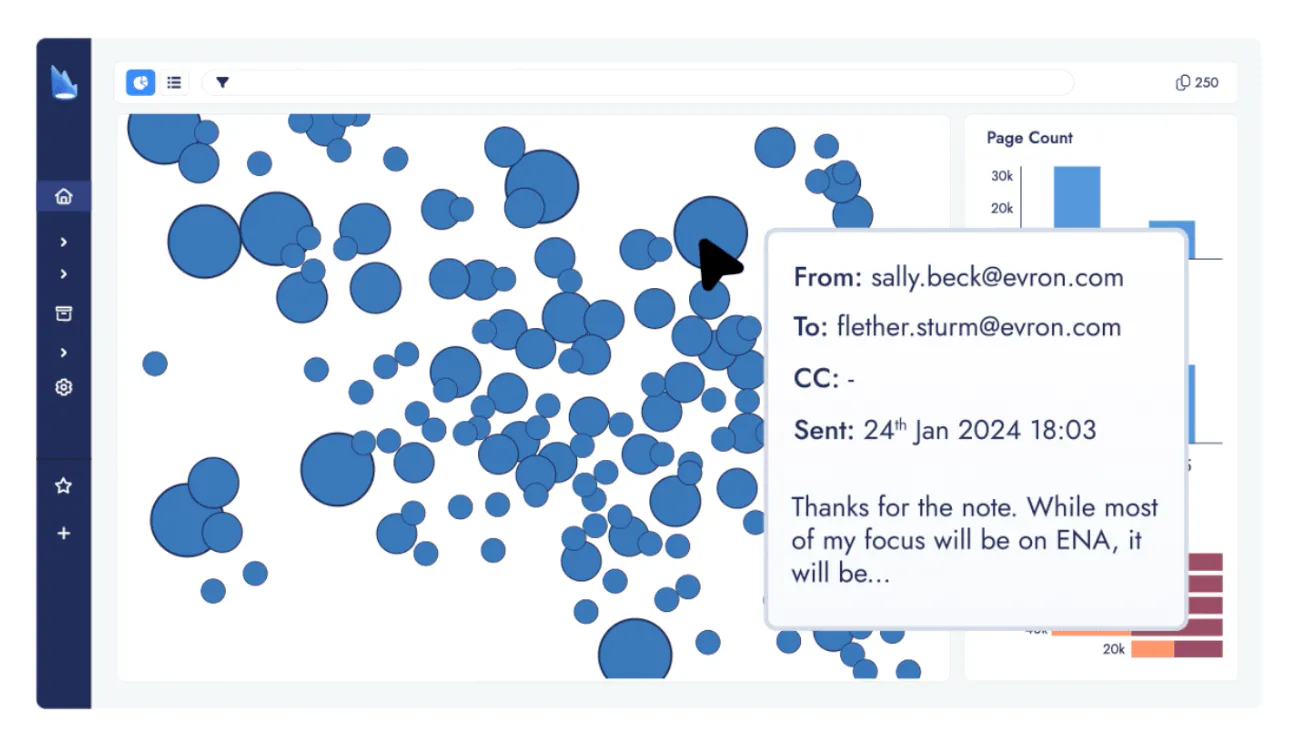
The Investigate function streamlines discovery by applying Luminance’s AI to large document sets across matters such as early case assessment, arbitration, internal investigations, and Data Subject Access Requests (DSARs). The system clusters related files, identifies anomalies, and highlights documents containing sensitive or privileged information. Users can search in natural language, filter by clause type, counterparty, or date, and export findings for disclosure or audit across multiple datasets. Three-dimensional visualizations map document relationships, allowing teams to surface actionable insights within hours. Built-in redaction tools automatically conceal sensitive information before disclosure.
Collaborate
Source: Luminance
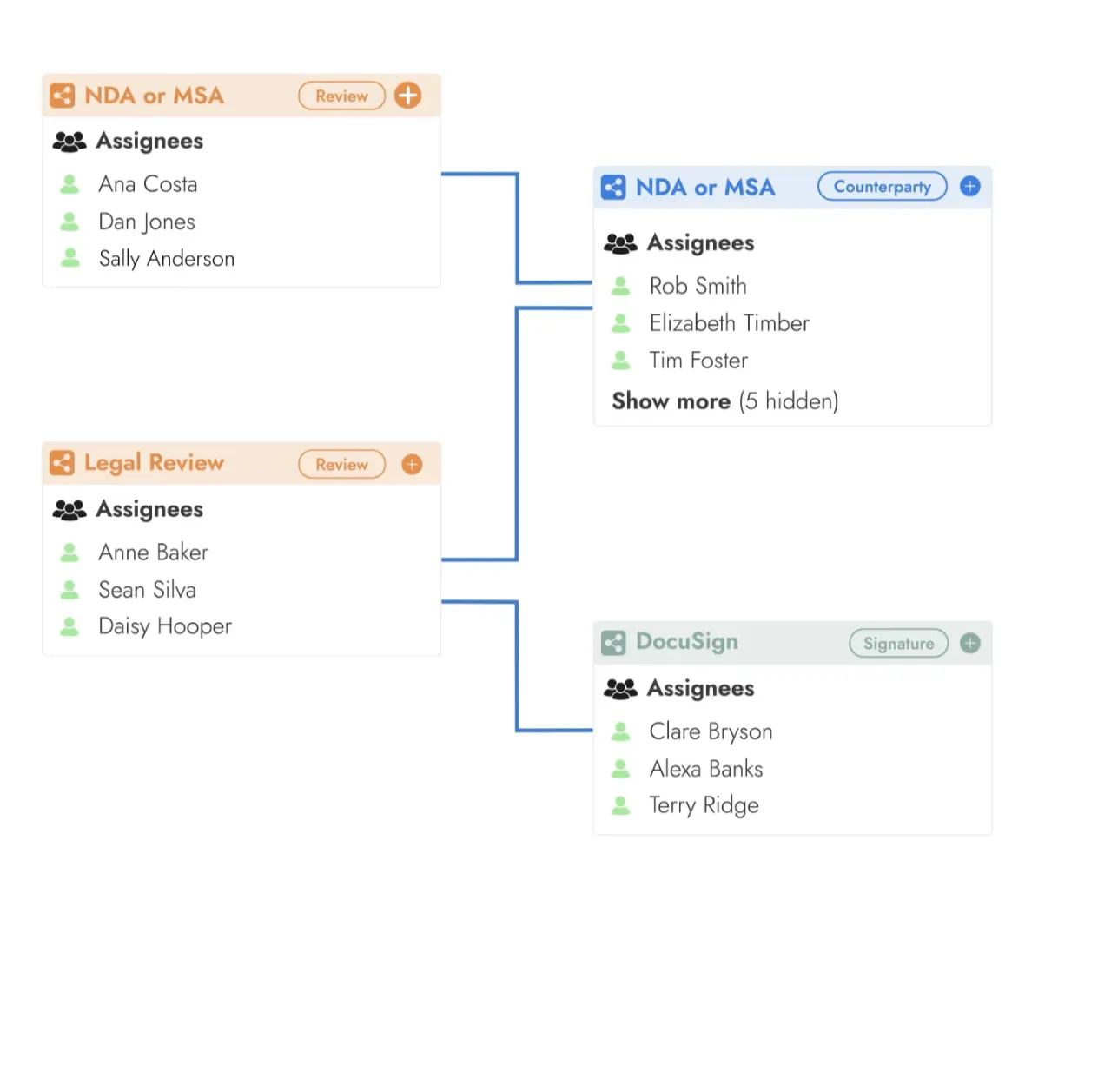
The Collaborate function connects legal and business teams through a centralized workspace for managing requests and approvals. It introduces a ticketing system where business users can communicate directly with Legal, track progress, and maintain an activity log of updates and assignments. The drag-and-drop workflow interface routes contracts and tasks through review, approval, and signature, reducing bottlenecks and improving visibility. Collaborate also enables non-legal users to review and amend contracts within defined parameters, using pre-approved language and risk guidance set by Legal.
Technology and Security
Luminance’s architecture combines its proprietary legal model with a network of specialized systems through a multi-model Mixture-of-Experts approach, which the company brands as legal-grade AI. The proprietary model, trained on more than 150 million legally verified documents, provides the foundation for all platform functions. On top of this base, Luminance integrates additional commercial and open-source models, including embedding and reasoning models, to form a panel of judges. Each model contributes a distinct type of expertise, and an orchestration layer evaluates their combined outputs to ensure balanced and transparent results. This multi-model structure enables the system to benchmark, validate, and adopt new models rapidly as they emerge, maintaining consistent legal accuracy across different domains of use.
A central feature of Luminance’s stack is its Agentic AI framework. Autonomous agents execute multiple workflows in parallel, reading, reasoning, and taking action automatically. The agents analyze clauses, propose revisions, and validate contract language across multiple documents simultaneously, bridging passive document review and active task execution. When uncertainty arises, Luminance’s AI is designed to defer to the user rather than generate speculative content, preserving legal integrity.
Luminance’s platform is deployed across industries that manage high volumes of complex, regulated contracts, with industry-specific solutions for financial services, manufacturing, pharmaceuticals, insurance, chemical, and technology. Functional deployments span corporate legal, compliance, sales, procurement, and executive teams, all running on the same core repository and analysis engine.
Market
Customer
Luminance’s customer base has evolved alongside its product. The company began by working with elite law firms on large-scale diligence and document-review projects, where accuracy and trust were paramount. Early pilots with Slaughter and May provided access to anonymized data and expert validation, helping refine its models and win deployments across the Am Law 200 and Magic Circle. Firms such as White & Case and Clifford Chance later deployed Luminance to accelerate due diligence and portfolio analysis for mergers, leases, and financings.
As the platform matured, the company shifted its focus to corporate legal departments, where demand for automation was stronger, and purchasing decisions were faster. During the COVID-19 pandemic, when companies needed to analyze thousands of contracts for change-of-control and force majeure clauses, Luminance’s ability to process large portfolios quickly helped it gain traction. Lightbody has described the pivot as the result of seeing in-house teams use the platform even though it wasn’t originally built for them, and of realizing there was no other system where they could upload contracts, ask questions, and get answers immediately. In 2024, Luminance shifted toward primarily targeting and growing in the US, securing contracts with customers such as Hitachi, Yokogawa, and AMD.
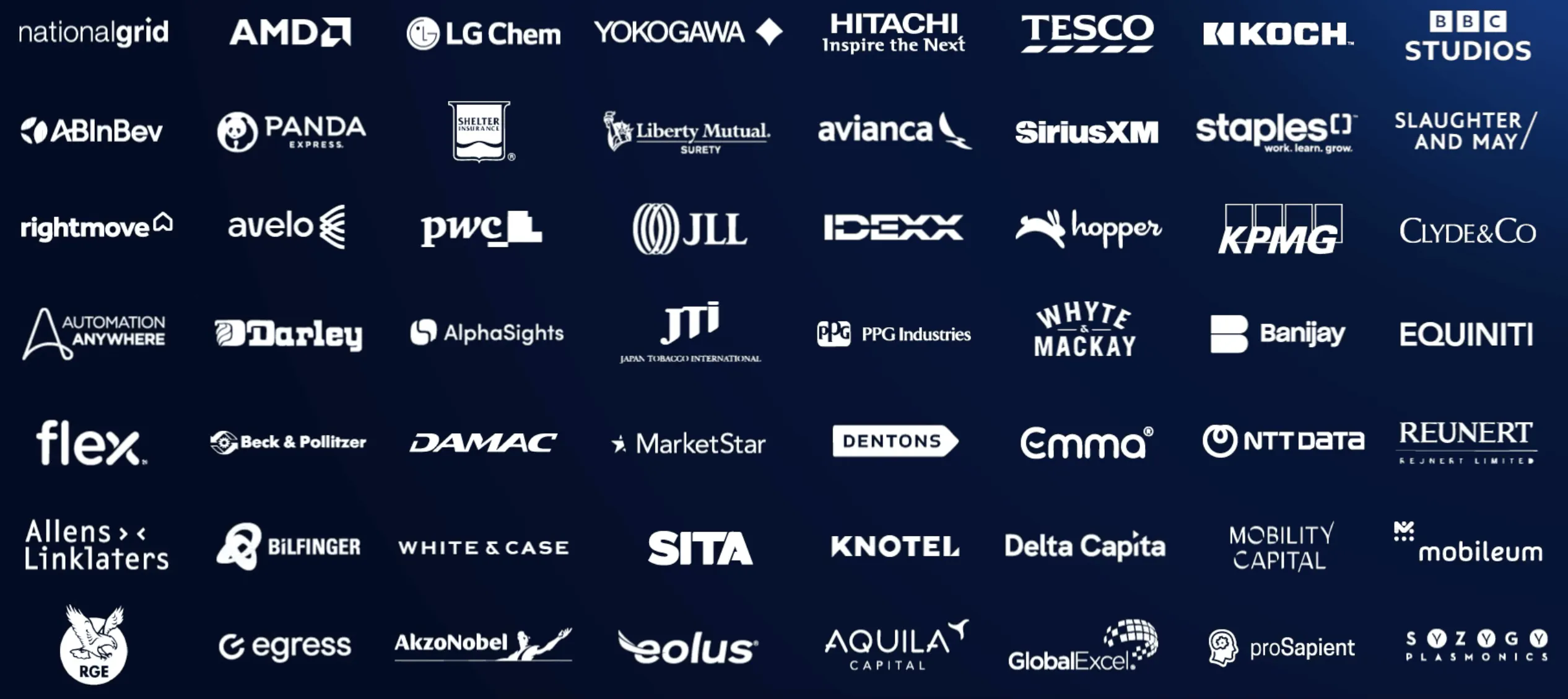
Luminance primarily serves enterprise companies with complex contracting needs. As of May 2026, the company reported more than 1K organizations across 70 countries among its users, including all Big Four consultancies, over a quarter of Global Top 100 law firms, AMD, BBC Studios, Hitachi, Liberty Mutual, Koch Industries, LG Chem, SiriusXM, Rolls-Royce, Lamborghini, and KPMG, alongside several global law firms that continue to use the platform.
Source: Luminance
Adoption among corporations has accelerated because efficiency directly supports their operating goals. In contrast, law firms face weaker incentives: the billable-hour model pays for human time, not automation. Surveys show that 79% of legal departments expected higher workloads in 2025, while 67% anticipated flat or smaller teams. This pressure has pushed companies to adopt AI tools like Luminance to increase throughput and standardize risk review without expanding headcount.
Customer case studies support the utility of Luminance as a way to automate various legal tasks and save time. NTT Data uses Luminance to automatically review incoming contracts, highlight risky language, and generate multilingual summaries with Ask Lumi, completing an 80-page master services agreement in five minutes. Hitachi Vantara integrates Luminance directly into Microsoft Word for first-pass reviews to save 500+ hours on contract drafting per year, while proSapient reports 40% time savings on administrative tasks per week.
Market Size
Legal AI consists of three main components: (1) contract review and negotiation platforms that apply natural-language understanding to risk detection and clause generation, (2) eDiscovery and diligence tools that analyze large document sets, and (3) workflow and compliance automation software that integrates legal reasoning into enterprise systems. Together, these functions make up the addressable market Luminance targets.
Contract management software has historically accounted for the largest share of spending in legal tech. The contract lifecycle management (CLM) segment alone represented roughly $3.3 billion in 2024 and is projected to exceed $8 billion by 2030, driven by the shift from document storage to intelligent review and negotiation. Adjacent categories are expanding as automation moves beyond law departments. The compliance-automation market was valued at nearly $3.5 billion in 2024 and is growing at more than a 13% CAGR.
Aggregating these components puts Luminance’s serviceable addressable market in the $7 billion to $10 billion range by 2030. Growth will be driven not only by new customers but also by deeper penetration within existing enterprises, as AI extends across legal, procurement, compliance, and finance functions. As generative systems become normalized across corporate workflows, legal departments, once viewed as cost centers, are expected to become key adopters of enterprise AI, positioning Luminance to capture a meaningful share of this expanding market.
More broadly, Luminance operates within the legal technology and enterprise automation markets, two sectors converging around the use of AI to manage unstructured text. The global legal-tech market was projected to reach $50 billion by 2027, driven largely by generative AI. Meanwhile, the broader legal-tech market was valued at approximately $26.7 billion in 2023 and is projected to reach $55 billion by 2029, representing a 12.8% CAGR between 2023 and 2029. Within this category, AI-driven solutions are the fastest-growing segment. The legal AI market was estimated at $1.4 billion in 2024 and is forecast to reach $3.9 billion by 2030, implying a 17% CAGR between 2024 and 2030.
Competition
Competitive Landscape
AI in legal is segmenting by workflow rather than into a single winner-takes-all suite. At the top of the funnel are research and drafting environments tied to reference corpora. Incumbents like Thomson Reuters layer generative assistants onto Westlaw and Practical Law, so lawyers can research faster and draft with provenance, reducing perceived risk for corporate counsel teams that already buy Thomson Reuters bundles. Customer stories show in-house teams consolidating on CoCounsel for research, Q&A, and first-pass drafting, with measurable hours saved each day.
Contract work splits into two distinct value-chain bands. One is day-to-day contracting inside enterprises: intake, first-pass review, redlining against playbooks, and portfolio analytics. The other is high-volume event work such as diligence, repapering, and investigations. Startups and scale-ups focus on a single band or step. There’s a wave of focused apps across review, drafting, negotiation, and compliance rather than a single end-to-end platform, while landscape mappings show point solutions multiplying across “research,” “review,” “draft,” “negotiate,” and “manage.”
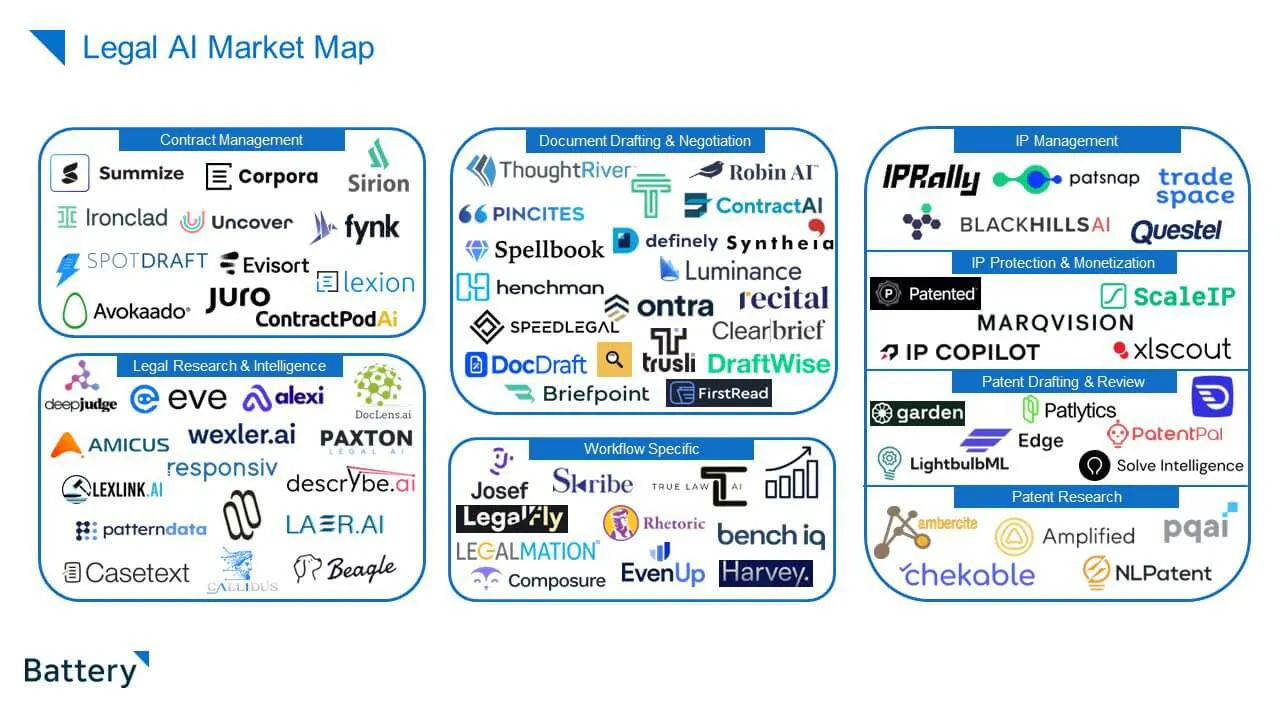
Source: Battery
The competitive set can also be broken out by buyer. Incumbents monetize law firms and mid-to-large corporate legal departments with content-anchored assistants, while venture-backed players split between firm-first tools and corporate-first contracting systems. There are firm-oriented assistants like Harvey on one side and a cluster of contract-analysis and negotiation companies, including Luminance and Europe-born peers such as Legora, on the other. In parallel, practice-management platforms like Clio are moving “up the stack” through acquisitions to bundle research and AI into operating systems for firms, thereby tightening distribution even when feature depth is uneven.
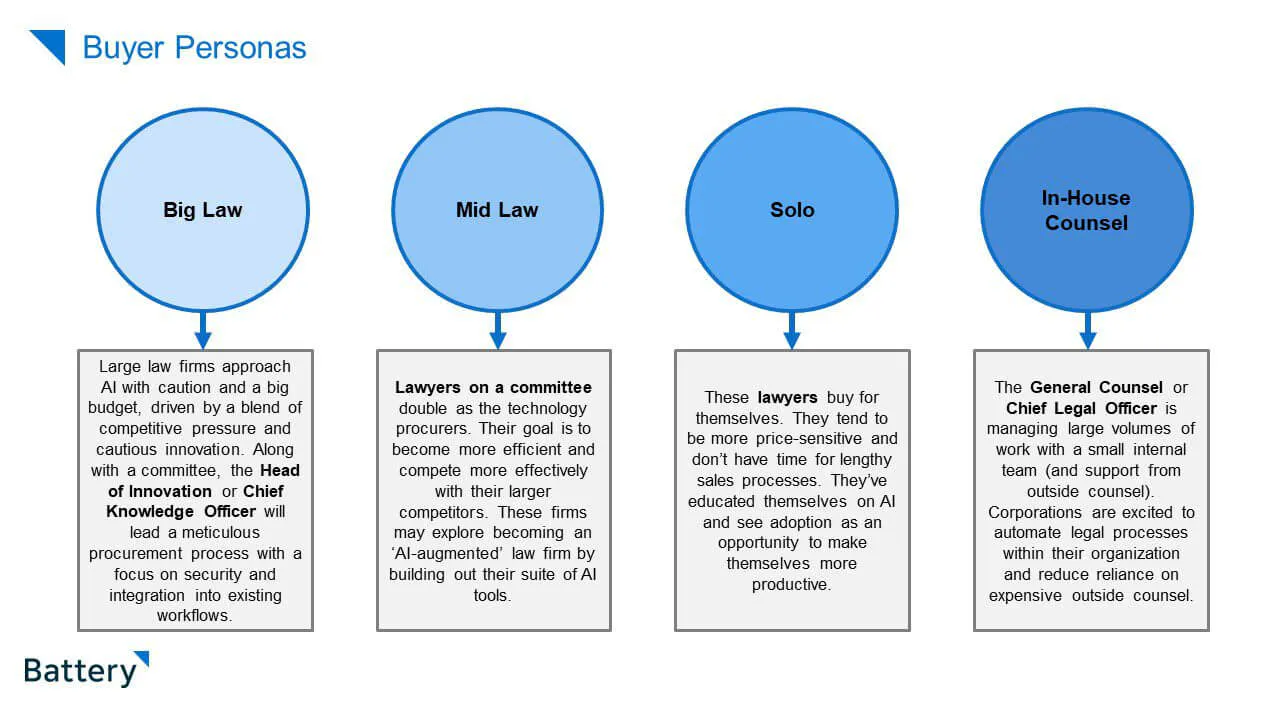
Source: Battery
Within this landscape, Luminance differentiates on three axes. First, it optimizes the contracting value chain end-to-end, from first-pass review and playbook-aware redlining to diligence and discovery within a single corpus, rather than leading with research content. Second, it emphasizes legal-grade outputs with traceability, including a model ensemble and controls that surface evidence rather than free-text guesses, aligning with in-house risk thresholds. Third, it targets enterprises as the primary buyer and treats firm deployments as a second motion, which fits market dynamics in which in-house teams feel acute pressure to do more with flat headcount.
Competitors
Thomson Reuters CoCounsel: Thomson Reuters launched CoCounsel in 2023 following its $650 million acquisition of Casetext. CoCounsel integrates directly with Westlaw, Practical Law, and Microsoft 365 to help lawyers summarize, draft, and analyze legal documents inside the tools they already use. The product runs on OpenAI’s GPT-4 and is layered with Thomson Reuters’ proprietary content and retrieval systems to enhance accuracy and source traceability.
As of May 2026, Thomson Reuters traded at a market cap of approximately $40 billion and a revenue multiple of roughly 5.3x. By embedding generative capabilities into its existing subscription suite, Thomson Reuters has positioned CoCounsel as a trusted companion for research and drafting rather than a standalone workflow engine. Its strength lies in distribution, as virtually all major law firms already rely on its ecosystem, and in decades of curated legal data that reinforce credibility and adoption among risk-averse buyers.
Clio: Clio, founded in 2008, brought law-firm management to the cloud and offers tools for client intake, billing, case management, and document automation. The company has raised approximately $1.8 billion in total funding, including a $900 million Series F in 2024 at a $3 billion valuation led by New Enterprise Associates, with Clio’s most recent secondary valuation reported at roughly $5 billion as of November 2025. In 2025, Clio expanded into AI with Clio Duo, a generative assistant, and acquired vLex for $1 billion to integrate legal research and drafting into the platform. Its strategy centers on becoming an all-in-one operating system for small and midsize firms, consolidating administrative, financial, and (as of 2025) research workflows. With a large installed base and broad product coverage, Clio’s evolution reflects a shift from practice-management software to a vertically integrated legal-tech suite.
Harvey: Harvey, founded in 2022 by former OpenAI Fellows Gabriel Pereyra and Winston Weinberg, builds a general-purpose legal AI platform. The company has raised over $1 billion in total funding, including a $200 million growth round at an $11 billion valuation co-led by GIC and Sequoia in March 2026. Earlier rounds include a $300 million Series D in February 2025 at a $3 billion valuation, followed by $150 million at an $8 billion valuation in October 2025. Backers include Sequoia, Coatue, Kleiner Perkins, the OpenAI Startup Fund, and Andreessen Horowitz. Harvey has announced partnerships with Allen & Overy, PwC, and Macfarlanes. Its product runs on OpenAI’s GPT-4 and is designed as a universal legal assistant capable of drafting, summarizing, and conducting research across multiple practice areas. It integrates large language models with proprietary legal datasets to generate structured, verifiable outputs, positioning itself as a “Copilot for Lawyers” with emphasis on speed of deployment and generalizability.
Legora: Legora is a Stockholm-based legal-AI company founded in 2023 by CEO Max Junestrand and CTO Sigge Labor that builds a collaborative AI stack for contract review and negotiation, centered on a Word plug-in, Tabular Review for clause-level benchmarking, a research agent with citations, and integrations into leading DMS tools. The product's aim is precision and speed on redlines rather than a full practice-management suite, which has driven adoption among European law firms and in-house teams that want specialized tooling embedded in existing workflows. Legora reached a $5.6 billion post-money valuation following a $550 million Series D led by Accel in March 2026 and a $50 million extension led by NVentures (Nvidia) and Atlassian in April 2026. The company crossed $100 million in ARR and reported over 1K law firm and enterprise legal-team customers as of April 2026, including Fortune 500 in-house legal teams.
Business Model
Luminance operates a subscription-based SaaS model, offering enterprise licenses for its suite of legal-AI products. Pricing is quote-based and customized to each client’s needs, reflecting factors like user count, data volume, and selected modules. Luminance does not publish per-seat pricing on its product pages, but enterprise contracts scale by team size, with volume discounts for multi-license deployments. Its SaaS model indicates favorable margins, with the main cost drivers being GPU compute for training and inference of the proprietary LPT, human-curated legal datasets, and customer-success engineering for enterprise deployments.
Traction
Luminance’s early partnership with firms such as Slaughter and May established a foundation for enterprise adoption. As of May 2026, the company claimed that more than 1K organizations across 70 countries were using Luminance, spanning both global law firms and in-house legal teams, up from over 700 organizations in February 2025. Roughly 40% of revenue came from the United States as of February 2025, reflecting the company’s deepened presence in North America and shift toward enterprise legal departments.
Growth has been strongest within Luminance’s corporate product line, which the company reported had achieved a 5x increase in customers and 6x growth in ARR over the prior two years, as of February 2025. Adoption has been driven by in-house teams under mounting workload pressure, where automation directly reduces review time and risk exposure. One unverified estimate indicates Luminance may have reached approximately $30 million in ARR by the end of 2024, growing 150% year-over-year from roughly $12 million in 2023, with the corporate product line contributing about 83% of total revenue.
Valuation
In February 2025, Luminance raised a $75 million Series C led by Point72 Private Investments, bringing its total funding to $165 million. The round included participation from Slaughter and May, the company’s original pilot partner, as well as existing backers Talis Capital and Invoke Capital. The Series C followed a $40 million Series B in April 2024 led by March Capital with participation from National Grid Partners and Slaughter and May, which supported expansion into North America. Luminance has not publicly disclosed valuations for either the Series B or Series C, but the Series C was oversubscribed, and the company raised more than $115 million within twelve months.
No pure-play public legal-AI comparable to Luminance exists, but two adjacent public peers anchor the multiple range. As of May 2026, Thomson Reuters traded at a market cap of approximately $55 billion at a revenue multiple of roughly 5.3x, reflecting the multiple a content-anchored, lower-growth legal incumbent commands. DocuSign, the closest public CLM-adjacent comparable, traded at a meaningfully lower revenue multiple as a mature SaaS, while higher-growth vertical-SaaS-with-AI peers such as Veeva carry richer multiples reflecting durable enterprise lock-in. Together, they bracket the valuation range a high-growth, legal-vertical AI software company should sit within at scale.
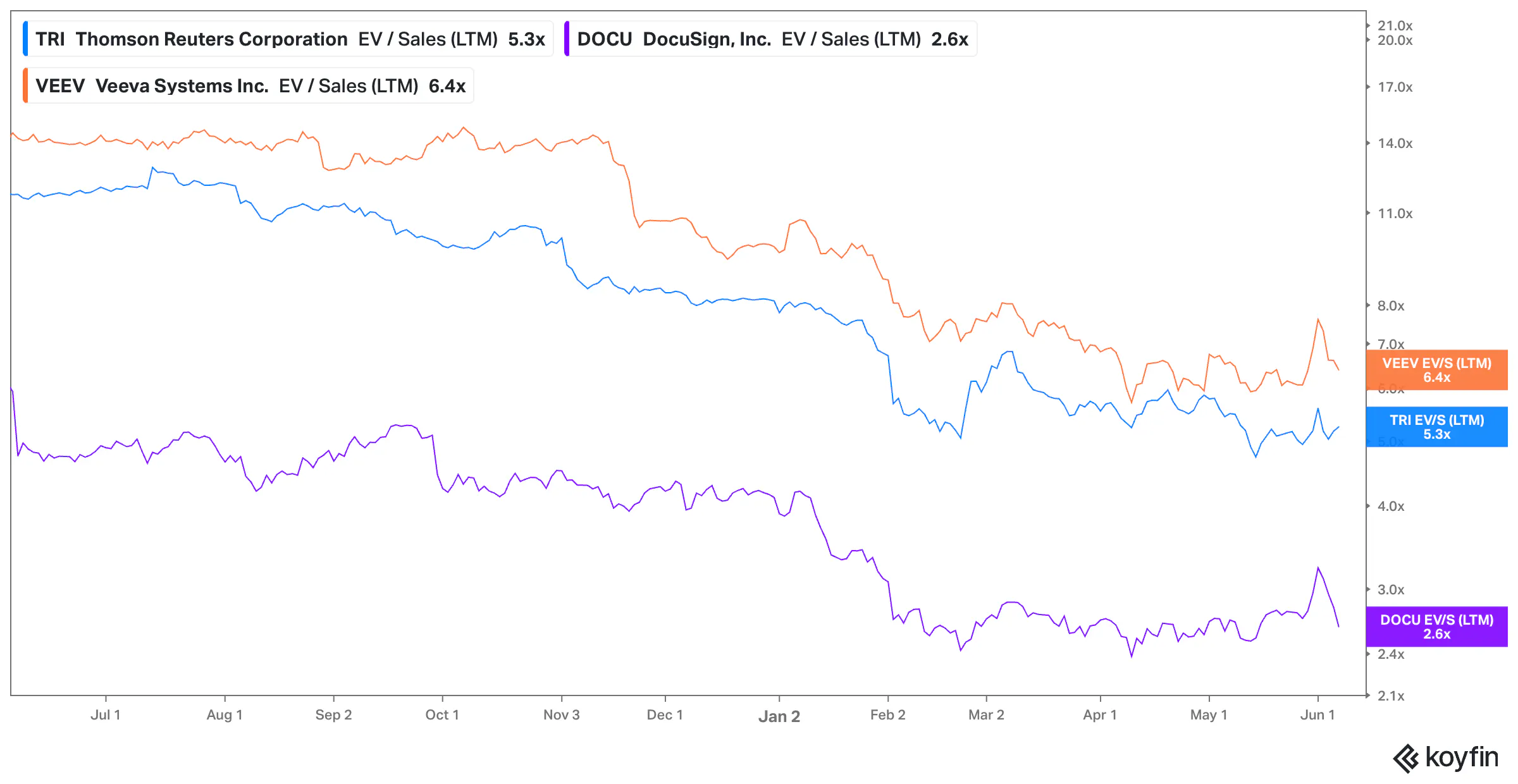
Source: Koyfin
Key Opportunities
Moving to Comprehensive Enterprise Contract Intelligence
Luminance’s founding vision, modeling how lawyers read, reason, and separate the signal from the noise, has evolved toward building domain-specific reasoning systems for any function that interacts with contracts. Lightbody has described the system as an end-to-end platform designed to “sit wherever your computers meet your contracts,” capable of serving legal, procurement, and compliance teams alike. The platform already enables non-legal users to generate agreements within guardrails, extract key risk data, and connect to external feeds to calculate regulatory or monetary exposure.
This shift from a legal-department tool to a cross-functional contract intelligence layer is already visible in product launches and customer adoption. Contracts underpin activities such as vendor management, compliance certification, and commercial performance tracking, yet these processes have traditionally remained fragmented. Luminance’s unified architecture centralizes these workflows, linking contractual terms to real-time business obligations. Features such as Deep Insight, released in 2025, connect regulatory change to contractual duties, reflecting the company’s progression toward serving as the system of record for enterprise risk and compliance, where every supplier, policy, and transaction can be monitored and validated by transparent, legal-grade AI.
Luminance’s trajectory suggests a path beyond contracts. The same reasoning engine that interprets clauses and obligations can extend to policies, governance frameworks, and internal procedures, or any domain where compliance depends on natural-language rules. As organizations codify more of their operations into machine-readable policies, Luminance could evolve into a policy reasoning layer that maps commitments across departments and data systems. In that world, contracts become only one expression of a company’s ruleset, and Luminance’s models serve as the interpreter connecting legal language to operational execution.
Progression Toward Agent-to-Agent Negotiation Systems
The next leap in contract automation comes when AI systems can negotiate directly with one another, and Luminance’s architecture is built for that future. The company has already demonstrated a concept car in which two Luminance instances successfully negotiated an NDA with tunable aggressiveness, underscoring how its structured, evidence-based approach lends itself to controlled autonomy.
This capability aligns with a broader market direction: enterprises are moving from static workflows to agentic systems that act, coordinate, and learn in real time. In contracting, that means routine negotiations like NDAs, vendor MSAs, and renewals will increasingly occur AI-to-AI, with humans supervising only edge cases. Luminance’s panel-of-judges consensus model, built for auditability and permission-based transparency, offers a foundation for this shift. Combined with features like Autopilot and Ask Lumi, this lays the foundation for a future where routine contracting becomes agent-to-agent negotiation under strict auditability, with agents reasoning, disagreeing, and reconciling positions with verifiable provenance, a feature that general-purpose LLMs lack.
If realized, this agentic future could redefine how legal and commercial transactions operate. Contracts would evolve from static documents into living systems that are continuously negotiated, risk-scored, and enforced by interoperable AI agents across organizations. For Luminance, the opportunity is to become the protocol layer for machine-to-machine negotiation, trusted precisely because it was engineered for legal-grade accuracy and accountability.
Key Risks
Technological Complexity and Cost of a Proprietary Model Stack
Luminance differentiates itself by developing its own Legal Pre-Trained Transformer (LPT), a proprietary model trained on over 150 million legal documents, while also incorporating external and open-source models into a Mixture of Experts framework, rather than relying solely on general-purpose APIs such as OpenAI’s GPT-4, Anthropic’s Claude, or Google Gemini. While this provides greater control over accuracy, data privacy, and auditability, it also creates significant capital intensity and technical overhead compared with competitors that fine-tune or wrap existing foundation models.
Training and maintaining a large transformer requires thousands of GPUs, human-curated datasets, and continuous retraining to incorporate evolving legal and regulatory language. Analyses estimate that building a 10-billion-parameter domain-specific model can cost $20 million to $30 million in compute and engineering resources alone, while inference and fine-tuning can represent 70% to 90% of total AI operating costs once a model is deployed. These costs are magnified for smaller providers that cannot amortize GPU and data-processing expenses across billions of API calls the way hyperscalers can.
Because Luminance manages both its internal model and the orchestration of external ones, iteration velocity remains slower than for API-based competitors such as Harvey, which can immediately adopt upstream model upgrades. Luminance engineers must re-benchmark the proprietary layer and validate the ensemble each time new architectures, such as routing, extended context windows, or retrieval-augmented generation (RAG), are introduced. This hybrid strategy narrows the gap between closed and open-model trade-offs but still exposes the company to higher compute costs and slower release cycles. If foundation-model providers continue improving in legal reasoning, Luminance could face cost-curve and cadence pressure where maintaining its proprietary stack yields control advantages but compresses margins relative to faster-moving API integrators.
Competitive Pressure and Rapid Proliferation of Legal AI Startups
The legal AI market has entered a period of rapid expansion, with dozens of venture-backed startups and incumbent platforms racing to capture enterprise clients. Funding in legal technology surpassed $2 billion globally in 2024 and 2025, driven by the rise of generative AI in contracting, diligence, and compliance. This influx has intensified competition for both customers and talent as offerings increasingly converge on similar capabilities like AI-assisted drafting, clause comparison, and playbook-driven negotiation.
Fast-growing startups are already signing big clients in the legal and enterprise spaces. Harvey has embedded itself across major law firms and global enterprises through partnerships with companies like PwC and reached an $11 billion valuation in March 2026. Europe-based Legora reached a $5.6 billion post-money valuation in April 2026 after disclosing over 1K law firm and enterprise customers and crossing $100 million in ARR.
As large corporations and law firms pilot multiple AI vendors simultaneously, competition increasingly hinges on speed to market and depth of integration rather than technical differentiation alone. Legal-AI tools tend to be sticky once deployed because they embed directly into document repositories and workflows, making the first vendor to close a deal or integrate into an enterprise environment difficult to displace. For Luminance, the risk is less about model quality than about selling and onboarding faster than peers. If competitors continue securing flagship customers and standardizing their tools across departments, even marginal differences in procurement timing could translate into long-term share loss.
Regulatory and Hallucination-Liability Exposure
Legal-AI vendors operate in a regulatory environment that is hardening around accuracy, provenance, and accountability. The EU AI Act, which entered force in August 2024 and applies its high-risk-system requirements from August 2026, classifies AI systems used in the administration of justice as high-risk and imposes obligations around data governance, transparency, human oversight, and conformity assessment. Luminance, headquartered in the UK with a significant European customer footprint, sits squarely within the scope for many deployments. Compliance overhead (including conformity assessments, documentation, and ongoing monitoring) adds operating costs and can slow new-product rollout.
A separate but related risk is hallucination liability. Public failures of legal AI to ground citations in real source material, most prominently the Mata v. Avianca case in 2023, where attorneys were sanctioned for filing a ChatGPT-generated brief citing non-existent cases, have made firms and in-house teams hyper-attentive to provenance and confidence calibration. Luminance’s evidence-citing architecture is designed to mitigate this, and the company markets “legal-grade” outputs explicitly to differentiate from general-purpose LLM-based tools. But a single high-profile failure (a Luminance-generated clause that materially harms a customer, a missed obligation flagged in a Comply dashboard, a deferential failure mode that nevertheless slips through) could puncture the “legal-grade” positioning and damage the brand asymmetrically. The same architecture that creates the brand also creates the surface area for failure.
Summary
Legal work remains one of the most manual and text-driven domains in business, with in-house teams reporting rising workloads and flat staffing even as document volumes surge. This imbalance has made the industry a natural candidate for AI, where structured rules and standardized language allow models to reason with precision. Luminance builds on this premise with its proprietary Legal Pre-Trained Transformer (LPT), trained on more than 150 million legal documents, that applies across the entirety of the contract lifecycle. Its architecture emphasizes auditability and accuracy, capabilities designed for enterprise legal teams managing risk at scale.
As of May 2026, adoption has expanded to over 1K organizations across 70 countries, spanning both global law firms and enterprises, with roughly 40% of revenue from the US as of February 2025. As AI becomes embedded in enterprise workflows, the central question is whether Luminance can preserve its differentiation against well-funded API-native competitors and move fast enough to secure the customers and category position that the agent-to-agent contracting future will reward.