Thesis
AI data centers have added power demands to the grid faster than the grid can expand to meet them. A typical AI-focused hyperscale data center consumes as much electricity each year as 100K households, and new data center campuses tend to cluster in specific regions, so their power demand hits local grids hard rather than spreading evenly across the country. In the US, data centers consumed 183 TWh of electricity in 2024, and that consumption is projected to grow by 133% by 2030. A December 2025 analysis of utility forecasts projected that data centers would account for roughly 55% of US peak demand growth through 2030.
Grid interconnection timelines do not match data center construction timelines. In established North American and European markets, the average wait time for a large-scale grid connection reached seven to 10 years as of April 2026, while data centers can often be built in two to three years. Hyperscalers have responded by pursuing their own power supply, but every alternative carries a tradeoff.
The lithium-ion batteries data center developers are adopting on-site typically last two to four hours, leaving solar-plus-storage short of overnight coverage. Nuclear power, meanwhile, faces five-to-seven-year permitting and construction timelines. Natural gas is faster to deploy, but it conflicts with many large tech companies' sustainability goals. Google has committed to running on carbon-free energy around the clock by 2030, Microsoft aims to be carbon-negative by 2030, and Amazon has pledged net-zero carbon emissions by 2040 through its Climate Pledge.
Exowatt is building a modular solar thermal power system, charged by sunlight on site and shipped as a container-sized unit, for data centers that need clean electricity faster than the grid can provide it. The company argues that the core components of solar thermal power (solar collection, thermal storage, and heat-to-electricity conversion) can become commercially viable if redesigned around factory-built modules rather than large custom power plants. Exowatt’s goal is to provide data centers with dispatchable clean power without waiting for grid access.
Founding Story
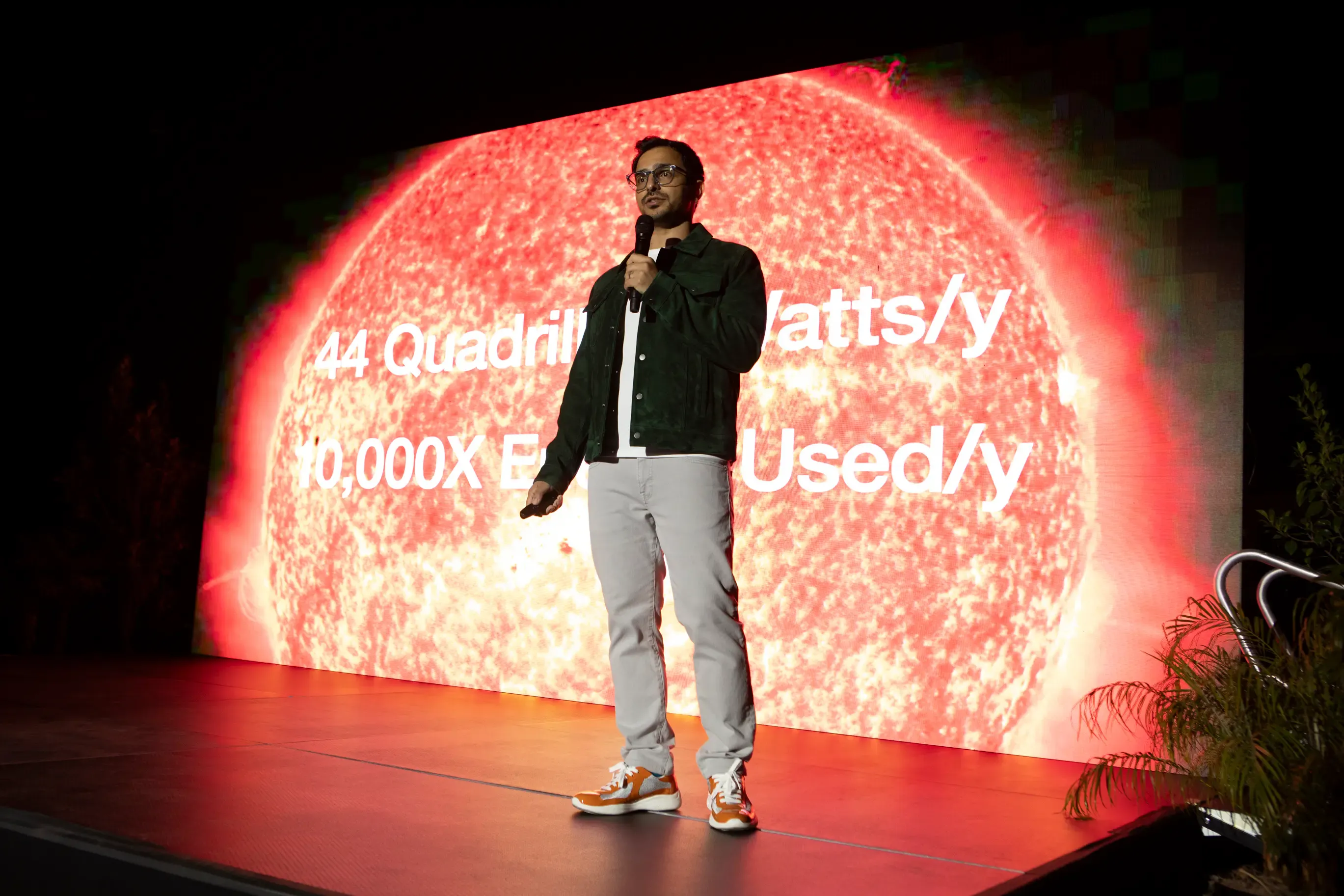
Exowatt was founded in January 2023 by Hannan Happi (CEO) and Jack Abraham (Chairman). The company was incubated within Atomic, Abraham's Miami-based venture studio. The idea came from Abraham, who encountered a heliostat solar plant on a trip to Israel and researched how the technology could be made viable at scale before recruiting Happi to build it.
Happi trained as a mechanical engineer at the Technical University of Munich and later worked at companies including GE, Siemens, Accenture, and Tesla. While working at Tesla, Happi ran into a supply chain logistics problem that he wanted to solve with long-range drones. In 2015, he co-founded Volansi, whose founding team included Wesley Zheng.
Volansi built high-payload, long-range vertical takeoff and landing drones for logistics use cases across commercial, medical, and defense markets. Its vehicles could carry up to 200 lbs over distances of up to 1K miles. Volansi raised more than $75 million from investors including Lightspeed Venture Partners and Y Combinator before selling its technology and assets to Sierra Nevada Corporation in 2022. Happi has described Volansi as one of the hardest possible startup paths since it involved hardware, regulation, and defense procurement, and he has said those lessons carried into how Exowatt builds and brings its product to market.
Source: Exowatt
Abraham attended the Wharton School before leaving to found Milo.com in 2008. Milo.com let consumers search local store inventory and pricing online. eBay acquired Milo.com in December 2010 for a reported $75 million, after which Abraham joined eBay as Director of Local. In 2012, Abraham founded Atomic, a venture studio that creates companies internally and pairs founders with capital and operational support. Atomic has created companies including Hims & Hers, Bungalow, Homebound, and Replicant. By 2023, Atomic had raised a $320 million fourth fund and held more than $750 million in assets under management.
Abraham moved to Miami in July 2020, bringing several Atomic leaders with him. In September 2022, Happi joined Atomic as a founder in residence in Miami at Abraham's invitation. Abraham had been thinking about the second-order effects of the AI boom, which affect chips, data centers, and power, so he and Happi teamed up in late 2022 to build a sustainable energy solution for AI infrastructure demand. Happi stated that the two set an aggressive cost target of $0.01 per kWh, then worked backward through more than 50 configurations and material combinations before settling on the P3 architecture.
Sushrut Bapat, a PhD engineer, served as Exowatt's Chief Engineer from its founding until February 2025. In January 2026, Nic Bustamante joined as Chief Data Center Officer and GM to lead ExoRise, bringing more than 25 years of hyperscale data center development experience across more than 100 markets, including prior work at Apple, Google, Microsoft, Rackspace, and Corscale. In June 2026, Exowatt appointed Suchet Singh as CFO. Singh was previously CFO of Terra Energy and of Verily Health Platforms, and vice president of corporate financial planning and analysis at Amazon.

Source: Aydin Senkut via X
Product
Engineering Context
Exowatt's main product, the P3, is a modular solar thermal power system that combines concentrated solar collection, thermal energy storage, and heat-to-electricity conversion through a Stirling engine. None of these ideas is new; concentrated solar power projects have existed for decades, thermal storage predates modern electricity markets, and the Stirling engine was invented in 1816. Happi claimed that prior attempts to commercialize these technologies failed because the systems were not modular, took years and billions of dollars in capital to build, and were optimized for technical performance rather than unit economics.
Happi has attributed the success of photovoltaic solar panels to their modularity. The levelized cost of electricity from utility-scale solar PV fell 90% between 2010 and 2023, and battery storage costs had fallen 93% since 2010 as of May 2026. However, Happi also pointed out the pitfalls of traditional PV solar panels, namely their dependence on rare materials and on China, which he said controls over 80% of the supply chain and manufacturing for solar and wind. As for electrochemical batteries, Happi stated that their cost is higher than that of thermal batteries by roughly one to two orders of magnitude, and that they degrade over their lifetime.
The system's main technical risk involves its Stirling engine and thermal battery. A Stirling engine uses an external heat source to heat a working fluid in a closed cycle, converting a temperature difference into mechanical motion and then electricity. In Exowatt's case, concentrated sunlight heats a thermal battery, and stored heat later drives the engine.
P3

Source: Exowatt
The P3 is a three-in-one solar power module that integrates solar collection, long-duration thermal storage, and electricity generation in a 40-foot shipping-container-sized footprint. It arrives factory-built for easy deployment and works in three stages. First, proprietary Fresnel lenses track the sun and focus incoming solar energy onto a target to create concentrated heat. Fresnel lenses are thinner and lighter than traditional curved lenses because they approximate a lens through a series of concentric ridges.
Second, the system stores concentrated heat in a thermal battery made from domestically sourced materials, which Exowatt has described as sand, dirt, and slag. Exowatt uses sensible heat storage, meaning the material stores energy through temperature change while remaining solid. There is no phase change, electrochemical reaction, or moving part inside the battery cell. Exowatt says the battery reaches temperatures of up to 1K°C, can hold heat for up to five days, and avoids the degradation profile of lithium-ion batteries because it does not rely on chemical charge-discharge reactions.

Source: Exowatt
Third, stored heat moves through a heat engine to produce electricity. Happi has described the process as air circulating through battery packs, collecting heat, and carrying it to the engine's heat exchanger. The hot side expands the working fluid, pushes a piston inside a generator coil, and generates electricity. Exowatt says the P3 can dispatch power for up to 24 hours, which addresses the main limitation of solar PV plus short-duration batteries for data center use. The P3 can also be paired with other on-site energy sources.

Source: Exowatt
The P3's main tradeoff is land use. Thermal storage requires physical material, and solar collection requires land area. Exowatt's own calculator estimated in 2024 that serving a 50 MW peak load for 24 hours in Arizona would require up to 1.1K acres, and in July 2026 the company put the requirement at roughly one acre per MWh of dispatchable capacity. Happi has argued that the need for land is not fatal to the business because many data centers are already moving to the Sun Belt, where solar resources are stronger, and land is cheaper.
Exowatt also offers a digital twin for the P3 in collaboration with NVIDIA and AWS. The digital twin links a physical system to a virtual representation for monitoring and predictive maintenance.

Source: Exowatt
ExoRise
Source: Exowatt
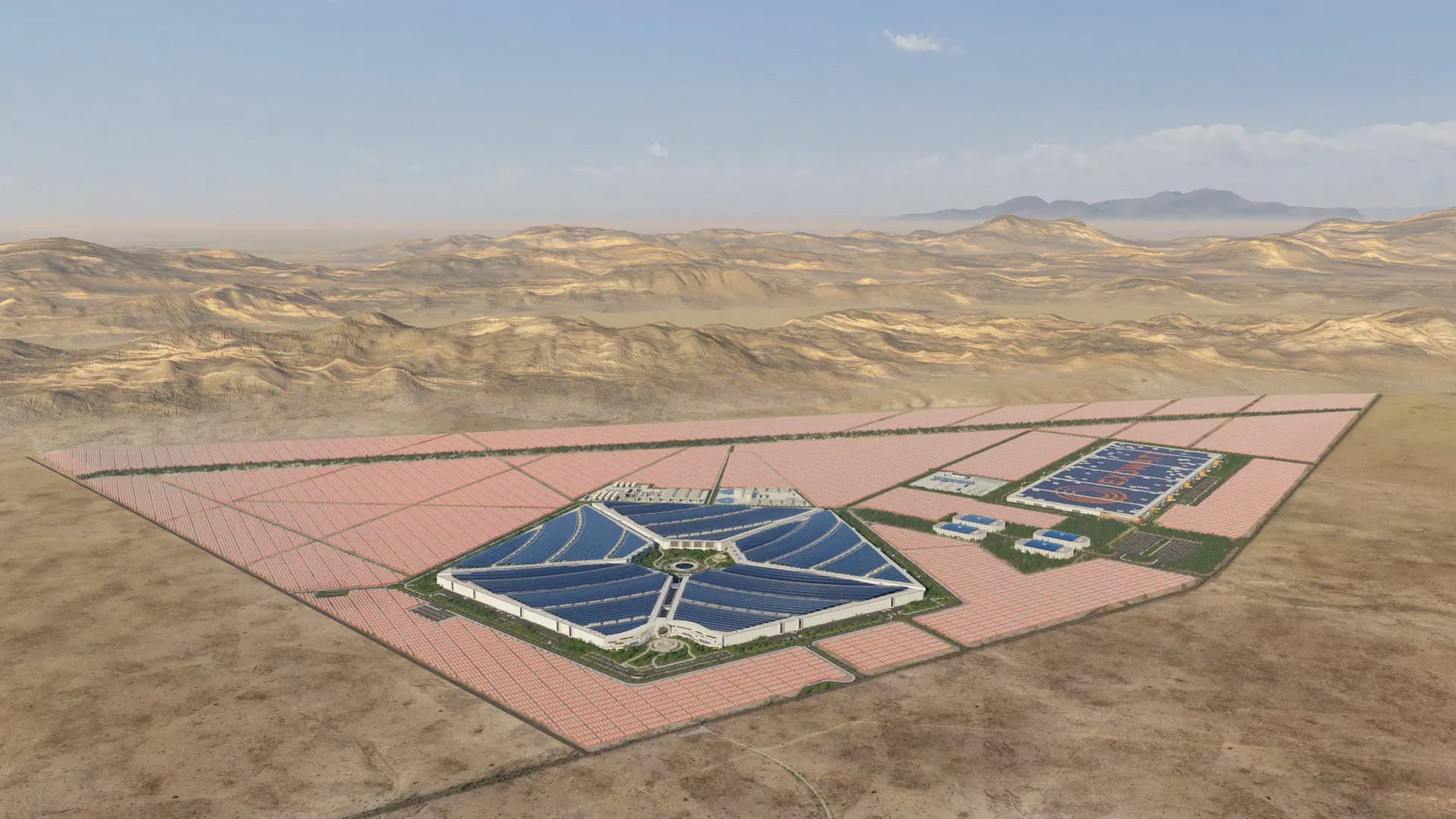
ExoRise, announced in January 2026, is Exowatt's land and infrastructure business line that bundles land, power, and P3 deployment into a single offering for data center customers, rather than coordinating each piece separately. Exowatt organizes ExoRise around three parts: land suited to utility-scale data centers, co-located solar thermal power with long-duration storage, and modular data center shells built on site. ExoRise focuses on high-solar land with abundant acreage across the US Southwest, including New Mexico, West Texas, Arizona, and Nevada. Exowatt expects an operational ExoRise pilot by the end of 2026.
ExoRise also appears to respond to a specific critique of the P3. In September 2024, a Columbia University professor said there was "almost no way" the modules could support a data center on a standalone basis. By owning more of the project stack, Exowatt controls more of the deployment process and takes a larger share of the economics. The tradeoff, however, is complexity; ExoRise makes Exowatt a power infrastructure developer, which raises the operating burden while the company, as of September 2026, had yet to prove its first product at scale.
Market
Customer
Exowatt's primary target is data centers willing to own on-site generation rather than wait for grid interconnection. Happi has said that the request he hears most often from customers is about time to power, meaning how fast the system can deploy. An April 2026 profile of the company reported that hyperscalers signing power contracts were paying $0.20-$0.30 per kWh. As of mid-2026, behind-the-meter projects accounted for more than 25% of all planned US data center capacity. The US South accounted for 71% of planned US data center construction spending through the end of 2026 as of September 2026. That spending overlaps with the Sun Belt corridor Happi has described as best suited to the P3, running from Eastern Oregon through California, Nevada, Arizona, Texas, New Mexico, Georgia, and Florida.
Exowatt's target market is concentrated around large hyperscalers and data center developers, with AWS, Microsoft, and Google accounting for 59% of all hyperscale data center capacity as of the end of 2024. Selling into that market is difficult because hyperscalers were securing data center capacity 24-36 months in advance as of February 2026, and new power infrastructure must clear a high reliability bar. Exowatt's backlog of more than 90 GWh is self-reported.
Adjacent companies have disclosed more concrete project proof. Cloverleaf Infrastructure, a direct ExoRise competitor that launched a few months before Exowatt unveiled the P3, was developing land in Wisconsin as of January 2026 for one of the OpenAI/Oracle Stargate data center clusters. Antora Energy launched a commercial-scale thermal battery at Wellhead Electric Company's facility near Fresno, California in September 2023, and in July 2026 it reported that its 5 GWh Big Stone system in South Dakota went from initial construction to delivering energy in under 12 months. Exowatt has neither.
Market Size
Global data center investment reached roughly $500 billion in 2024 after nearly doubling since 2022. One estimate put global data center spending at as much as $7 trillion by 2030. The dedicated data center power market, which includes UPS systems, power distribution, generators, energy storage, power management software, and related electrical infrastructure, is expected to grow from $35.1 billion in 2025 to $50.5 billion by 2030.
Data centers used roughly 415 TWh of electricity in 2024, or about 1.5% of global electricity consumption. The International Energy Agency expects data center electricity consumption to more than double to roughly 945 TWh by 2030, representing just under 3% of global electricity consumption. In the US, data centers could consume up to 9% of electricity generation annually by 2030, up from 4% of total load in 2023. In May 2026, public estimates placed the 2026 combined AI infrastructure CapEx for the largest hyperscalers at more than $700 billion. Exowatt sells into the power infrastructure portion of that buildout.
Competition
Competitive Landscape
Exowatt's most direct competitors are venture-backed thermal storage companies like Antora Energy and Fourth Power, which are also trying to make long-duration energy storage cheaper by storing energy as heat. Its most relevant commercial competitors are public or incumbent power providers like Bloom Energy, Constellation Energy, and First Solar, which already have operating deployments and established customer relationships. Exowatt's pitch against both groups is time to power, using a system charged by on-site sunlight rather than grid electricity. Incumbent providers already run operating fleets; as of September 2026, Antora Energy had moved further along commercially than Exowatt, and Fourth Power remained at an earlier stage.
Direct Competitors
Antora Energy: Antora Energy was founded in 2018 by Andrew Ponec, David Bierman, and Justin Briggs. It builds thermal batteries that store heat in solid carbon blocks at up to 2.4K°C, then deliver industrial heat or electricity. In July 2026, Antora Energy raised a $550 million Series C co-led by Eclipse and G2 Venture Partners, at a $2.5 billion valuation. It followed a $150 million Series B in February 2024, led by Decarbonization Partners, a joint venture between BlackRock and Temasek. As of September 2026, Antora Energy had raised a total of $770 million from investors including Breakthrough Energy Ventures, Lowercarbon Capital, Ribbit Capital, and Salesforce Ventures.
Antora Energy is one of Exowatt's closest technology competitors because both companies use thermal storage to avoid the cost and degradation profiles of lithium-ion batteries. Both are modular and target long-duration dispatch, arguing that storing energy as heat is cheaper than storing it electrochemically. Antora Energy started with factories and industrial customers in sectors such as chemicals, food processing, and heavy industry, where heat can account for a large share of energy demand, and in July 2026 it cited a growing pipeline of signed agreements with hyperscalers as well as industrial customers. Exowatt starts from electricity demand in data centers and builds around the need for behind-the-meter dispatchable power.
Fourth Power: Fourth Power was launched in 2023 by Asegun Henry, an MIT professor and mechanical engineer. It builds utility-scale thermal energy storage systems based on high-temperature graphite storage and thermophotovoltaic conversion. In December 2023, Fourth Power raised a $19 million Series A led by DCVC, and in September 2025, it raised a $20 million Series A extension led by Munich Re Ventures, with follow-on investments from DCVC and Breakthrough Energy Ventures. As of September 2026, it had raised a total of $39 million, and its valuation had not been publicly disclosed.
Fourth Power competes with Exowatt at the technology thesis level. Both companies argue that thermal storage can become a cheaper long-duration alternative to lithium-ion batteries. Fourth Power heats graphite to approximately 2.4K°C using electricity, moves heat using liquid tin, and converts thermal radiation back into electricity using thermophotovoltaic cells. A full-scale system is expected to provide 25 MW of power and 250 MWh of storage, with a demonstration system targeted for 2026.
Alternative Power Solutions for Data Centers
Constellation Energy: Constellation Energy became an independent public company in February 2022, when Exelon completed its separation. In January 2026, Constellation completed its acquisition of Calpine, making it the largest producer of electricity in the US, with 55 GW of capacity. It had a market cap of $93.5 billion as of September 2026. Constellation Energy competes with Exowatt for hyperscaler clean power budgets because both sell large-scale, low-carbon electricity to hyperscalers. In September 2024, Constellation signed a 20-year power purchase agreement with Microsoft to restart Three Mile Island Unit 1, adding approximately 835 MW of carbon-free energy expected online in 2028.
Bloom Energy: Bloom Energy was founded in 2001 and sells fuel cell systems that generate on-site electricity for data centers, manufacturing facilities, and other commercial customers. Bloom went public in 2018 and had a market cap of $81.1 billion as of September 2026. Bloom Energy is one of Exowatt's most relevant near-term competitors because it already sells distributed power into data centers. In April 2026, Bloom Energy expanded its Oracle partnership to support up to 2.8 GW of fuel cell capacity, with an initial 1.2 GW deploying across Oracle projects in the US.
First Solar: First Solar was founded in 1999 and manufactures thin-film solar modules. It had surpassed 100 GW of cumulative module sales as of June 2026 and had a market cap of $20.6 billion as of September 2026. As of June 2026, First Solar reported a contracted sales backlog of 45.1 GW extending through 2030. An 875 MW solar project in Texas built with First Solar modules helps power Google's data centers. First Solar makes conventional PV modules and does not offer dispatchable power or thermal storage.
Cloverleaf Infrastructure: Cloverleaf Infrastructure was founded in 2024 and develops powered land and energy infrastructure for large-scale data center customers. It raised $300 million in a July 2024 private equity round led by NGP Capital and Sandbrook Capital, and in August 2026 NVIDIA made a minority investment reportedly worth several hundred million dollars. Its Project Red Granite site in Port Washington, Wisconsin, which Vantage Data Centers will operate, spans up to 1.9K acres and is planned to deliver up to 3.5 GW of power by 2030. Cloverleaf Infrastructure competes directly with ExoRise because both bundle land and power infrastructure for hyperscale data center customers. Cloverleaf works with regional utilities to bring grid power to its sites, while Exowatt is trying to replace that grid dependency with the P3.
Business Model
Exowatt operates two distinct revenue models. The first is direct hardware sales, in which Exowatt sells P3 modules to customers who handle their own deployment. Exowatt also provides support throughout the P3's lifecycle and offers the digital twin alongside the hardware, and it has not disclosed how either is priced. The second is ExoRise, where Exowatt handles the entire project stack rather than selling individual modules to a customer.
Exowatt frames P3 pricing around cost per kWh rather than a flat hardware price. At launch, Exowatt stated that the P3 can generate electricity at just under $0.04 per kWh. In 2025, the company said that costs could fall to $0.01-$0.02 per kWh as annual production ramps up to 100 GWh. A standard 25 kWh module is priced at $7.5K. If those figures hold once land, installation, and operational costs are included, they would sit well below hyperscaler power contracts priced at $0.20-$0.30 per kWh.
Exowatt's since-removed calculator estimated that the same 50 MW peak project running for 24 hours would cost around $420 million and require at least $1 million in annual operations and maintenance. That works out to $8.4 million of upfront project cost per MW of peak capacity. The hardware-only model is asset-light, but ExoRise is asset-heavy. At that cost per project, scaling ExoRise would require capital well beyond the $140 million Exowatt had raised as of September 2026. ExoRise project development margins depend on how land and infrastructure costs are financed and operated, which Exowatt has not disclosed. P3 hardware sales generate revenue when modules ship, but ExoRise revenue does not fully arrive until a project is developed and operational, a timeline that could stretch years.
Traction
At its April 2024 launch, Exowatt reported more than 500 MW of backlog demand from data centers across the US and said it planned to deploy the P3 with its first data center customers. In September 2024, Exowatt unveiled the P3 at RE+ in Anaheim and reported a 1.2 GW backlog of reserved capacity, primarily memoranda of understanding and letters of intent. In April 2025, Exowatt's Series A announcement stated that the company had a demand backlog of more than 90 GWh from data centers, energy developers, and hyperscalers across the US, with several commercial deployments expected to go live in 2025. In July 2026, Exowatt described the 90 GWh backlog as a mix of binding contracts and early-stage agreements. The backlog was reported in megawatts of power in 2024, and in gigawatt-hours of energy from 2025, so the figures are not directly comparable.
In January 2026, Exowatt stated that its first ExoRise pilot would be operational by the end of 2026, and in February 2026, Exowatt formed a partnership with DG Matrix, selecting its Interport solid-state transformer as a preferred power conversion platform for P3 and ExoRise deployments. In March 2026, Exowatt opened an 11-acre campus in Austin with 48K square feet of office and manufacturing space to support deployment. As of September 2026, Exowatt had not publicly disclosed any of the commercial deployments it expected in 2025, or a named customer, specific project site, or revenue figure.
Valuation
As of September 2026, Exowatt had not publicly disclosed its valuation, and it had raised a total of $140 million in funding. In April 2024, a16z, Atomic, and Sam Altman backed the company’s $20 million seed round. In April 2025, Felicis led Exowatt’s $70 million Series A split between $35 million of equity and $35 million of debt from HSBC Innovation Banking, with participation from Andreessen Horowitz and 8090 Industries. In November 2025, MVP Ventures and 8090 Industries led a $50 million Series A extension, which was raised at a higher valuation than the April 2025 round. Felicis and Sam Altman returned, and new investors included StepStone Group, Dragon Global, and the Florida Opportunity Fund.
Key Opportunities
Hyperscaler Demand for On-Site Power
Data center growth is becoming politically expensive for ratepayers. PJM capacity prices rose 833% in the 2025-2026 auction, with data centers driving 63% of the increase. As of March 2026, lawmakers in states including New York and Maryland had introduced bills to pause new data center construction, and in early 2026, executives from Microsoft, Anthropic, and other tech companies signed a nonbinding ratepayer protection pledge committing to "build, bring, or buy" the power needed for their operations. Of the behind-the-meter data center projects one tracker had identified as of mid-2026, 92% had been announced since the beginning of 2025.
Federal tax rules add a second lever. Happi has said the P3 qualifies for production and investment tax credits for generation and storage, and for domestic content credits. The July 2025 One Big Beautiful Bill Act kept full-rate credits for energy storage projects that start construction by the end of 2033, and from 2026 it denies the credits to projects that use too much Chinese equipment. Because the P3 is made and sourced in the US, those rules favor Exowatt over storage projects with Chinese supply chains. The same law narrowed the solar credits, requiring solar projects that begin construction after early July 2026 to be placed in service by the end of 2027, which limits how much of the P3's generation side can count on them.
Recurring Revenue From Owning the Powered Site
ExoRise extends Exowatt from selling modules into owning and operating powered sites for data centers. Demand for that kind of offering is already visible. Cloverleaf Infrastructure had sold more than 7 GW of powered land to data center developers as of August 2026. A P3 sale generates a one-time hardware payment plus any service revenue, but an ExoRise project, if structured around long-term site operations, generates revenue for the site's lifetime. Data centers typically have a lifespan of 15 years, creating an opportunity for longer-duration customer relationships, since a customer that has already committed land, permitting, and power architecture to Exowatt will not swap out the energy system halfway through a deployment. A hardware-only customer, however, can switch vendors on the next order.
Key Risks
Unproven Reliability of a High-Temperature Mechanical System
Critics argue that Exowatt's P3 combines technologies with mixed commercial histories. Stirling Energy Systems and Infinia failed trying to commercialize solar Stirling systems. With the falling cost of solar PV and lithium-ion batteries, no new US concentrated solar power project had been announced between 2020 and September 2026. Happi countered by stating that Exowatt's configuration is unique and that its main driver has always been cost reduction and not technical efficiency or performance.
The P3 is more operationally complex than a standard solar panel. It concentrates sunlight, stores heat at industrial temperatures, and uses a mechanical heat engine. Exowatt's own maintenance schedule calls for routine lens cleaning and for servicing the linear generator and tracking mechanisms about once every five years. A former technical employee at Exowatt stated that the design needed a lot of manual adjustment and wasn't foolproof. Exowatt markets the P3 as requiring minimal maintenance, but the product still requires reliable field operations across many modules. Any uptime issue would matter because data centers need continuous power.
Cost Targets That Depend on Unbuilt Manufacturing Scale
Exowatt's long-term $0.01 per kWh target is aggressive. The company's stated cost at launch was just under $0.04 per kWh, and reaching $0.01 would mean cutting the cost per kWh by 75%. Happi has said the company should hit the one-cent target when production reaches around 1 million units per year, a different measure from the 100 GWh of annual production the company cited in 2025, and a manufacturing scale Exowatt had not demonstrated as of September 2026. ExoRise compounds that uncertainty because Exowatt must simultaneously prove the P3, scale manufacturing, and build hyperscaler relationships. In January 2026, Exowatt did not respond to questions about ExoRise's anticipated technology mix or how much of the business would focus on development versus direct P3 sales.
Better-Funded Rivals Signing Hyperscalers First
Hyperscalers buy data center capacity 24-36 months ahead, so the on-site power for sites coming online in 2028 and 2029 is being contracted in 2026. Exowatt's competitors are already in those conversations with operating equipment. In July 2026, Antora Energy cited a growing pipeline of signed agreements with hyperscalers, backed by a Series C that took its total funding to $770 million. In April 2026, Oracle committed to an initial 1.2 GW of Bloom Energy fuel cells across its US projects. As of September 2026, Exowatt had no operating P3 deployment to show buyers during that procurement window, and its first ExoRise pilot was scheduled for the end of 2026. If hyperscalers fill their 2028 and 2029 on-site power needs with suppliers that can point to running systems, Exowatt could miss the contracting cycle that its backlog depends on.
Summary
Data centers need firm power faster than the grid can provide it, and Exowatt is building for that constraint. The resulting demand for behind-the-meter power has shown up in hyperscaler commitments to bring their own power and in the share of planned capacity set to use behind-the-meter power. The P3 is Exowatt's attempt to meet that demand with grid-free modular solar thermal power, converting heat to electricity on demand. ExoRise extends that thesis by bundling land and power infrastructure into a single offering.
However, similar technologies have failed before, and the P3 introduces maintenance considerations beyond conventional solar. Exowatt must also compete with incumbents like Bloom Energy and a better-funded thermal storage startup in Antora Energy. Public customer evidence remains limited, and ExoRise adds project development complexity before the core hardware has demonstrated commercial proof. The open question is whether Exowatt can convert its reported backlog into named customers and operating deployments, starting with the ExoRise pilot it expects by the end of 2026.