Thesis
Industries operating in remote, infrastructure-poor environments are being affected by two converging trends: the rise of edge computing and IoT, and the expansion of satellite connectivity. The edge computing market was valued at $33.9 billion in 2024 and is projected to grow to $702.8 billion by 2033. Growth is driven by rising demand for real-time data processing in industrial, energy, and defense applications. Moreover, breakthroughs in phased-array antenna technology, inter-satellite laser links, and cost-effective reusable launch systems are enabling low-Earth orbit (LEO) satellite networks to provide high-speed, global internet access. These innovations are making connectivity viable in previously unserved regions, unlocking new opportunities for data infrastructure where traditional networks have failed.
As industries such as oil and gas, mining, manufacturing, and logistics undergo digitization, they face the challenge of processing and acting on large volumes of real-time data in locations with unreliable or nonexistent cloud connectivity. These advancements require robust data processing solutions in areas with unreliable cloud connectivity. Traditional cloud computing architectures struggle with latency, security concerns, and bandwidth constraints in these environments. Businesses in these sectors increasingly require local computing power, resilient connectivity, and AI-driven decision-making at the network's edge.
Armada* provides portable data centers, edge computing software, and AI-powered analytics, all integrated with Starlink satellite connectivity. Unlike competing cloud providers, which rely on centralized data centers, Armada’s infrastructure is deployable anywhere, enabling real-time processing, automation, and decision-making in remote and industrial settings. By leveraging the expansion of edge computing, IoT, and satellite connectivity, Armada aims to become a leader in edge infrastructure with an integrated solution that legacy providers and traditional telecom companies have yet to match.
Founding Story
Armada was founded in late 2022 by Dan Wright (CEO) and Jon Runyan (COO). The pair originally met at Gunderson Dettmer and later worked together at Emergence Capital.
According to a 2025 interview with Wright, the idea for the company came about as a result of a “friend conversation”. This conversation occurred at a private conference in Park City, Utah, in November 2022. The conference was hosted by 137 Ventures, a major investor in SpaceX that would later become an investor in Armada’s Series A. Recognizing a gap in real-time data processing for industries operating in remote, disconnected environments, Wright and Runyan sought to bridge the global digital divide by delivering edge computing, AI, and satellite-enabled solutions to enterprises operating in extreme conditions.
Prior to founding Armada, Wright served as CEO of DataRobot, an AI company, and was COO at AppDynamics, leading up to its acquisition by Cisco for $3.7 billion. Runyan was General Counsel at Okta, guiding it through its IPO. Their combined experiences in AI-driven software and scaling mission-critical systems informed their vision that, as IoT, AI automation, and cloud computing expanded, companies would increasingly need real-time, on-premise data processing and connectivity. In March 2023, Armada expanded its founding leadership team with the addition of Pradeep Nair, who had previously been a VP of Microsoft Azure, as Founding CTO.
Operating in stealth mode throughout 2023, Wright and Runyan focused on developing a comprehensive platform that integrates connectivity, advanced computing, and real-world AI applications. This platform was designed to address complex challenges faced by industries such as oil and gas, mining, manufacturing, and logistics, particularly in remote locations where traditional connectivity is unreliable or nonexistent. In June 2023, the company hired Prag Mishra, who had spent the prior two decades at Amazon and Microsoft, to serve as Head of Artificial Intelligence. In November 2023, Mishra was promoted to Chief AI Officer.
In December 2023, Armada emerged from stealth mode, announcing a $55 million seed funding round led by Founders Fund, Lux Capital, Shield Capital, and 8090 Industries. The company's mission was “to bridge the digital divide and enable operators to solve mission-critical problems using AI at the edge.”
Product
Armada’s stated goal is to “redefine the boundaries of edge computing”, enabling businesses to leverage real-time data insights, regardless of location. The company provides a full-stack edge solution that seamlessly integrates connectivity, compute, storage, and real-world AI to tackle demanding challenges where data is generated. Supporting industries such as energy, manufacturing, logistics, and the public sector (SLED and Federal), Armada aims to enable digital transformation in remote and bandwidth-constrained environments.
It does so by offering an edge computing ecosystem tailored to provide real-time data processing, AI-driven analytics, and robust enterprise connectivity. Its integrated platform encompasses hardware, software, and AI applications, all optimized to work seamlessly with SpaceX's Starlink satellite connectivity. Traditional cloud solutions fall short in these settings due to latency issues and bandwidth constraints. Armada bridges this gap by delivering on-premise compute capabilities, AI integration, and satellite-enabled connectivity in a modular and deployable format.
Edge
Armada’s Edge Platform (AEP) is the common platform that all four of Armada's products, Atlas, Galleon, Bridge, and Marketplace, run on. It combines connectivity, compute, and real-world AI to solve challenges right where data is generated, designed specifically for the most remote and challenging locations.
In practical terms, AEP is the software backbone that makes everything work together. Itprovides centralized monitoring and control across all deployments, handles built-in Starlink connectivity management, and enables rapid deployment and updating of AI applications. It also orchestrates, monitors, and secures every workload deployed to a Galleon, whether those are Armada's own OpsAI apps, third-party partner apps, or a customer's own containerized software. It also includes AI Assist, which provides real-time context-aware diagnostics, alerts, and troubleshooting across deployments.
AEP extends into GPU management and orchestration, allowing operators to deploy, manage, and monetize AI workloads across GPU clusters while maintaining data sovereignty and regulatory compliance. AEP is what makes Armada's hardware and software products feel like one unified system rather than disconnected tools, giving operators a single place to manage connectivity, compute, applications, and assets.
Atlas
Source: Armada
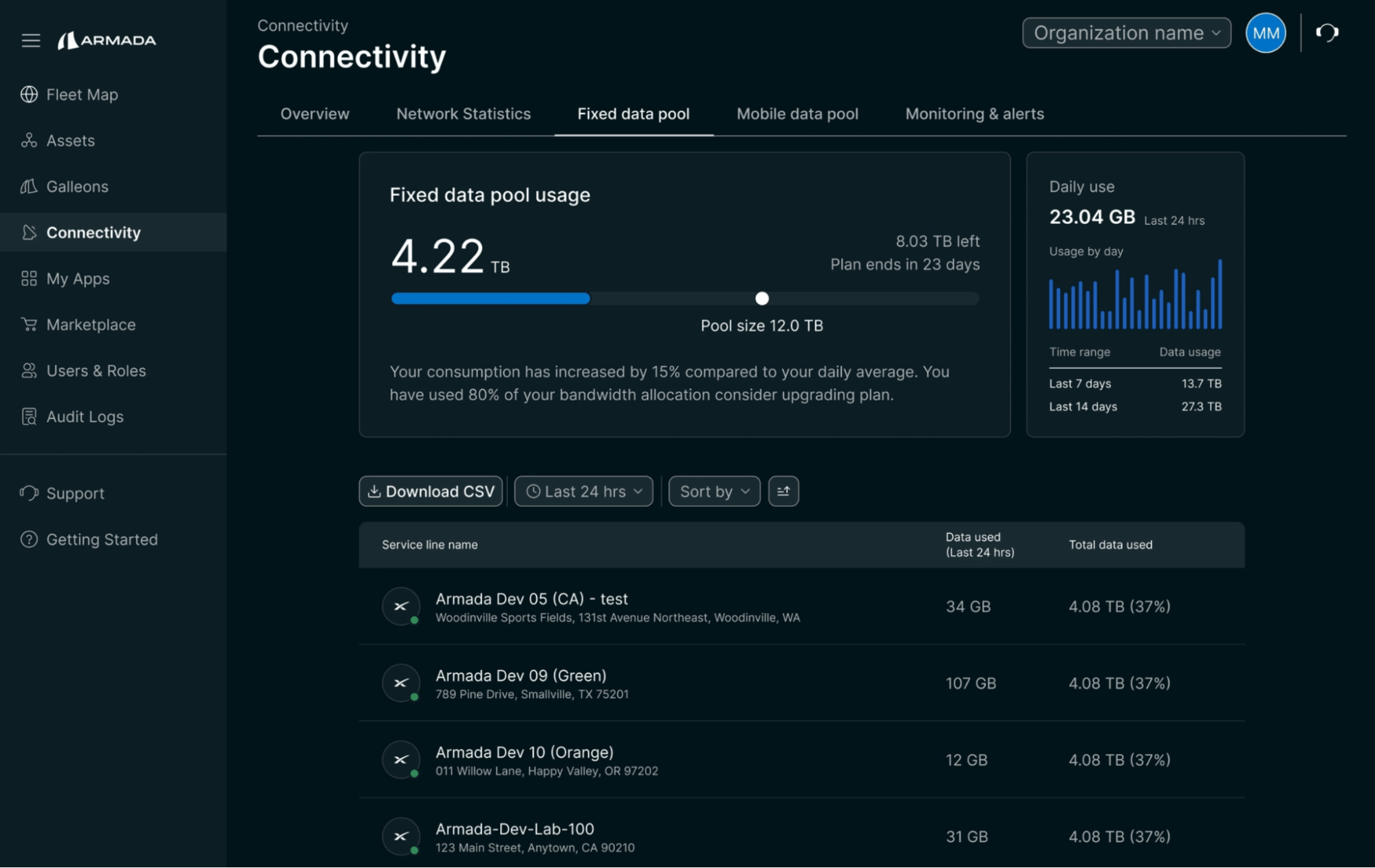
Armada describes Atlas as “an operational insights platform for all your connected assets.” It’s an operational insights platform designed to give organizations a unified view of all their connected assets from a single dashboard. It lets users seamlessly monitor and manage Starlink terminals, SDWAN, drones, cameras, and sensors from a “single pane of glass”. The platform is particularly well-suited for enterprises operating in remote or challenging environments that rely on edge connectivity and IoT infrastructure.
Atlas serves as an enterprise Starlink management platform, offering a unified management console to control all terminals from one dashboard, real-time monitoring and alerts to track performance and status across an entire network, and asset integration to seamlessly incorporate drones, sensors, and other network devices alongside Starlink terminals. It's also built to scale from a single location to thousands of global deployments.
Beyond connectivity management, Atlas includes specialized modules for more advanced use cases. For example, there’s a dedicated "Drones" module that enables comprehensive monitoring of drone activity, telemetry data viewing, and centralized media management. This includes flight paths, playback of captured footage, and tracking drones at their last known locations. The platform also has enterprise-grade security features like SSO, role-based access control, and detailed audit logs for compliance purposes.
Galleon
Source: Armada
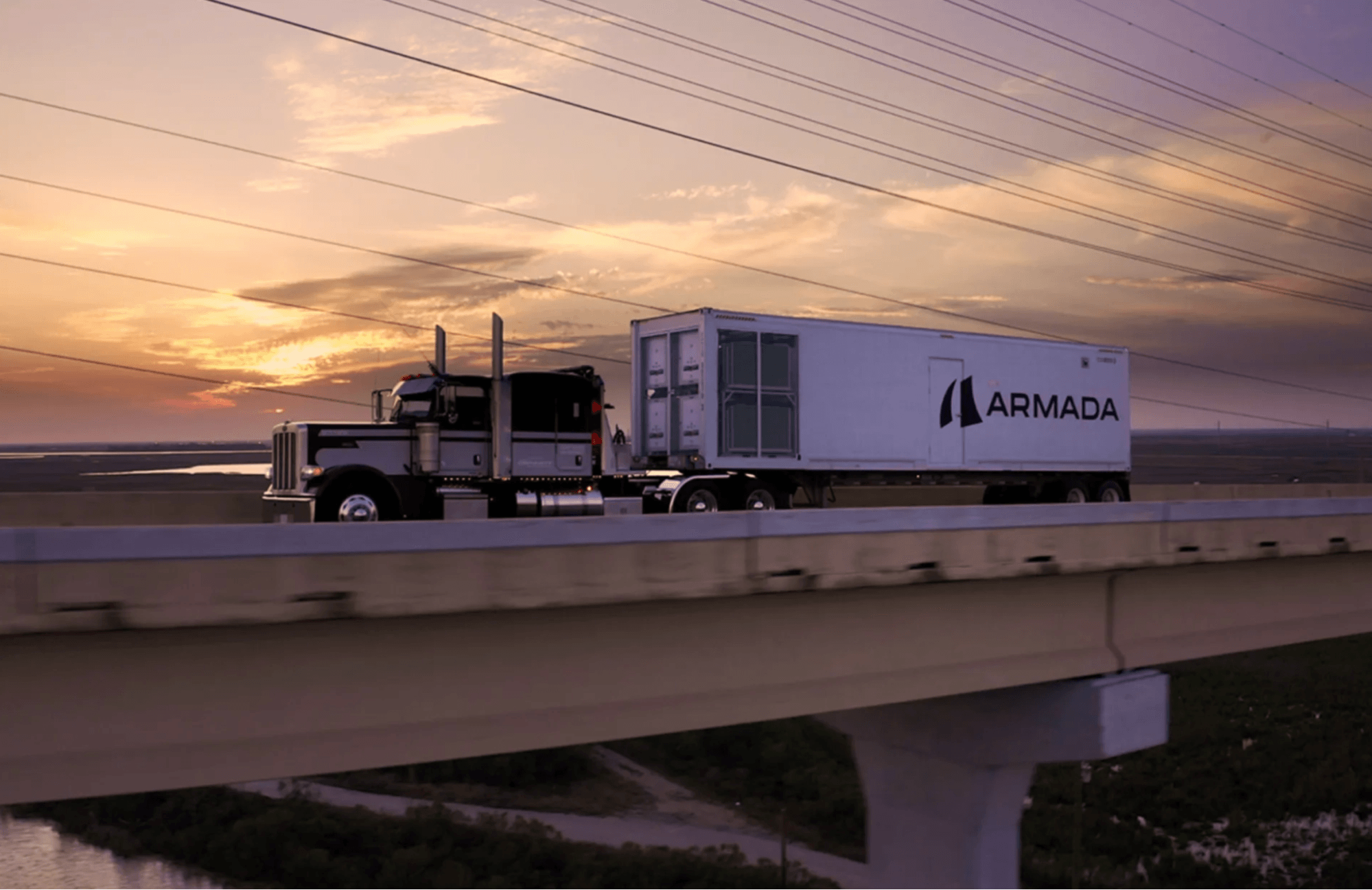
Galleon is a ruggedized, modular, containerized data center designed to bring powerful edge computing to the most remote and challenging environments, such as an offshore oil rig, a defense mission, or a remote mining site. It comes preloaded with compute, networking, storage, heating, and cooling, and can be configured with CPUs, GPUs, and XPUs to meet the demands of a specific application. Armada says that it can be deployed in days.
A core value proposition of Galleon is running AI workloads closer to where data is generated, reducing latency and bandwidth costs by processing data locally and only sending mission-critical information back to the cloud via Starlink. This allows organizations to maximize the value of existing sensors and get real-time insights without relying on traditional cloud infrastructure.
Galleon is managed through the Armada Edge Platform, which provides centralized monitoring and control across multiple deployments, built-in Starlink connectivity management, and rapid AI application deployment from a single interface. It comes in four configurations: Beacon (suitcase-sized), Cruiser (20-foot), Triton (40-foot), and Leviathan (megawatt-scale liquid cooled).
Leviathan
Leviathan was launched in July 2025 with the goal of “advancing US leadership in energy and AI by enabling distributed AI training and inference in contested and communication-challenged areas.” According to CEO Dan Wright:
“American energy and AI dominance hinges on one thing: moving massive compute to the edge fast where data and low-cost power live… Leviathan, the newest member of our Galleon product line, does exactly that. Each unit delivers megawatt-scale performance in a fraction of the time and much more flexibly than traditional data centers, due to their ability to rapidly adapt to changes in AI chips and cooling, and co-locate with all available land and energy, regardless of its form or location. This latest product launch and funding further accelerate our mission to bridge the digital divide and ensure that the world runs on the American AI stack.”
Marketplace
Source: Armada
Armada's Marketplace is an integral part of the company’s ecosystem, offering a curated selection of certified connectivity and IoT assets. It's a hub for discovering, purchasing, and deploying AI applications, industrial software, and connected hardware for Galleons and edge infrastructure. Users can browse a curated catalog and deploy any workload to a Galleon with a single click, with everything orchestrated, monitored, and secured by the Armada Edge Platform. This marketplace enhances the overall functionality of Armada's solutions and allows customers to access next-generation AI applications tailored for edge deployment
The catalog is organized into three categories. First, Armada's own first-party AI applications called OpsAI, which are purpose-built for real-world industrial environments and leverage existing infrastructure like cameras and sensors for safety monitoring, anomaly detection, and predictive maintenance. Second, partner apps from trusted third-party vendors like Aveva, Halliburton, and Avathon, covering use cases from SCADA and well engineering to hyperspectral analysis. Third, users can bring their own existing containerized applications, import them into Marketplace, and deploy them to any Galleon without any rewriting required.
Marketplace also covers hardware, allowing users to purchase and provision connected assets within the same interface. All devices ship pre-registered to the Armada Edge Platform for zero-touch onboarding, so the entire edge stack can be managed in one place.
Bridge
Source: Armada
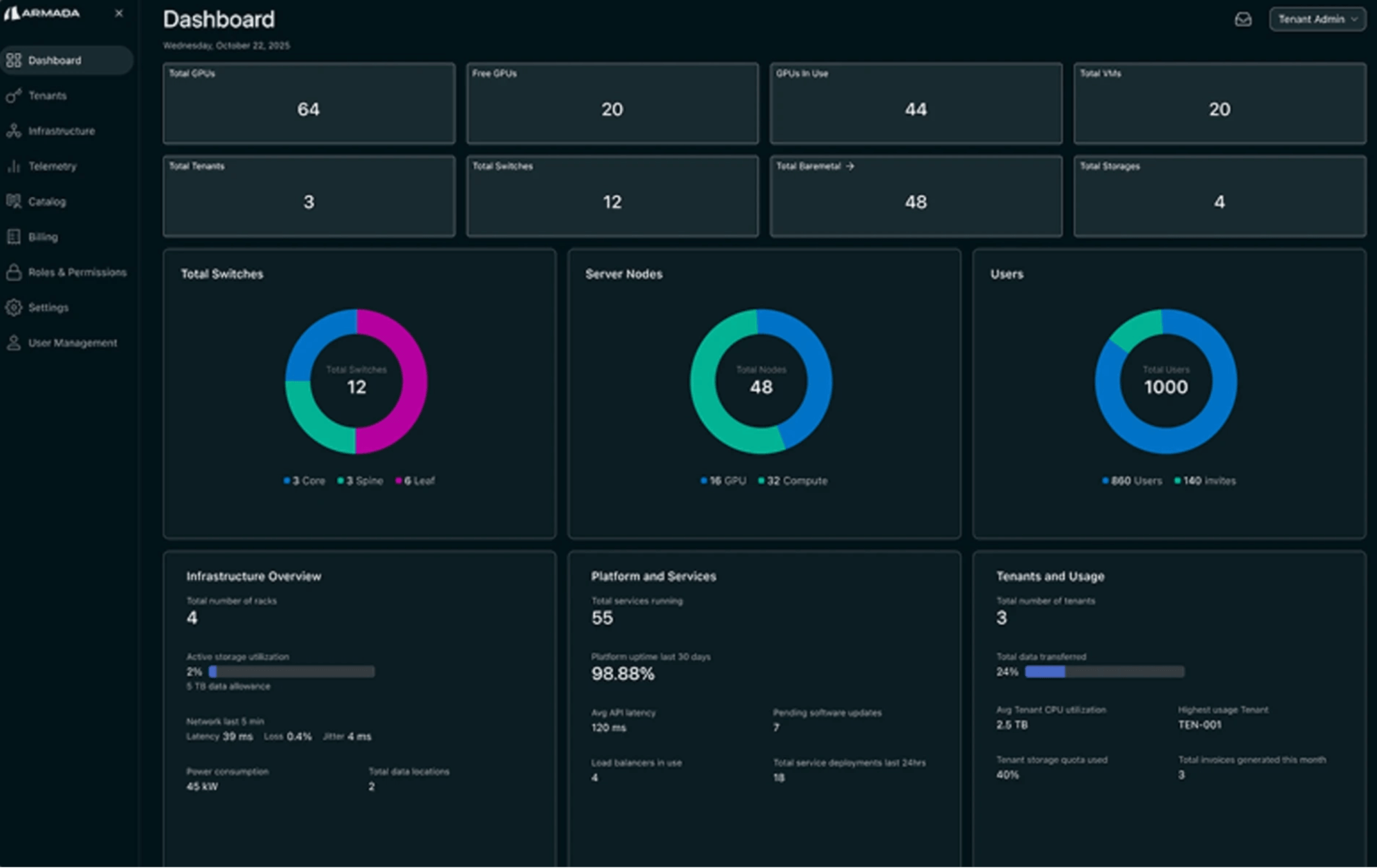
Bridge is software that turns GPU clusters into AI factories, enabling operators to manage, scale, and monetize GPUs across datacenter, cloud, and edge deployments. It unifies GPU orchestration, scaling, and management so AI workloads can run anywhere with cloud-like efficiency and control, supporting elastic resource allocation, multi-tenant security, and GPU monetization from a single interface.
Bridge runs directly on users’ infrastructure, enabling fully data-sovereign AI cloud services that meet regional compliance and security requirements, including air-gapped deployments. It supports three primary use cases: AI Factory (orchestrating large-scale workloads on your own infrastructure), GPU-as-a-Service (turning any GPU cluster into a secure, self-service cloud), and Platform-as-a-Service (running and managing AI models via APIs, dashboards, and automation).
Bridge is built on NVIDIA-certified architecture and integrates with NVIDIA NCP, Spectrum-X, Quantum-2, and Base Command Manager. It can be deployed either as a turnkey solution paired with Armada's Galleon hardware or on an operator's existing GPU infrastructure, making it suitable for a range of customers, including data centers, telecoms, universities, and land and power operators looking to monetize underutilized compute capacity.
OpsAI
Source: Armada
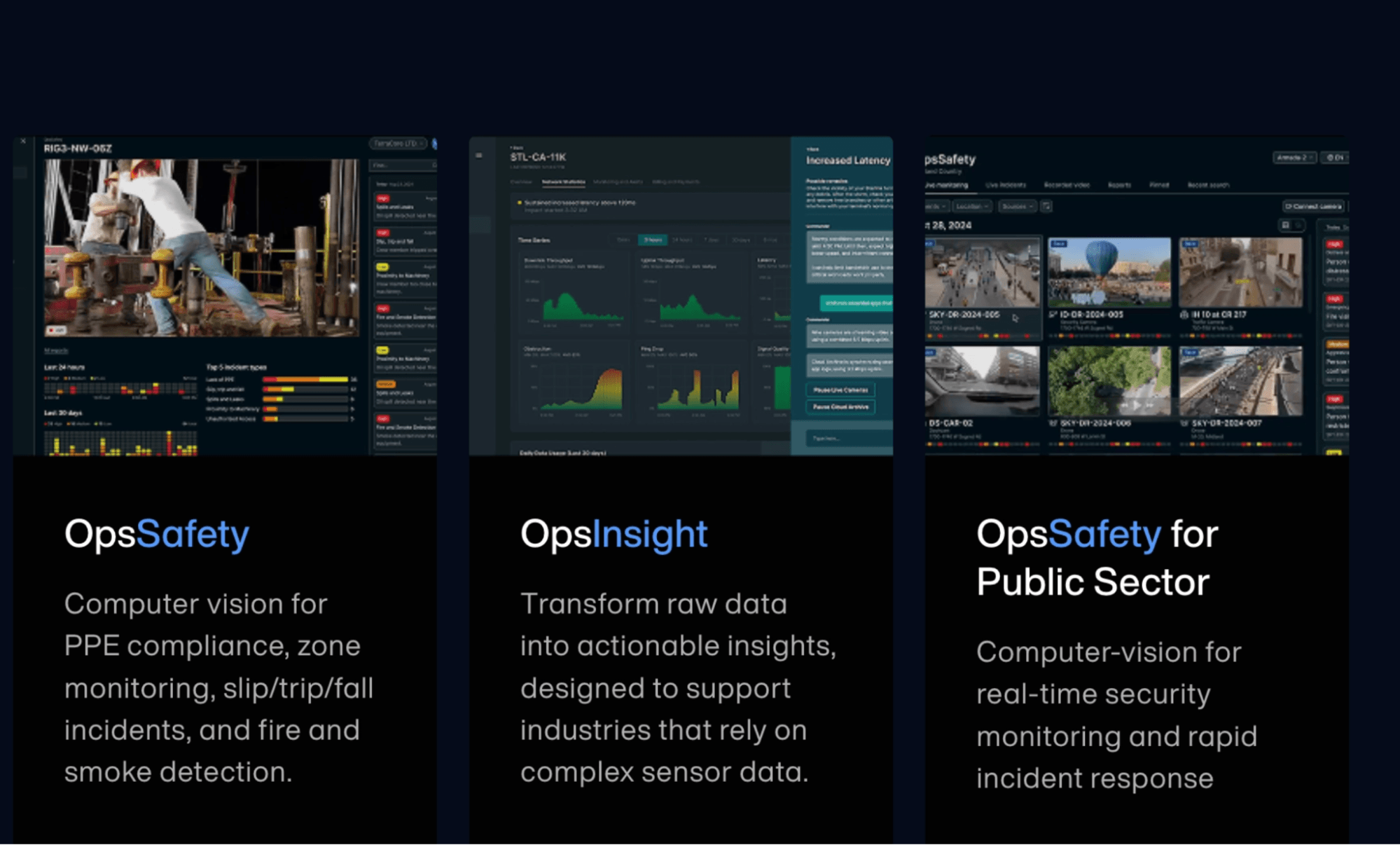
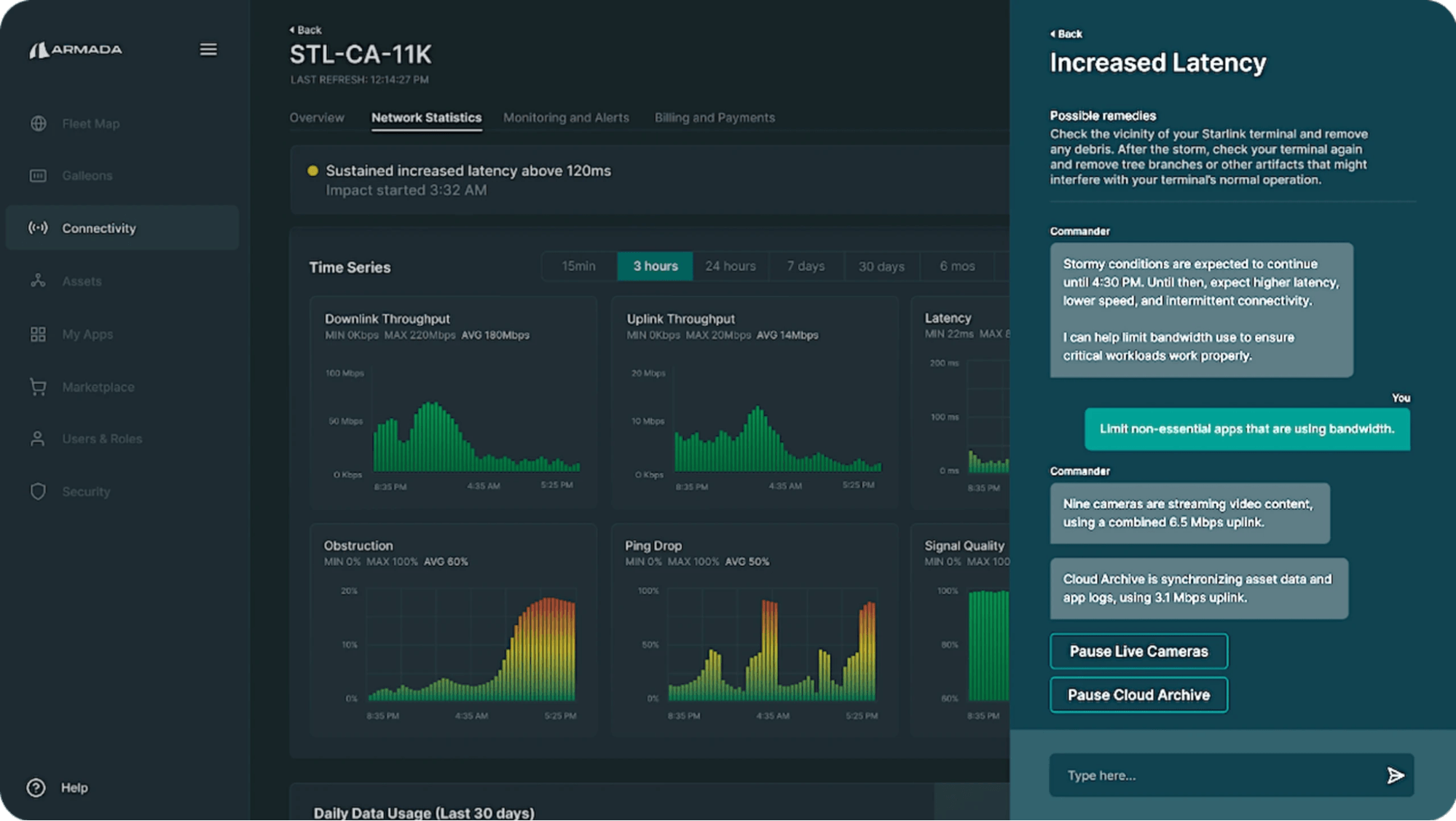
Armada's OpsAI is a portfolio of real-world AI applications purpose-built for mission-critical intelligence at the edge. It transforms sensor and camera data into actionable insights across three core solutions: OpsInsight, which aggregates unstructured data streams to surface patterns and support real-time decision-making for use cases like process control and predictive maintenance; OpsSafety for Commercial, a computer vision tool that monitors PPE compliance, zone activity, and fire and smoke detection across challenging conditions; and OpsSafety for the public sector, a device-agnostic situational awareness application for real-time incident monitoring, people and asset tracking, and rapid response.
Designed for flexibility, OpsAI supports diverse AI models, integrates with existing camera and sensor infrastructure, and deploys across cloud, on-prem, and hybrid environments, with built-in security and enterprise-grade scalability to meet the demands of the most demanding operational settings.
Market
Customer
Armada’s core customers are enterprises and government organizations that operate in remote, high-risk, and infrastructure-limited environments, where traditional cloud computing and connectivity solutions fall short. Its customer base, at the time of its $131 million round raised in July 2025, included “energy companies, mining operations, manufacturers, logistics providers”, along with the Department of Defense. These industries require real-time data processing, AI-driven automation, and resilient connectivity. This makes Armada’s integrated edge computing and Starlink-powered platform an enabler of their operations. According to Dan Wright, “We focus on customers that we know will eventually have thousands of what we call connected assets.”
Oil and gas companies operate some of the world’s most remote and high-risk industrial sites, from deep-sea drilling platforms to isolated land-based fields. These operations require continuous real-time monitoring and AI-powered automation to maintain safety and efficiency. According to a 2023 survey, 92% of oil and gas companies worldwide were investing in AI to enhance exploration, drilling, and production processes while improving safety and environmental compliance. However, these operations are highly dependent on connectivity, and traditional cloud solutions are impractical due to latency, bandwidth constraints, and infrastructure limitations.
Governments and defense organizations increasingly rely on resilient, AI-driven computing for national security, disaster response, and border protection. Digital transformation in the public sector has accelerated, with the COVID-19 pandemic increasing the urgency for advanced government IT infrastructure. Defense agencies need localized, secure, and real-time AI computing for battlefield reconnaissance, military logistics, and cyber defense, often in environments where cloud-based solutions are infeasible due to security risks and network latency. For example, during the 2025 LA wildfires, Armada's platform supported real-time coordination and situational awareness to assist in the efforts.
Manufacturing plants and supply chain operators generate massive amounts of real-time IoT data that must be processed instantly to ensure quality control, predictive maintenance, and automation. The rise of Industry 4.0 and smart manufacturing has accelerated the demand for edge computing solutions, as traditional cloud-based processing is often too slow and unreliable for mission-critical automation. AI-powered computer vision systems are now a fundamental part of automated assembly lines, warehouse robotics, and logistics.
The mining industry operates in extreme environments, from underground operations to open-pit mines in remote regions. Mining firms face ongoing challenges with safety hazards, environmental monitoring, and equipment failures. As the industry accelerates its digital transformation, AI-driven automation is becoming increasingly critical for optimizing extraction processes, improving yield, and reducing downtime through predictive maintenance. Traditional IT infrastructure struggles to support low-latency computing in remote mining locations, making edge computing and resilient connectivity essential for operations.
Telecom providers are under increasing pressure to expand high-speed internet coverage into rural and underserved areas, while also rolling out 5G and next-generation networking infrastructure. Many telecom providers are now adopting edge computing to reduce network congestion, optimize bandwidth usage, and enable real-time AI analytics for network performance management. Additionally, 5G networks require local edge computing nodes to handle increased data loads, reduce latency, and support IoT devices, creating a strong demand for decentralized computing solutions.
Market Size
The edge computing market is expected to grow from $60 billion in 2024 to $110.6 billion by 2029, representing a 13% CAGR. The market size for Armada's solutions encompasses several key components, including hardware, software, and services.
The hardware segment includes Armada's Galleon mobile data centers and other edge computing devices. The software component features Armada's Atlas, its Edge platform, and other edge computing management solutions. Additionally, the services sector covers connectivity, AI applications, and support services.
Armada's market size is poised to grow substantially as edge computing becomes increasingly critical for businesses worldwide. Several factors are driving this growth, including the proliferation of IoT devices, the rollout of 5G networks, and the increasing demand for real-time data processing and AI applications. Furthermore, the need for reduced latency and improved security in data processing further accelerates the adoption of edge computing solutions.
The potential customer base for Armada is substantial, considering the increasing adoption of IoT devices and the need for edge computing solutions across various sectors. In 2025, 75% of enterprise data originated at the edge, and there was 15.4% growth in edge computing investments, driven by the increasing integration of AI applications across industries
Competition
Competitive Landscape
The market in which Armada operates is relatively fragmented, with companies focusing on different aspects of edge computing, from hardware infrastructure to software solutions and AI applications. The edge computing market spans cloud services, specialized edge computing firms, and telecommunications providers.
Cloud giants like Microsoft Azure, Amazon Web Services (AWS), and Google Cloud are expanding their capabilities to the edge, allowing enterprises to integrate edge workloads with their broader cloud ecosystems. Specialized edge computing companies such as Akamai Technologies and NVIDIA focus on content delivery, hardware acceleration, and AI-powered computing at the edge. Additionally, telecommunications companies like AT&T and Verizon are leveraging their network infrastructure to enhance edge computing services, integrating 5G technology for improved connectivity and performance.
Despite a number of overlaps with several edge computing and infrastructure service providers, there are very few companies that compete directly with Armada in ruggedized edge computing infrastructure. Most adjacent competitors either offer components of an edge service or assume some kind of existing connectivity, versus being fully at the edge.
Competitors
WEKA: Founded in 2013, WEKA provides a high-performance, software-defined data platform designed for AI and machine learning workloads. In May 2024, the company raised a $140 million in Series E funding led by Valor Equity Partners, bringing its total funding to $415.1 million, with notable investors including Qualcomm Ventures, NVIDIA, and Micron. While WEKA specializes in optimizing storage for AI-driven environments, its focus remains on high-performance computing infrastructure rather than end-to-end edge deployment. On the other hand, Armada offers a complete edge computing ecosystem.
Akamai Technologies: Founded in 1998, Akamai offers a global platform for secure and optimized digital experiences, focusing primarily on content delivery and cybersecurity. The company is publicly traded and, as of March 2026, had a market capitalization of $14.4 billion. Akamai’s edge solutions are primarily focused on web and cloud-based applications, with a strong emphasis on cybersecurity and CDN services. Armada differentiates itself by offering physical, on-premise edge computing infrastructure.
Vapor IO: Founded in 2014, Vapor IO specializes in edge co-location and networking infrastructure, primarily focusing on deploying small, fixed data centers in urban areas. The company raised a $90 million in Series C funding in January 2020, led by Berkshire Partners. This remains its total publicly disclosed funding as of March 2026. Vapor IO is effective for latency-sensitive applications in metro regions but does not address the needs of industries requiring mobile, ruggedized edge infrastructure.
EdgeConneX: Founded in 2009, EdgeConneX builds and operates data centers at the edge of the network, serving both edge and hyperscale computing needs. The company was acquired by EQT Infrastructure in 2020 for an undisclosed amount. EdgeConneX’s approach is largely stationary and focused on serving established network hubs. Armada differentiates itself by offering flexible, mobile, and rapidly deployable edge solutions that function independently of traditional data center locations.
Business Model
Armada operates under a hybrid hardware-software platform-as-a-service business model, though the company has not publicly disclosed its revenue. Armada likely generates revenue through multiple streams, including product sales, subscription services, connectivity resale, professional services, and software licensing.
The company's product sales primarily come from its Galleon mobile data centers — ruggedized, portable data centers designed for deployment in remote environments. These units come in four form factors (Beacon, Cruiser, Triton, and Leviathan), ranging from a suitcase-sized unit to a megawatt-scale liquid-cooled system. Armada's Commander Edge package, which includes the Galleon data center, was reported to start at $450K per year in July 2024. Subscription services are another key revenue driver, with businesses subscribing to Armada's Edge Platform (AEP) and Atlas for ongoing connectivity management and operational monitoring.
All Armada products are available on the Microsoft Azure Marketplace as of March 2026, with Azure customers able to apply pre-committed Azure spend toward Armada's offerings. The company also provides professional services, including installation and deployment of Galleon data centers and Starlink terminals, as well as customization and integration services to align with enterprise IT infrastructure needs.
Traction
Partnership
As of March 2026, Armada's technology was operational in over 100 countries. It serves industries such as oil and gas, mining, telecommunications, hospitality, and government sectors. It has also announced several important strategic partnerships with both government and commercial partners in recent years.
Armada’s partnership with Microsoft, which began with Microsoft’s $40 million investment in Armada in July 2024, allows Azure customers to extend capabilities to remote locations using Armada’s infrastructure and is an important part of Armada’s go-to-market strategy. As Dan Wright put it:
“They [Azure customers] don’t have to rebuild everything to run on Linux or CUDA… They can assume they’ll have access to the same Azure stack at the edge. That’s the power we’re delivering.”
In February 2025, Armada signed a cooperative research and development agreement with the US Navy and delivered a Galleon mobile edge data center to support advanced network management, command and control, and edge computing solutions for the US Naval Forces Southern Command. Commenting on the partnership, CEO Dan Wright stated:
“With Armada, we believe the Navy will gain a decisive edge in developing technology solutions that directly enhance warfighter readiness… Our mission is to fortify U.S. national security by delivering resilient computing and communications platforms that excel in the most challenging and unpredictable operational environments.”
In the same month, Armada deployed its Galleon Edge data centers in Saudi Arabia, in collaboration with Aramco Digital and Microsoft. These deployments aim to integrate AI-driven safety solutions for Aramco's construction sites and energy facilities, utilizing Azure's cloud infrastructure within Armada's Galleon modules.
In December 2025, Armada signed a Memorandum of Understanding (MOU) to become an official collaborator on the US Department of Energy's Genesis Mission, a federal initiative aimed at connecting the nation's National Laboratories, supercomputers, and federal datasets into a unified, AI-enabled research platform, described by DOE leadership as the most significant program since the Manhattan Project.
Under the MOU, Armada and DOE will explore partnership agreements to advance three national imperatives: accelerating discovery science, securing American energy dominance, and strengthening national security. Armada plans to support the initiative using its Galleon modular data centers and Edge Platform, which can deploy megawatts of GPU-dense, sovereign compute to laboratory sites in months rather than the multi-year timelines of traditional data center builds, joining fellow collaborators including NVIDIA, OpenAI, and Microsoft.
In February 2026, Armada and European AI infrastructure company Nscale signed a letter of intent to jointly deliver full-stack AI infrastructure, combining Nscale's large-scale sovereign cloud data centers with Armada's rapidly deployable Galleon modular data centers and Edge Platform for public sector and enterprise customers globally. The partnership enables a hub-and-spoke model where Nscale provides foundational compute capacity at scale while Armada extends sovereign AI capabilities to new geographies at the edge, allowing organizations to deploy secure, compliant AI infrastructure in locations where it previously didn't exist.
Armada was listed among a16z’s American Dynamism 50 in 2025, which was a list of “50 tech companies uniquely positioned to prevent [a future conflict with China] and fortify the US.” According to its website, Armada had tens of thousands of connected assets and thousands of active users as of March 2025. Notable partners of the company included Microsoft, Starlink, OpenAI, and NVIDIA.
Source: Armada
Other collaborations include Halliburton's Landmark for advancing edge computing in the oil and gas sector, Edarat Group for deploying modular data centers across the Middle East and North Africa, and Skydio for integrating advanced drone technologies.
Valuation
In July 2025, Armada raised $131 million in funding at an undisclosed valuation, with notable investors in the round including Founders Fund, Lux Capital, and Microsoft’s venture fund. The round brought the company’s total funding to $239 million, including a $40 million funding round in July 2024, a $55 million Series A in December 2023, and a $13 million seed round in February 2023. Other notable investors in the company include Contrary*, Felicis, Valor Equity Partners, and 8VC.
Key Opportunities
Expanding TAM in Edge Computing
The global edge computing market is projected to reach $232 billion by 2024, fueled by the increasing adoption of AI applications, the need for low-latency processing, and the rise of distributed computing architectures. Industries are moving toward real-time, decentralized data processing, as cloud computing alone cannot support the speed, security, and cost efficiency required for AI-powered automation in industrial applications. Additionally, the ongoing expansion of IoT devices further amplifies the need for edge computing solutions that can process data locally, minimize latency, and optimize bandwidth usage.
Armada is positioned to capture market share in this rapidly growing industry by offering a fully integrated edge computing ecosystem that combines hardware, AI software, and Starlink-powered connectivity. As demand surges in sectors like energy, defense, and telecommunications, Armada’s modular, scalable solutions provide enterprises with the flexibility to process, store, and analyze data at the edge.
Industry-Specific Applications in Oil & Gas
The oil and gas industry, in particular, is undergoing a digital transformation, with companies investing heavily in AI-driven analytics, automation, and predictive maintenance to enhance efficiency, safety, and sustainability. 92% of oil and gas companies worldwide are investing in AI or planning to do so within the next five years, underscoring the growing need for real-time data processing in remote drilling sites and offshore operations.
Armada is already capitalizing on this trend through strategic partnerships with major industry players. Through its collaboration with Halliburton's Landmark division, Armada is helping integrate real-time edge computing capabilities into oilfield operations, allowing companies to process seismic data, monitor drilling equipment, and optimize production workflows without reliance on high-latency cloud computing. Success in this case could lead to further adoption by an industry in flux.
AI-Driven Innovation at the Edge
As industries increasingly deploy AI-driven automation, the need for low-latency, AI-enabled edge computing infrastructure continues to grow. Generative AI, real-time computer vision, and multimodal AI models are being adopted across sectors like defense, public safety, manufacturing, and logistics to improve efficiency, security, and decision-making. However, current cloud-based AI solutions introduce significant latency, connectivity challenges, and security risks, all of which Armada is uniquely positioned to solve.
With AI workloads expected to account for more than 74% of all data center traffic by 2030, the ability to run AI models at the edge, closer to data sources, will be essential for enterprises seeking to maximize performance and cost efficiency. By embedding AI-powered automation into its edge computing infrastructure, Armada is capturing a growing market and creating new monetization opportunities through AI-driven software offerings.
Strategic Partnerships
Armada’s ability to expand its market footprint and integrate with enterprise IT ecosystems is being accelerated by strategic partnerships with leading technology and industrial companies. For example, the company’s prior $40 million funding round, led by Microsoft’s venture fund (M12), signals a strong push toward enterprise adoption by integrating Armada’s platform with Microsoft’s Azure Marketplace. This partnership allows Armada to tap into Microsoft’s vast enterprise customer base, providing enterprises with seamless access to its edge computing and AI solutions.
Beyond Microsoft, Armada has also secured partnerships with industry partners like Halliburton, the Department of Energy, and Skydio, further embedding its solutions into critical infrastructure, energy, and industrial automation markets. These collaborations validate Armada’s technical and commercial viability and provide a built-in distribution network to scale adoption across global enterprises, government agencies, and industrial operators.
Key Risks
Technological Dependency on Starlink
Armada’s connectivity solutions rely heavily on SpaceX’s Starlink satellite network to deliver low-latency, high-speed internet access in remote environments. While this integration is a core differentiator of Armada’s offering, it also represents a single point of failure. Any disruptions, pricing changes, or strategic shifts by SpaceX could significantly impact Armada’s service reliability and cost structure.
Starlink is still scaling its infrastructure and has experienced outages in the past, which could affect Armada’s ability to provide continuous, mission-critical connectivity to its customers. Additionally, if SpaceX were to increase enterprise pricing or impose stricter data-usage policies, Armada could face margin compression or service limitations. Lastly, as satellite connectivity expands globally, geopolitical and regulatory challenges could limit Starlink’s availability in certain markets, restricting Armada’s ability to operate in key regions.
Operational Challenges in Hardware Deployment
Armada operates a hardware-dependent business model that requires manufacturing, deploying, and maintaining ruggedized edge data centers (Galleon units) in remote environments. Scaling this aspect of the business presents significant operational and financial risks. Sourcing high-performance computing components, ruggedized materials, and networking hardware can be subject to global supply chain disruptions, cost fluctuations, and geopolitical instability. Moreover, deploying large, specialized hardware units to remote locations (e.g., offshore oil rigs, military outposts, mines) introduces complex shipping, installation, and maintenance issues, leading to delays and cost overruns. Unlike SaaS companies that can scale instantly, Armada’s hardware growth is limited by manufacturing capacity and deployment speed, which could bottleneck expansion if demand surges too quickly.
Summary
Armada's edge computing solutions are positioned to capitalize on the adoption of AI and advanced data processing in remote and challenging environments. The company has gained traction across various industries, with its technology deployed in over 60 countries as of February 2025. From 2022 to 2024, Armada focused on developing its core technologies and building partnerships. In 2024, the company began to emphasize enterprise market penetration, making its products available on the Microsoft Azure Marketplace and securing strategic partnerships with industry leaders such as Halliburton. Armada is positioned to continue expanding its product offerings, potentially focusing on developing new AI applications for edge environments, accelerating its commercialization efforts, and addressing the challenges of bridging the digital divide in underserved regions.
* Contrary is an investor in Armada through one or more affiliates.