
Thesis
Software development has historically been shaped by efforts to reduce coordination costs and reliance on specialization. Early integrated development environments (IDEs) like Turbo Pascal (1983) consolidated editing, compiling, and debugging into a unified interface. As collaboration became a higher priority, tools such as Git (2005), GitHub (2008), and Docker (2013) addressed version control and deployment. By 2015, Visual Studio Code (VS Code), a free, cross-platform editor, introduced a lightweight, customizable IDE that allowed developers to install only the features they needed through extensions. In 2024, over 74% of developers used VS Code, with 50 million active users, reflecting the continued demand for tools that balance flexibility with reduced overhead.
Advances in generative AI have also changed the way that software is being developed. While GitHub Copilot (2021) provided AI-generated inline suggestions that helped developers complete tasks 55% faster on average as of May 2024, it lacked broader project-wide context and the ability to coordinate changes across files until late 2024. As of December 2025, tools like Claude Code (launched May 2025) and Cognition’s Devin 2.0 (launched April 2025) could perform high-context tasks such as implementing features, updating schemas, and modifying code across multiple files. As implementation becomes easier, developers can focus more on problem definition, integration, and high-level decisions. This mirrors historical automation shifts, like in manufacturing and agriculture, where humans moved to higher-level strategy as machines handled routine work.
As of February 2025, the AI code tools market was valued at $4.9 billion in 2024 and was expected to exceed $30 billion by 2032, growing at a CAGR of 27.1% from 2024 to 2032. This growth reflects the increasing demand for automation, which has enabled non-specialists, smaller teams, and freelance coders to become more productive in code generation.
Anysphere is building infrastructure for the shift to AI-powered coding and implementation. Its product, Cursor, is a code editor designed to integrate AI across the entire development workflow. Built on a fork of VS Code, it combines repo-wide code understanding, multi-file editing agents, and native terminal access in a single interface. As of December 2025, it had over 1 million daily active users, powered 50K businesses, and achieved 9,900% year-over-year ARR growth. Cursor’s adoption reflects a broader reorientation in software development, away from manual execution and toward AI-enabled, intent-driven workflows.
Founding Story
Anysphere was founded in 2022 by four MIT classmates, Michael Truell, Sualeh Asif, Arvid Lunnemark, and Aman Sanger, who met while studying computer science and mathematics. They collaborated on research and projects at MIT and participated in programs like Neo Scholars, a mentorship network for technical undergraduates.
Truell, who became CEO, interned at Google, Two Sigma, and Octant. He was a USA Computing Olympiad finalist and built a programming game at age 14. Asif, who became CPO, grew up in Pakistan, represented his country at the International Mathematical Olympiad, and interned at IBM working on neural machine translation. Lunnemark won medals at the International Olympiad in Informatics and held roles at Stripe, Jane Street, and QuantCo. Sanger had experience in medical AI and enterprise ML, with roles at Google, Bridgewater Associates, and You.com. He also ran an AI consultancy and was named to Forbes 30 Under 30 in 2025.
The founders originally set out to build AI tools for mechanical engineering, focusing on autocomplete for CAD software. However, they quickly realized the market was stagnant, uncompetitive, and outside their direct expertise. Additionally, data limitations and a lack of accessible training material made developing robust models challenging. By mid-2022, they pivoted to software development after identifying the limitations of GitHub Copilot as a plugin, as it had improved only incrementally over time.
Cursor was conceived as a platform that the founders themselves would want to use, which turned out to be a tool that could provide meaningful AI assistance throughout the coding workflow, not just in isolated moments. They recognized that even without breakthroughs, AI capabilities would continue to improve through scaling models and training data. They saw an opportunity to build a full IDE with AI integrated throughout the coding workflow and raised a $400K pre-seed round in April 2022 to start development.
Instead of building a new IDE from scratch, they forked Visual Studio Code. This allowed them to offer a familiar interface while embedding AI deeply into the development process. Anysphere graduated from OpenAI’s accelerator program in 2023 and launched Cursor in March 2023.
Product
Cursor is Anysphere’s flagship product and was launched in March 2023. Cursor is an IDE that was designed to improve developer productivity by integrating AI features into the coding environment. These AI features include the ability to execute high-level tasks end-to-end autonomously and access intelligent code suggestions. As of December 2025, it was available on macOS, Windows, and Linux.
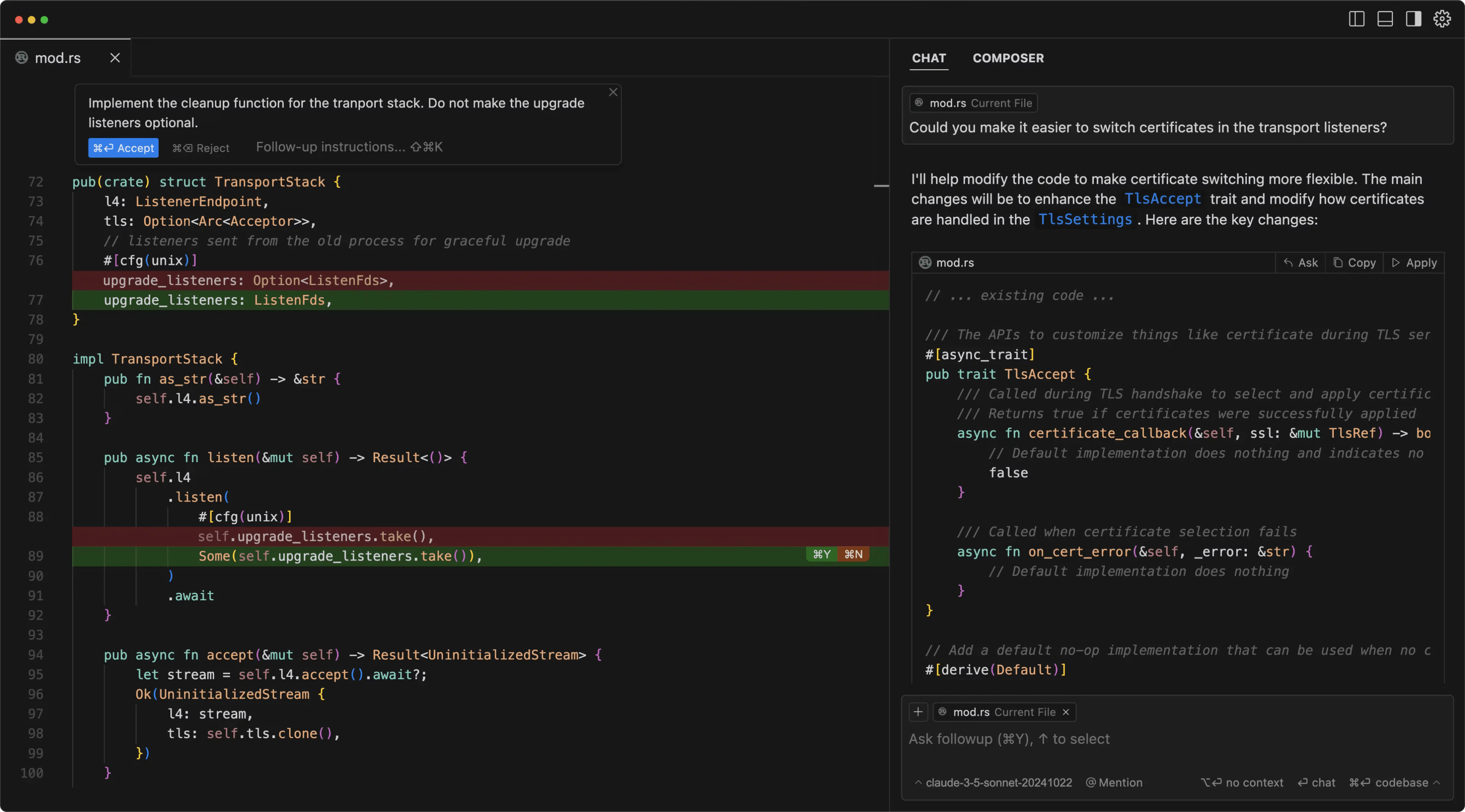
Cursor builds on top of Microsoft’s Visual Studio Code architecture for familiarity through its three-panel layout and an easy onboarding process for existing users. The software supports adding plugins or tools for tailored workflows and includes integration with Git, terminals, and other developer tools. On first launch, Cursor offers automatic migration of users’ VS Code settings and extensions to preserve all custom configurations. The onboarding workflow includes model selection, which defaults to OpenAI’s GPT-4 Turbo, and privacy preferences.
Cursor provides options to enable SOC 2-certified cloud sync for settings or maintain full local storage. For security purposes, all AI actions that would modify the codebase or execute terminal commands require explicit user approval before execution.
Source: Cursor
Architecture
Cursor’s architecture is based on VS Code. By forking VS Code, Cursor inherits its Electron-based desktop structure (wherein it is structured like a web app but runs as a desktop application), the Monaco editor (the same editor used in VS Code), and the extension API, allowing it to support a wide range of programming languages and developer tools. However, while it looks and functions similarly to VS Code on the surface, Cursor is designed as an AI-first development environment, with native support for autonomous coding agents.
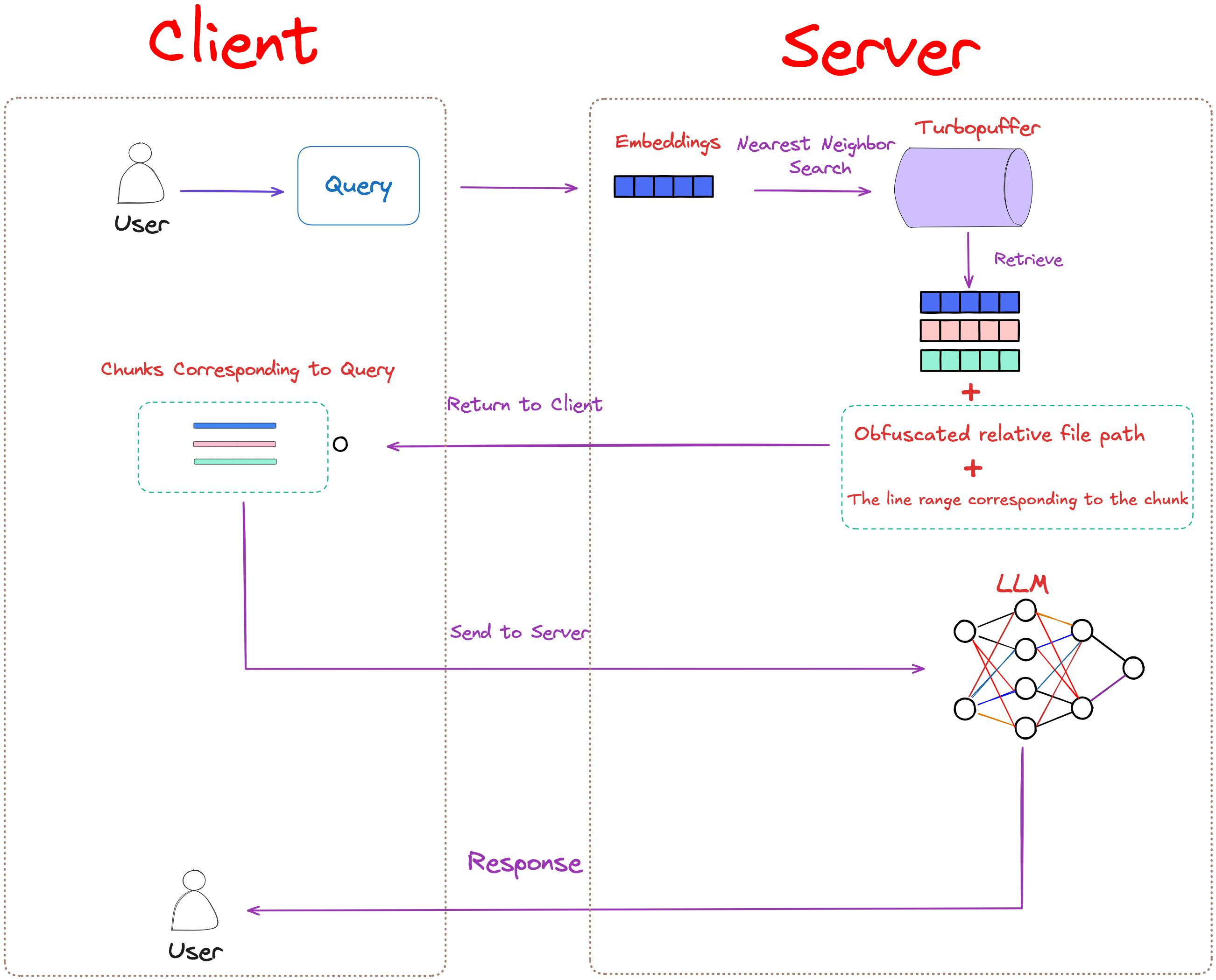
Cursor’s key architectural addition to VS Code is its Retrieval-Augmented Generation (RAG) system, which allows its AI to navigate and work across large codebases. RAG works by generating a Merkle tree, a data structure made up of hashes, that tracks changes to files. Rather than re-uploading the entire codebase during each interaction, Cursor only uploads files that have changed, minimizing latency and bandwidth use.
Once code files are uploaded, they’re broken into smaller segments and converted into vector embeddings. These embeddings are stored in a vector database, enabling fast retrieval. When a developer makes a request, Cursor embeds the query, runs a nearest-neighbor search to find the most relevant chunks of code, and passes those to the AI model to generate accurate and context-aware code suggestions.
The system caches through AWS to accelerate re-indexing and supports incremental updates, which helps the tool stay responsive even as the codebase evolves. To maintain stability and ensure access to the latest features and bug fixes, Cursor regularly rebases its code on the newest versions of Visual Studio Code.
Source: AI Exploration Journey
Agent Mode
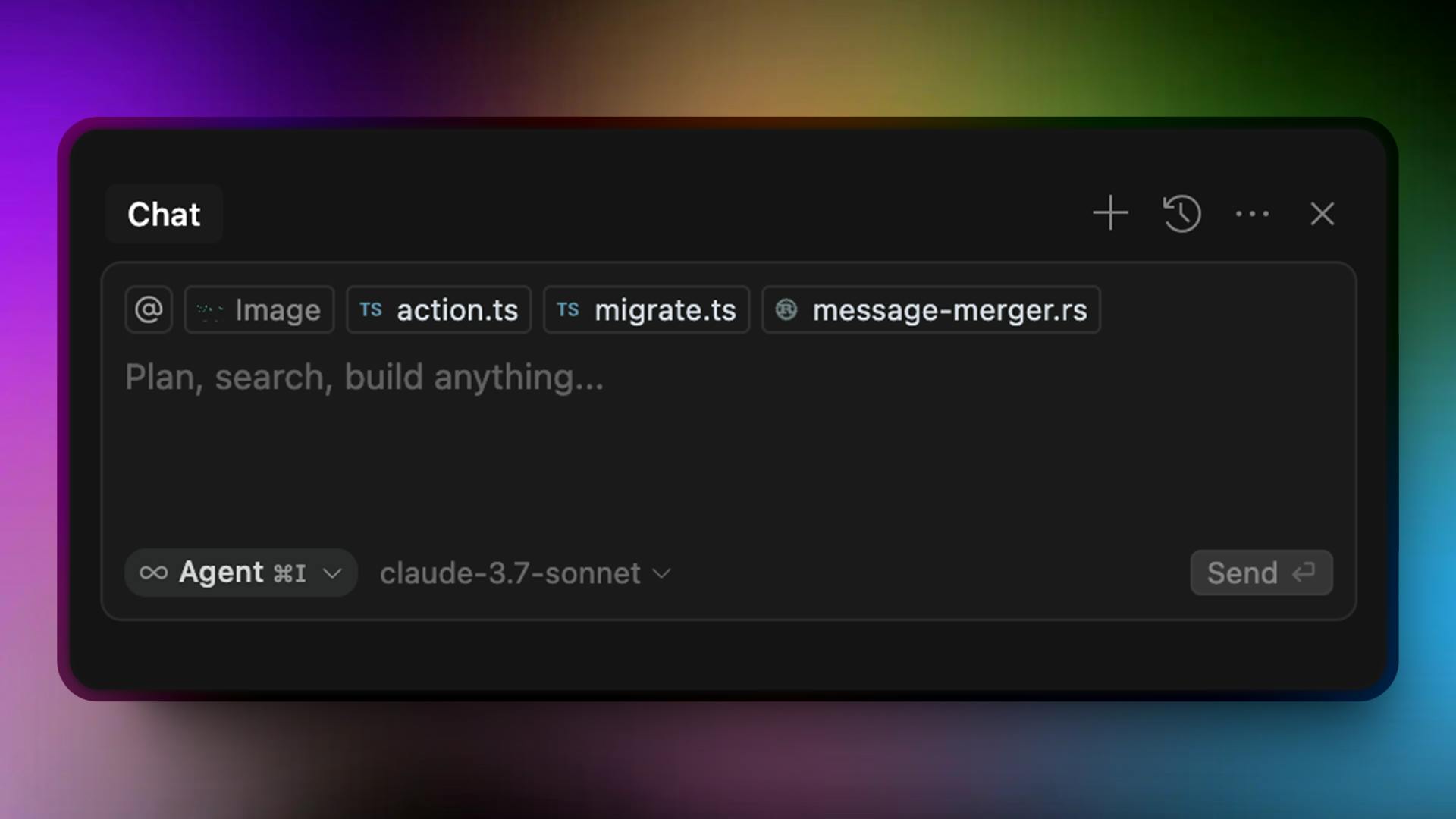
Agent Mode is an autonomous AI development assistant built to help engineers carry out complex coding tasks across large codebases. Unlike traditional code completion tools that work line by line, Agent Mode is designed to operate at a higher level, making multi-line and even multi-file changes with minimal user intervention. For example, if a developer asks it to “add a menu bar to my website,” the system will interpret the request, search relevant files, plan out the necessary changes, and edit the code accordingly.
Agent Mode follows a structured workflow to complete tasks. It begins by analyzing the user’s request in the context of the codebase, identifying relevant components, and consulting documentation or external sources if needed. It then breaks the task into smaller steps, modifies the code as required, and verifies the results. Agent Mode can automatically create to-do lists to complete more complex tasks by looking at the relationship between each sub-task. The agent will then update the work monitor in real-time and mark the tasks that are done. This also includes detecting and resolving errors (like linting issues, which are formatting or style problems flagged by static code analyzers) before presenting a final summary of its changes. The system creates checkpoints before making any modifications, allowing developers to roll back if needed. These checkpoints are stored locally, track the changes the agent makes, and it cleans up on its own.
To apply the changes generated by Agent Mode, a specialized Cursor model called Apply takes the code suggestions and integrates them into a user’s file. While Agent Mode autonomously generates the code changes, Apply handles safe merges of those changes across multiple files and large codebases. After Apply processes these changes, developers can review the proposed modifications through a diff-based interface, enabling the user to accept or reject specific edits before finalizing the edits.

Source: Cursor
To support this level of autonomy, Agent Mode is equipped with a suite of integrated tools. These include code search and documentation capabilities, web browsing, file editing, and terminal access for tasks like installing packages or building code. Cursor uses custom retrieval models to provide the AI with relevant context from the codebase, reducing the need for users to manually select files or explain dependencies. Still, developers can steer Agent Mode by tagging relevant files or toggling access to tools.
To handle the complexity of long conversations and large codebases, Cursor employs context management strategies. As chats grow beyond the model’s window, Cursor automatically summarizes earlier messages to keep key information while making room for new ones. When in a file or folder format, Cursor condenses them to fit the content within the model’s limit.
Configuration options allow users to select the underlying language model, set shortcuts, enable auto-run and auto-fix settings, and manage tool access. These settings give developers control over how much autonomy to grant the assistant, balancing trust in the system with the ability to supervise and intervene when needed.
Agent Mode also includes several general features to support development workflows. These include the ability to export or duplicate sessions, browse conversation history, and use custom commands. Commands allow users to reuse workflows. Agent Mode is also equipped with a set of tools for codebase search, file reading, web search, fuzzy file matching, and semantic search utilities, as well as editing and runtime execution. These tools enable the agent to read, modify (or delete, if allowed), and run code, including executing terminal commands or interacting with external services through configured MCP services.
In December 2025, Cursor released Multi-Agent judging, which allows an internal judge to select the optimal outputs from multiple agents working on tasks in parallel.
Source: Cursor
Tab
The Tab feature moves code development forward by providing developers with intelligent code suggestions as they write. Users can accept suggestions incrementally using the Tab key, essentially allowing them to sift through a set of proposed edits. The system anticipates cursor positioning based on editing patterns, linter errors, and past completions, applying related changes across multiple codebase locations for repetitive modifications like updating import statements or refactoring variable names. Additionally, the Tab feature can highlight potential issues as developers code, including type inconsistencies, unreachable code, and logical errors.
In January 2025, Cursor released Fusion, an upgraded Tab model that improved difficult edit prediction accuracy by over 25% and enabled suggestions over 10 times longer than the original March 2024 version. These gains were driven by better training data, larger context windows, improvements to the model architecture, and inference optimizations that reduced latency. As of January 2025, it generated over a billion edited characters per day, with a ~100x increase in request volume.
Inline Edit
The Ctrl+K (or Cmd+K on Mac) shortcut allows users to write and edit code inline using AI-generated suggestions inserted directly into the file view. Users can also press Alt+Enter (or Option+Return on Mac) to ask questions based on the selected code. For changes to the whole file, users can use Ctrl+Shift+Enter (Cmd+Shift+Return on Mac). Ctrl+L will then permit users to send the selected code to Chat to make multi-file changes, detailed explanations, and advanced capabilities. Unlike Agent Mode, which handles broader, multi-step tasks, this feature is optimized for targeted, context-aware edits. The same shortcut is available in the terminal, where users can input natural language descriptions of desired actions, and Cursor will generate the corresponding shell commands.

Source: Cursor
Codebase Chat
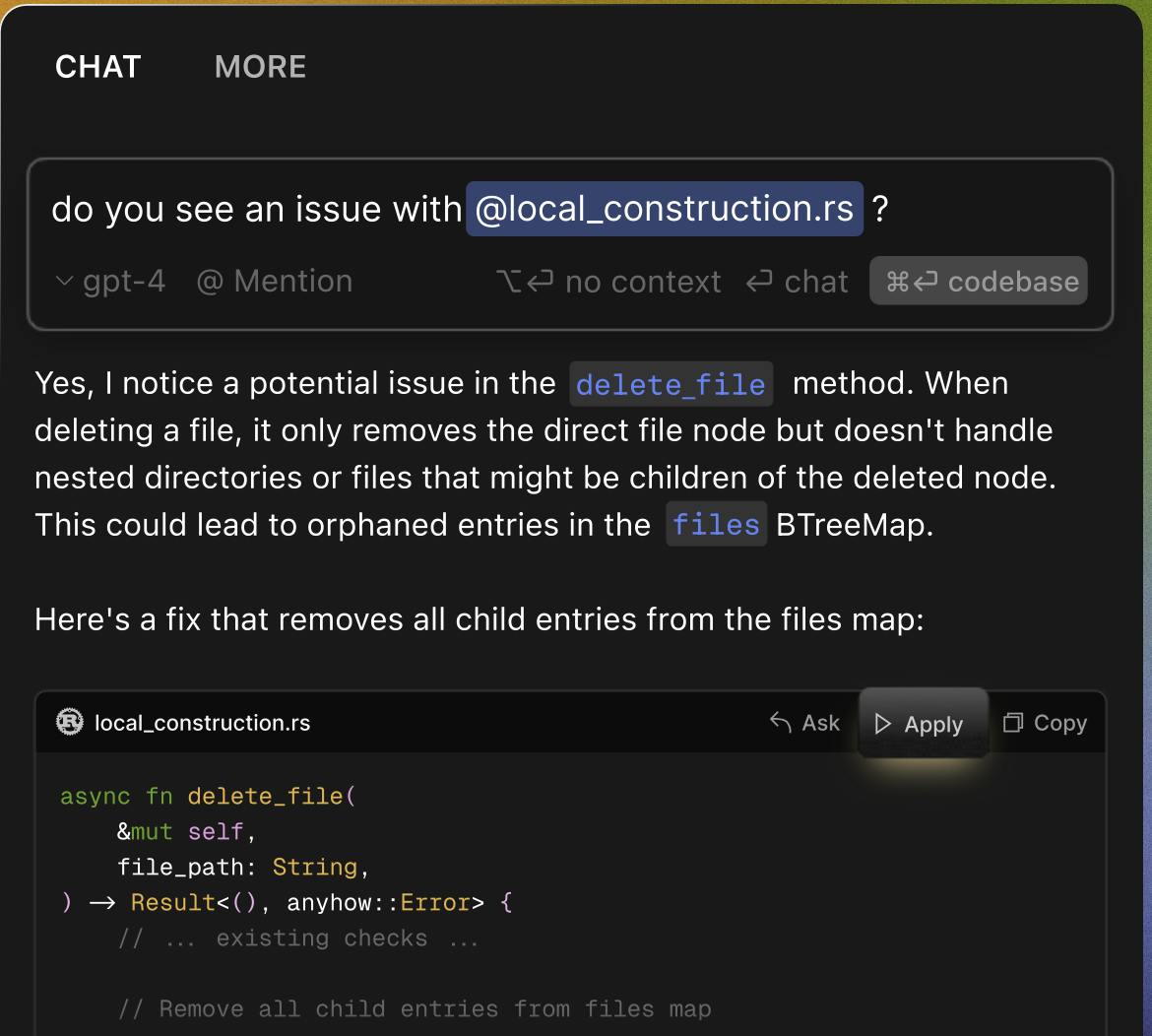
Codebase Chat allows users to query their codebase in natural language through a read-only feature called "Ask," which returns relevant information without modifying the code. Users can reference specific files or symbols using the @ symbol, which triggers a search through the codebase to locate and return matching content. To apply any suggested code, users can click the play button above a chat-generated code block to insert it directly into the file.
The chat interface accepts additional context inputs. Users can include visual context by uploading images or clicking the image icon. The @Web command initiates a search of external sources, such as online documentation, and incorporates current information into the response. Users can also reference external libraries using @LibraryName or upload new documentation through @Docs.
Source: Cursor
Bugbot
Bugbot integrates with GitHub to review pull requests (PRs), identifying bugs, security concerns, and code quality issues. Reviews run automatically on each PR update or can be triggered manually with a comment, leaving inline explanations and suggested fixes.
During its beta period, Bugbot identified a number of issues across PRs, scaling from roughly 60K issues on June 15th, 2025, to nearly 500K by July 13th, 2025. Across over 1 million PRs, this early usage demonstrates Bugbot’s ability to detect a significant volume of bugs, security issues, and quality problems.
Bugbot adapts to the project structure through the use of .cursor/BUGBOT.md files, which provide rules for different parts of the codebase. A root rules file is always included, while additional files are applied depending on the affected directories. Configuration options allow teams and individuals to control review frequency, limit execution to when explicitly mentioned, or enable/disable Bugbot per repository. A dedicated dashboard provides analytics and visibility into review activity.
Setup requires Cursor admin and GitHub organization admin access. Once the GitHub app is installed and repositories are enabled from the Cursor dashboard, Bugbot is ready to run.

Source: Cursor
Command-Line Interface
As Cursor has grown beyond the IDE, the team has extended its agent capabilities to the command line through Cursor CLI, a beta product that brings AI-powered coding assistance directly to developers’ terminals. The CLI allows users to write, review, and modify code through conversational interaction, while also supporting non-interactive print mode for automation workflows like CI pipelines and scripting.
Users can launch interactive sessions to describe goals, review proposed changes, and approve edits, or run prompts with flags for specific tasks, such as security scans. The system allows users to resume from previous conversations across multiple interactions and integrates MCP so that the same tools and servers configured for Cusor IDE can extend into the CLI.
The CLI agent also mirrors the rules system of the IDE, automatically applying guidance files to shape agent behavior across different projects. Users can select files and folders for context, compress history, and iterate efficiently while retaining control over the agent’s scope.
To support automation, non-interactive mode allows integration into scripts and pipelines, with structured outputs or plain text responses. For direct system operations, Shell Mode enables safe, short command execution by requiring approval, permission checks, and output review, making it effective for tasks like builds, file operations, or environment inspection.

Source: Cursor
Commit Message Generation
Cursor can generate descriptive commit messages by analyzing staged code changes and referencing the repository’s Git history. The feature supports custom rules and formatting to align with project-specific conventions.
Shadow Workspace
Cursor supports the creation of isolated development environments using hidden windows and kernel-level folder proxies. This setup prevents the AI from making direct changes to the main codebase, making it suitable for testing major refactors or experimental features without affecting the stability of the primary development environment.
Proprietary Models
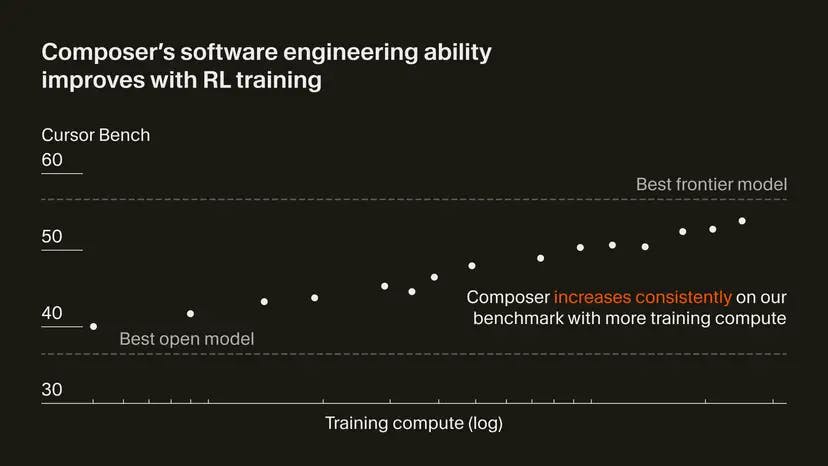
Cursor’s primary proprietary model is Composer, a model it released in October 2025 with performance the company claimed was measured between the best open-source coding assistant models and state-of-the-art models.
Source: Cursor
Custom API Keys
Cursor supports the use of custom API keys, allowing developers to integrate their preferred AI models within the development environment. For enterprise use cases, the platform includes configuration options such as proxy support and custom endpoints to align with organizational security and compliance requirements.
Model Router
The “Auto-select” feature dynamically chooses the most appropriate model based on the task. For example, for operations that require low latency, such as inline completions and syntax fixes, the system would most likely prioritize highly responsive models. More complex tasks involving multi-step reasoning or analysis are more likely to be routed to larger, more capable models. As of September 2025, Cursor provided access to 33 models, including GPT-5, Grok-4, Gemini 2.5 Pro, DeepSeek V3.1, and Claude 4 Sonnet 1M.
Legacy Plugins
As of June 2024, Cursor continued to support its Supermaven plugins for development environments, including VS Code, JetBrains, and Neovim, but these are considered legacy products and are no longer the focus of active development.
Visual Editor
In December 2025, Cursor released Visual Editor, an interface that allows developers to use drag-and-drop tools to manipulate underlying code for designing web components (including options for editing font sizes, element opacity, spacing, and other properties).
Market
Customer
Cursor’s user base has historically consisted mainly of individual developers and small engineering teams, including freelancers and those at early-stage startups. These users may prioritize speed and flexibility over enterprise-level features like security or compliance integrations. Unlike larger teams that may already be committed to GitHub Copilot through Microsoft’s enterprise bundling, Cursor users may have a tendency to seek tools that offer a familiar UI and support for a large and customizable selection of language models.
However, that profile is quickly evolving. As of June 2025, half of the Fortune 500 are among its customers, along with some of the top startups, including Rippling, Brex, Ramp, Stripe, and many others. In side-by-side evaluations, 95% of engineering teams choose Cursor. For example, early adopters included engineers at Near AI who adopted Cursor to reduce time spent searching for coding answers online and a software product designer who used Cursor to produce most of the code for an iOS charging-screen app.
As of February 2025, Anysphere was building an enterprise sales team, indicating interest in expanding its target customer base to include enterprises. In February 2025, between 4K and 5K companies reportedly reached out to request enterprise access to Cursor. Later, in July 2025, Cursor acquired the talent from Koala to further develop its enterprise team.
Market Size
The global software developer tools industry was valued at $6.6 billion globally in 2024 and was expected to grow to $22.6 billion by 2033 with a CAGR of 14.5% from 2024 to 2033. Cursor operates more specifically within the AI-enabled software development market. As of May 2025, this market was valued at $341 million in 2023 and was expected to grow at a 35.3% CAGR to $2.8 billion by 2030. By 2027, 80% of enterprise software engineering efforts are expected to use AI coding assistants in some form, as of October 2024.
Key growth drivers for the AI-enabled software development market include the organizational and individual demand for developer productivity, growing software and codebase complexity requiring increased tooling, and widespread LLM adoption to automate repetitive development tasks. These converging factors are likely to create favorable conditions for AI-native development tools.
Competition
Cursor faces competition primarily from AI code editors and plugins, and specialized coding agents. Direct competition comes from AI code editors, including incumbents such as Microsoft’s GitHub Copilot and smaller entrants like Windsurf and Poolside.
As of January 2025, Cursor was reported to be preferred by solo developers for its codebase comprehension and responsive workflows. However, incumbents like Microsoft and OpenAI retain clear distribution advantages through existing user bases and integration with widely adopted development tools.
AI Code Editors & Plugins
GitHub Copilot: GitHub launched its technical preview of GitHub Copilot in June 2021, with all developers being able to access it in June 2022. Copilot is an AI coding assistant developed by GitHub and OpenAI that suggests and automates new lines of code inside supported IDEs. The platform had over 20 million users and served 90% of the Fortune 500 as of July 2025. As of 2024, it had 50K enterprise customers, including Accenture, Goldman Sachs, Etsy, and Dell. In February 2025, GitHub introduced agentic capabilities to Copilot under the proposal Project Padawan. In this mode, Copilot takes a step forward in the AI space with its ability to update its own code, detect errors, and fix them automatically.
Owned by Microsoft (acquired GitHub for $7.5 billion in 2018), Copilot has been integrated into the Microsoft developer ecosystem. It's available as a plugin in Visual Studio Code, the world’s most-used IDE with approximately 14 million monthly active users. In July 2025, Microsoft reported a 75% increase in Copilot Enterprise customers quarter over quarter, with Copilot (in 2024) being a larger business than all of GitHub at the time of its acquisition in 2018.
As of May 2024, developers widely adopted GitHub Copilot: 81% installed it on day one, with 43% rated it “extremely easy to use” and 51% calling it “extremely useful.” Copilot was credited with boosting productivity, code quality, and developer confidence. As of December 2025, GitHub Copilot operates as a freemium model, which includes Free ($0 per user per month), Pro, ($10 per month or $100 per year), Pro+ ($39 per month or $390 per year), Business ($19 per user per month), and Enterprise ($39 per user per month).
Claude Code: Launched in February 2025 by Anthropic, Claude Code is a developer tool built on the Claude Opus 4 language model. It features a 200K-token context window and is designed for deep codebase understanding and generation. Claude Code uses agentic search to analyze entire projects without manual context selection and can make coordinated changes across multiple files. It integrates with existing development workflows, including test suites and build systems, and supports terminal-based use as well as IDEs like VS Code and JetBrains. The tool is configurable and does not alter files without explicit approval.
Claude operates as a freemium model as of December 2025. The company’s individual plans are: Free ($0 per user per month), Pro ($17 per month if paid annually or $20 per month), and Max ($100 per user per month). Its Team plan has a Standard seat ($25 per user per month if paid annually or $30 per month, with a minimum of five members) and Premium ($150 per person per month, with a minimum of five members). Its Enterprise plan will vary and requires contacting the sales team for an estimate.
As of December 2025, Anthropic is valued at $183 billion after raising $13 billion in a Series F round co-led by Iconiq Capital, Fidelity Management & Research Company, and Lightspeed Venture Partners. This marks an increase from its $61.5 billion Series E valuation in March 2025, when it raised $3.5 billion from investors such as Lightspeed Venture Partners, General Catalyst, D1 Capital Partners, Bessemer Venture Partners, Menlo Ventures, and others.
Windsurf: Founded in 2021 by Stanford and MIT alumni, Windsurf (formerly Codeium) initially focused on GPU virtualization and compiler software before pivoting to AI-powered developer tools. It launched as a cross-IDE autocomplete extension compatible with editors like VS Code, JetBrains, and Eclipse, differentiating itself through low-latency completions and a freemium pricing model.
In late 2024, Windsurf introduced its own AI-native IDE, built to support agentic workflows. By early 2025, its products had been used by over 1 million developers, with its extensions reaching more than 800K users. As of December 2025, Windsurf’s pricing model has four tiers: Free ($0 per user per month), Pro ($15 per user per month), Teams ($30 per user per month), and Enterprise (bespoke pricing by case).
In July 2025, Windsurf reported that senior leaders, Varun Mohan and Douglas Chen, along with members of the research and development team, were joining Google’s DeepMind. The reverse acquihire was a part of a $2.4 billion deal, in which Google will have access to Windsurf’s technology under non-exclusive terms. However, the rest of the team will be joining Cognition, the creators of Devin, an AI coding agent. The acquisition has provided Cognition with Windsurf’s IP, product, trademark and brand, and its employees. At the time of the acquisition, Windsurf had $82 million of ARR, doubling quarter-over-quarter, and a user base of over 4K enterprise customers. This was down from its ARR of $100 million in April 2025, after Anthropic cut direct access to its Claude AI models due to rumors that OpenAI might acquire the company. Prior to the acquisition, the company was valued at $1.3 billion after raising a $150 million Series C round led by General Catalyst and included participation from Kleiner Perkins and Greenoaks.
Google Gemini Code Assist: Google launched Gemini Code Assist in October 2024, entering the AI coding assistant market with a tool built on its Gemini models. The product integrates with major IDEs and offers features like code completion, contextual documentation, bug detection, and security scanning. It primarily targets enterprise developers within the Google Cloud ecosystem.
In July 2025, Google released Agent Mode, which serves as an AI pair programmer, and made enhancements to the IDE for Gemini Code Assist. These enhancements include more control over context, allowing users to focus the chat on specific code snippets, and they can now attach terminal output to the chat directly.
Despite Google's resources and AI infrastructure, Gemini Code Assist entered the market later than alternatives like GitHub Copilot, which launched in 2021. Unlike tools such as Cursor, it lacks deep codebase understanding and agentic workflows, functioning more as a conventional autocomplete tool with cloud integration.
Google’s AI has two plans as of December 2025: Pro ($19.99 per month) or Ultra ($249.99 per month). Google breaks this down even further for developers and has 20 different versions, from Gemini 1.5 Pro to Imagen 4 to Gemini 3 Pro, either improving on the previous model or having a different purpose. The API pricing of these models depends on whether tokens, images, or videos are used and can range drastically depending on whether it's the input price, context caching, or live API, among others.
Gemini 3 Pro, considered Google’s best model for coding, has a Standard tier input pricing at $2.00 per 1 million tokens for prompts under 200k tokens and $4.00 per 1 million tokens for prompts over 200k tokens. Its output pricing is $12.00 per 1 million tokens for prompts under 200k tokens and $18.00 per 1 million tokens for prompts over 200k tokens. When grounding with Google Search, it is free for up to 5K requests, after which it is $14 for every additional 1,000 search requests.
The Batch Pricing model differs slightly for bulk usage. Its input price is $1.00 per 1 million tokens for prompts under 200k tokens and $2.00 per 1 million tokens for prompts over 200k tokens. Its output pricing is $6.00 per 1 million tokens for prompts under 200k tokens and $9.00 per 1 million tokens for prompts over 200k tokens.
Amazon Q Developer: Amazon Q Developer, AWS’s AI coding assistant, was launched in April 2024. It provides inline code suggestions in 21 programming languages and 4 Infrastructure as Code (IaC) languages, vulnerability scanning, automated documentation, and chat-based support within common IDEs. A notable feature is its agentic workflow, where agents can autonomously implement features, run tests, review code, and handle tasks like legacy code transformation and platform migration.
The tool is integrated with AWS services and connects to platforms like GitHub, GitLab, Microsoft Teams, and Slack. Amazon has reported high acceptance rates for its suggestions, including a 50% acceptance rate by National Australia Bank.
As of December 2025, its pricing tier is broken into different tiers for individuals and enterprises. The two options for individual developers are: Free ($0 per month), Pro ($19 per month). Businesses have the option of Business Lite ($3 per user per month) and Business Pro ($20 per user per month).
Poolside: Poolside was founded in July 2023 by Jason Warner (former CTO of GitHub who incubated Copilot) and Eiso Kant (Athenian founder). The company raised $626 million in total funding as of December 2025, including a $500 million Series B in October 2024 that valued the company at $3 billion before it publicly launched its first product.
The company focused on enterprise deployments, allowing customers to retain full control over code and data while fine-tuning models on internal codebases. As of October 2024, Poolside operated a 10K-GPU training cluster and reported working with Global 2000 firms and government agencies, though customer details remained undisclosed. Its product suite includes two proprietary models: Malibu for reasoning and chat, and Point for real-time code completion, both trained on synthetic and open-source data.
Replit*: Founded in 2016 by Amjad Masad, Replit evolved from a browser-based coding platform into an AI-powered development environment. As of December 2025, the company had raised $472 million. Replit raised a $250 million Series C round with a valuation of $3 billion in September 2025 from investors such as Prysm Capital, Amex Ventures, a16z, Craft Ventures, and Paul Graham. In June 2025, the company surpassed $100 million ARR, up from $10 million ARR at the end of 2024. In September 2025, the company announced it had hit $150 million ARR. As of December 2025, Replit had over 40 million users across developers, educators, and non-technical creators. The product was also used by over 500K businesses as of July 2025. Growth accelerated following the launch of its Ghostwriter AI assistant in October 2022.
In September 2024, Replit released Replit Agent, an AI tool designed to generate applications from natural language prompts. By February 2025, it had released version 2. Agent v2 introduced a real-time app design preview that renders live interfaces as the agent builds the app or website. The platform also includes infrastructure support such as built-in authentication, pre-configured databases, and secure third-party integrations.
As of December 2025, Replit has four tiers: Starter ($0 per user per month), Core ($25 per user per month or $20 if billed annually), Teams ($40 per user per month or $35 if billed annually), and Enterprise (custom pricing).
Tabnine: Founded in 2013 as Codota and rebranded in 2017, Tabnine was an early entrant in the AI coding assistant market. The company focused on privacy-first deployment, allowing customers to run models locally and fine-tune completions on internal codebases. As of December 2025, Tabnine supports over 600 programming languages, libraries, and frameworks through its LLM, with integration into major IDEs. Customers with private installations can also connect and fine-tune their own models for enhanced customization. It monetized through seat-based licensing aimed at individuals and enterprises, particularly those with strict data privacy requirements.
Despite being considered second in market share for AI coding assistants, behind Microsoft Copilot as of January 2025, Tabnine's model quality was often viewed as lagging behind leading alternatives such as OpenAI’s. As of December 2025, Tabnine provided access to 13 models, including Claude 4 Sonnet, GPT-4.1, and Gemini Pro, and had raised $57.1 million across rounds in 2020, 2022, and 2023, backed by investors including Headline and Khosla Ventures. As of December 2025, Tabnine offers access to its agentic coding assistant for $59 per month.
Zed: Zed was founded in 2021 by the creators of Atom, Electron, and Tree-sitter as a performance-focused code editor built in Rust. It used multi-core CPU and GPU acceleration to support low-latency editing and real-time collaboration. Zed has grown to have 1.1K contributors, over 150K total developers, and 9% of Rust developers as of August 2025.
In May 2025, Zed introduced Agentic Editing, which deploys agents to make AI-powered edits. Agent-generated edits are treated as editable text, which users can review and modify. Zed maintained an open-source model and supported both user-supplied API keys and local models. As of December 2025, the product offered a free tier, a Pro plan at $10 per month, and an Enterprise option priced for individual customers. Beyond AI, Zed offered multiplayer coding, integration with Jupyter runtimes, and a built-in terminal paired with a language-aware task runner.
In September 2025, the company raised a $32 million Series B round led by Sequoia Capital, with participation from existing investors. This brings its total funding to over $47 million as of December 2025. The company also announced DeltaDB, an open-source sync engine that uses Conflict-Free Replicated Data Types (CRDTs) to keep track of every change being made as it happens. This further improves its emphasis on real-time collaboration between humans and AI agents.
Specialized Coding Agents
Devin: Cognition, founded in 2022, developed Devin as an AI software engineer designed to complete full software development projects autonomously. Cognition launched Devin in March 2024 and launched Devin 2.0, an upgraded version, in April 2025. Devin demonstrated capabilities including end-to-end software development, autonomous problem-solving, debugging and testing, and research and implementation of technical solutions. As of December 2025, Devin is priced at $20 per month for Core users, $500 per month for Team users, and is priced custom for enterprises.
In September 2025, the company secured a $400 million round, doubling its valuation to $10.2 billion as of December 2025, after it raised $300 million at a $4 billion valuation in March 2025. Devin represents a different competitive threat than traditional coding assistants, targeting enterprise teams seeking to replace engineering capabilities through fully autonomous development workflows.
In July 2025, Cognition acquired Windsurf, the agentic IDE. As of December 2025, Windsurf has four different tiers for its pricing: Free ($0 per user per month), Pro ($15 per user per month), Teams ($30 per user per month), and Enterprise ($60 per user per month).
Qodo: Qodo, formerly known as CodiumAI, was founded in 2022. Qodo is an AI code generation tool focused on test generation and code review processes. The platform operates on a subscription-based model and provides automated test generation, code quality analysis, performance optimization suggestions, and documentation generation capabilities.
As of December 2025, Qodo has three different pricing tiers: Developer ($0 per month), Teams ($38 per user per month or $30 if paid annually), and Enterprise (custom pricing).
The company raised $40 million in Series A funding in September 2024, led by Susa Ventures and Square Peg at an undisclosed valuation. As of December 2025, Qodo has raised a total of $50.6 million. As of December 2024, one million developers had tried Qodo’s solution, and several Fortune 100 companies had adopted its enterprise platform.
Business Model
Cursor operates on a subscription-based, freemium SaaS model. It monetizes through usage-based pricing, paid subscription tiers, and enterprise offerings. As of December 2025, it offered four individual plans:
Hobby (free): Pro two-week trial, limited agent requests, and limited tab completions/
Pro ($20 per month): More limits on Agent, unlimited Tab completions, access to Background Agents, Bugbot, and maximum context windows. Users who pay annually save 20% ($16 per month).
Pro+ ($60 per month): equivalent to Pro with 3x usage on Clause, OpenAI, and Gemini models
Ultra ($200 per month): Offers 20x on all OpenAI, Claude, and Gemini models. It also provides priority access to new features.
Individual plans also have access to background agents that are charged at $20 (Pro), $70 (Pro Plus), and $400 (Ultra) for API agent usage + additional bonus usage. According to Cursor, the usage data for the median user is as follows:
Pro: ~225 Sonnet 4 requests, ~550 Gemini requests, or ~500 GPT 5 requests
Pro+: ~675 Sonnet 4 requests, ~1.7K Gemini requests, or ~1.5K GPT 5 requests
Ultra: ~4.5K Sonnet 4 requests, ~11K Gemini requests, or ~10K GPT 5 requests
Cursor uses a tiered request system to manage usage and latency. Fast requests are prioritized and designed for low-latency responses, but are capped monthly based on the user’s plan. When a user exceeds this quota, they can continue with slower requests, which enter a shared queue and often experience longer wait times. Users can also pay for additional fast requests on a per-use basis. To control spending, users can set a cap that switches their account to slow requests after the limit is hit.
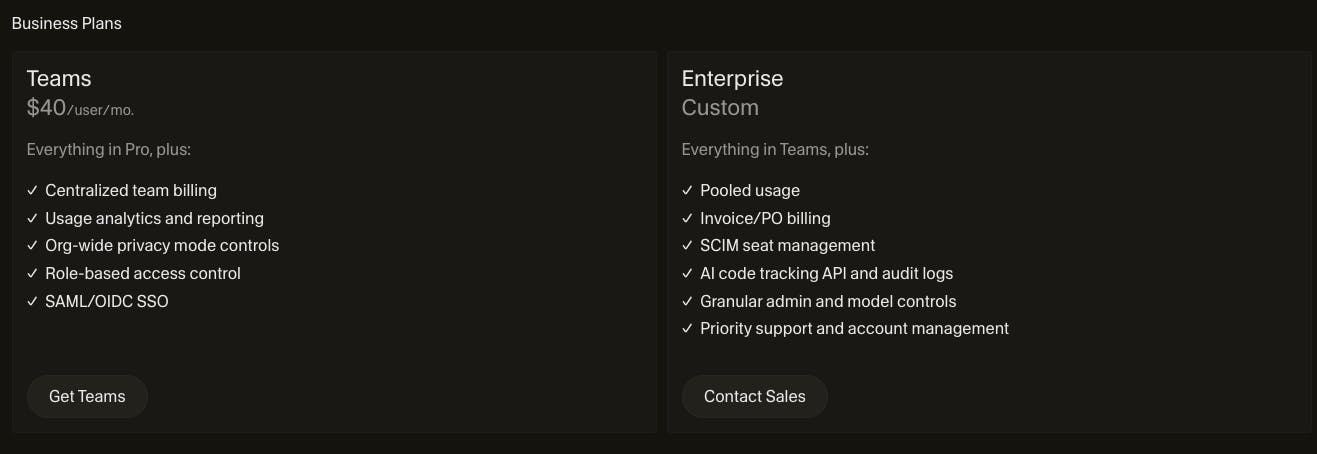
Team plans operate on a per-user model, with customizable options available. The company announced it will transition from fixed to variable request costs beginning in September 2025. As of December 2025, the two team plans are:
Enterprise (custom pricing): Everything in Teams plus advanced analytics and reporting, priority security, and dedicated account management.
Source: Cursor
Separate from Cursor’s subscriptions is Bugbot. Bugbot’s Pro plan ($40 per month) covers unlimited reviews across up to 200 PRs per month, unlimited access to Cursor Ask, integration with Cursor for bug fixes, and Bugbot Rules. The Teams plan ($40 per month) offers unlimited code reviews across all PRs, pooled team usage, and advanced rules and settings. Enterprise (custom pricing) extends this to analytics, reporting, priority support, and dedicated account management.
Cursor also supports an Auto option for pricing, which selects the best premium model based on performance and speed. As of December 2025, Auto is priced at $1.25 per 1 million input tokens, $6.00 per 1 million output tokens, and $0.25 per 1 million cached input tokens. Cursor has made a change to Auto’s pricing in June 2025, from being charged the same as other premium models to being unlimited for individuals and priced at the same costs as other premium models for Teams.
On the enterprise side, annual contracts typically range from $19.2K to $152.6K with a median contract value of $61.4K. Despite these high-end contracts, as of February 2025, Cursor’s average contract value was estimated to be relatively low at $276, reflecting its focus on individual developers as its core user base. The business model has been criticized by analysts who point to the company charging users lower or equivalent pricing to Anysphere’s own costs of accessing foundation models.
Traction
Anysphere Inc. began development of Cursor in April 2022, after raising a $400K pre-seed round. In March 2023, Anysphere launched Cursor, an IDE built on VS Code. Key features were released in late 2023, including inline command and chat, which enabled users to interact with their code using natural language.
Source: Sacra
By the end of 2023, Anysphere had raised a $8 million seed round and 30K daily active users. In November 2024, Anysphere acquired Supermaven, an AI-powered code completion tool founded by Jacob Jackson, formerly of Tabnine and OpenAI. Supermaven had raised $12 million, achieved $1 million in ARR, and served over 35K users at the time of acquisition.
Within 20 months after launch, in January 2025, Cursor crossed $100 million in ARR, reportedly without any marketing spend. In 2024 and early 2025, OpenAI explored a potential acquisition of Anysphere but ultimately chose to acquire Windsurf instead. Anysphere declined multiple acquisition offers to remain independent and continue scaling.
Despite rising interest from enterprise buyers, Anysphere initially focused on serving individual developers. The company made it difficult for enterprises to contact it, even removing contact options from their website. In early 2025, however, it began assembling an enterprise sales team to respond to growing inbound interest. In February 2025 alone, between 4K and 5K companies reportedly reached out to request access to Cursor.
By March 2025, two years after the launch of Cursor, the company had expanded to 60 employees, with over 360K paying subscribers and over 50K businesses. By April 2025, Cursor had reached one million daily active users and 14K enterprise customers. As of April 2025, Cursor accounted for approximately 1.3% of the global developer tools market. That same month, Anysphere was ranked number 26 on Fast Company’s list of the World’s 50 Most Innovative Companies. As of December 2025, the company has a single-digit monthly cash burn rate and is sitting on $1 billion in cash reserves.
Anysphere is used by many of the world’s leading companies, including half of the Fortune 500, as well as many high-growth startups, such as OpenAI, Midjourney, and Perplexity. In July 2025, Anysphere acquired Koala, an AI-powered CRM startup. While Cursor will not integrate Koala’s product, Koala’s leading engineers will join Anysphere to build out a team focused on enterprise readiness. Koala had previously raised a $15 million Series A round in February 2025, led by CRV with participation from HubSpot Ventures, Recall Capital, and Afore Capital.
Valuation
In November 2025, Anysphere raised a $2.3 billion Series D round, valuing the company at $29.3 billion. As of December 2025, Anysphere’s total funding has reached $3.5 billion. The Series D round was led by Accel and Coatue. Previous funding rounds included participation from Benchmark, Index Ventures, Andreesen Horowitz, and Thrive Capital. In October 2023, the company’s $8 million seed round was led by Open AI’s Startup Fund. This round included participation from Nat Friedman and Arash Ferdowsi, along with other angel investors. In December 2025, Michael Truell shared that the company had no plans to IPO soon.

Source: Crunchbase
Key Opportunities
Evolving into a Full Developer Agent
Cursor is built on an architecture that may have the ability to expand beyond code editing into autonomous software orchestration. The market opportunity extends beyond traditional developer tools. While that segment was valued at $6.6 billion in 2024, as of May 2025, the broader software creation market, including low-code and no-code platforms, was valued at $203 billion in 2022. By increasing its support for less technical users, Cursor can access a larger market while continuing to serve its core audience of developers and small teams focused on efficiency.
Model Differentiation
If Anysphere’s proprietary model, Cursor-Fast, consistently outperforms general-purpose LLMs on these latency-sensitive tasks, Cursor could begin to establish vertical model advantages. This could reduce reliance on external APIs, lower inference costs, and allow for model behavior that aligns more closely with Cursor’s interface and workflow. While it is unlikely to match the capabilities of frontier LLMs, Cursor-Fast may offer cost and performance benefits for targeted use cases.
Key Risks
Structural Competitive Threats
Cursor operates at the application layer and has limited control over its core technology stack, relying primarily on third-party foundation models apart from its lightweight Cursor-Fast model. This creates structural exposure to competitors such as Microsoft and OpenAI, which own both the underlying models and dominant development environments. Microsoft’s bundling of Copilot with GitHub and other enterprise products increases switching costs and limits Cursor’s ability to compete in enterprise markets.
As of June 2025, Cursor’s adoption was driven by a streamlined user experience for individual developers, but this is not a durable advantage without proprietary data or mechanisms for platform lock-in. In February 2025, the company began assembling a team for enterprise growth. However, competing with incumbents that have established enterprise relationships and integrated product suites remains a challenge.
Unproven Retention and Business Durability
Cursor’s growth to $500 million in ARR within 27 months of launch suggests strong initial demand, but retention and long-term engagement have not been validated. In developer tools, early adoption can reflect user interest in new functionality or interface improvements rather than durable integration into core workflows. Without evidence of recurring, embedded use, particularly in team environments, revenue may be vulnerable to churn.
Until February 2025, Cursor remained optimized for individual users and smaller teams, with the intent to grow its ability to serve larger organizations or more advanced use cases. In the absence of infrastructure-level differentiation or clear switching costs, Cursor risks being subsumed by larger platforms or integrated as a feature elsewhere, which could hinder its ability to maintain growth and build a defensible business over time.
Hacking and Vulnerability
In May 2025, cybersecurity researchers discovered three malicious npm packages targeting the macOS version of Cursor. These packages were disguised as tools offering discounted access to the Cursor API. Once installed, they exfiltrated user credentials, downloaded an encrypted payload from attacker-controlled infrastructure, modified Cursor’s core code (main.js), and disabled auto-updates to maintain persistence.
With a user base that includes both technical and non-technical users, the platform is exposed to social engineering risks. Anysphere needs to improve package validation and implement protections against core file modification to reduce the risk of credential theft, data loss, and operational disruption.
AI Hallucination
In April 2025, Cursor users encountered a session management bug that caused logouts when switching devices. When users contacted support, the AI support agent, Sam, provided a fabricated explanation, falsely stating the behavior was due to a new single-device policy. The company later confirmed the issue was a backend bug, and the support response was an AI hallucination, not an intentional policy change.
The incident demonstrates the operational and reputational risks of deploying AI in customer-facing roles without proper safeguards. A hallucinated support response turned a minor technical issue into a negative reputational event, raising concerns about oversight, reliability, and user trust. For a developer-focused generative-AI product, where credibility and accuracy are critical, such failures directly undermine product confidence and brand integrity.

Source: ArsTechnica
Summary
Anysphere has developed Cursor, an AI-native development environment that integrates AI agents into the coding workflow. Cursor builds on Visual Studio Code and includes features such as Agent Mode, Codebase Chat, and a proprietary Cursor-Fast model. As of December 2025, it had over a million daily active users, and its annual recurring revenue had grown to $500 million within two and a half years of launching Cursor. As of December 2025, the company raised $3.4 billion across seven funding rounds and is valued at $29.3 billion.
Cursor competes directly with GitHub Copilot and Windsurf, which was acquired by Cognition in July 2025. Its fixed subscription model may face pressure from bundled enterprise offerings by incumbents like Microsoft, and it has previously been vulnerable to hacking and AI hallucination. Enterprise adoption remains limited, and long-term user retention has not been demonstrated as of December 2025. Future performance will depend on whether the company can extend its product into adjacent workflows, continue attracting enterprise clients, and increase switching costs.
*Contrary is an investor in Replit through one or more affiliates.