Thesis
Out of the 1.9 million US farms in 2025, the vast majority are classified as "small family farms," which are defined as farms with less than $350K in annual gross cash farm income. These small farms made up 86% of all US farms as of 2024, yet many conduct little of their business online. As of 2025, 85% of farms had internet access, but only 45% conducted business with any non-agricultural websites. Accounting, in particular, has long been a manual process for these farms. In a 2018 survey of 1.5K farmers, 69% of them relied on pen, paper, and other non-computerized tools, and 56% of them had added Excel or general accounting software to the mix.
Small family farms have been consolidated steadily by larger, more industrialized operations that benefit from economies of scale. From 2017 to 2022, the number of US farms fell by 7%, the number of family- or individually-owned farms fell by more than 140K, and the number of farms with more than $5 million in annual sales nearly doubled. For the independent farms that remain, accounting is particularly important. Farm records are the foundation for many on-farm decisions and for reporting to lenders and government agencies.
Farms have started to move their records off paper. In a 2024 farmer survey, 70% of respondents used at least one farm record-keeping tool. However, general-purpose accounting tools are not built around the operational realities of farming. QuickBooks, while used by some farms, was described in a 2017 university extension guide as "not ideal for agricultural producers" because it is built to track inventories of products bought and resold.
Ambrook was founded to address this challenge. The company built a financial management platform for agriculture businesses, with bookkeeping that syncs transactions directly from users' bank accounts alongside payments, reporting, and an embedded business account. Ambrook builds for the farm owner who keeps the books in the field rather than for the accountant who reviews them later, and it has since extended the same platform to trucking, construction, and property management in service of its core mission of creating a "more prosperous and resilient future for America's family-run businesses."
Founding Story
Ambrook was founded in 2020 by Mackenzie Burnett (CEO), Jeff Anders, and Dan Schlosser (Head of Product). The three started out researching water scarcity and climate resiliency in the American West. Together, they learned that water efficiency was too often blocked by back-office financial challenges, an area where operators often lacked expertise. The team decided to solve this problem starting with agriculture, and built the founding mission into the company's name: "Am" (from the Latin for love) plus "brook" (a stream of water).
Burnett's parents were civil servants with the US Department of Agriculture. She studied international relations at the University of Maryland and earned a master's in international policy from Stanford. She co-founded Redspread, which CoreOS acquired in 2016, and later worked on water trading in the Central Valley and joined the ConstitutionDAO core team. Burnett has described herself as driven to "solve esoteric societal problems."
Anders, who leads design at Ambrook, co-founded Minimill, a web-focused design agency, with Schlosser after university. Afterward, Anders worked as a product designer at Meta, led design at Interact, and headed the design team at Scale AI. Schlosser has experience building products across both large enterprises and small startups. After graduating from Columbia University with a computer science degree, he worked as a product manager at Google on Firebase and Google Drive, then as a senior product manager at The New York Times and a product manager at Covid Act Now.
Ambrook didn't start as accounting software. It began by helping producers find and apply for working capital for disaster relief and conservation work. During this period, Ambrook's team found that many of these businesses lacked the financial records lenders and grant programs required, and some could not produce a balance sheet. As a result, Ambrook decided to build financial management software tailored to agriculture, an industry that differs from the businesses general-purpose accounting software was built to serve. As of October 2026, 69 people listed Ambrook as their employer on LinkedIn, and the team included people who previously worked at companies such as Stripe, Google, and Meta.
Product
Source: Ambrook
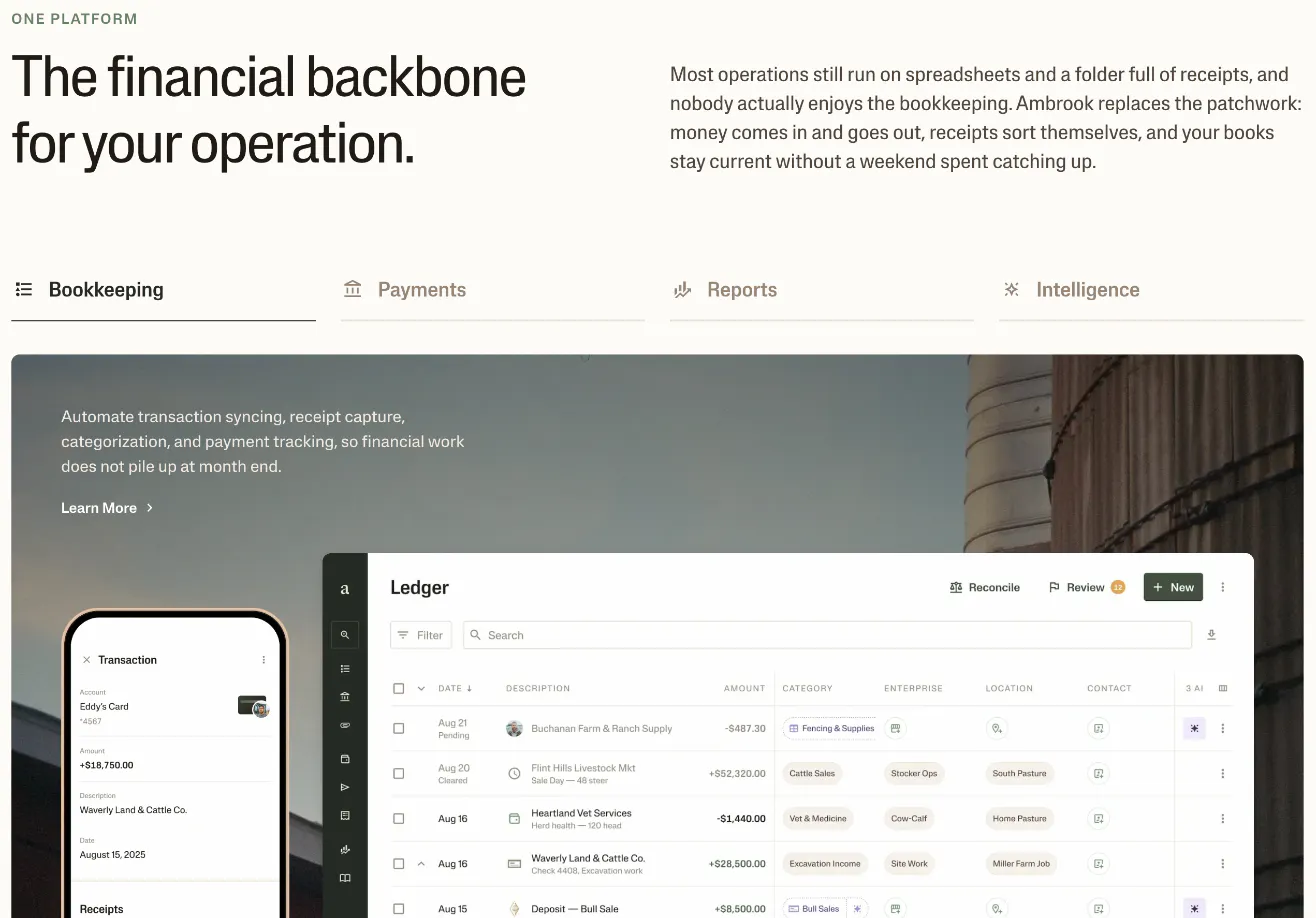
Ambrook is a financial management platform for farms and other family-run businesses. The company presents it as one platform with four parts (bookkeeping, payments, reports, and a layer it calls Intelligence that categorizes transactions, flags anomalies, and answers questions about the books), around which sit inventory tracking, multi-entity management, a mobile app, and optional bookkeeping and tax services. The platform is designed to be mobile-first, and nearly a third of customers used only the mobile app each month as of August 2026. Ambrook primarily targets independent farmers and mid-sized operations, a segment where financial management is critical for ensuring profitability, but whose owners may not have time, expertise, or interest in accounting.
Bookkeeping
Ambrook's bookkeeping syncs transactions automatically from users' bank accounts and lets users tag and categorize expenses in line with Schedule F and Schedule C tax requirements. Expenses can be split across categories and supported by receipts, which Ambrook reads from photos, even handwritten ones. Manual entries, internal transfers, and check recordings complement the automated bank feed, enabling a full picture of on- and off-farm activity. The ledger runs on double-entry accounting, supports journal entries, and works under cash or accrual methods, and each transaction can be tagged by enterprise and location so that a cattle herd and a hay crop can be tracked separately.
Operators who run several businesses can manage each one with its own ledger, chart of accounts, and balance sheet under a single login, and roll reports up across all of them. Payments between entities run through Ambrook Pay. Each entity is billed as its own subscription, with discounts for additional entities.
Payments
Source: Ambrook
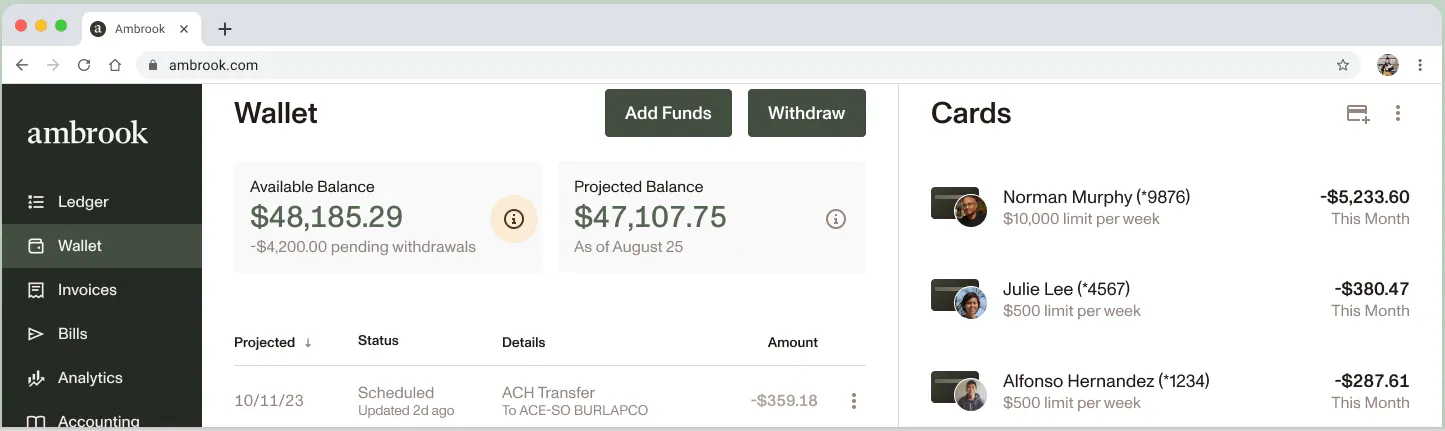
The Ambrook Wallet is a business account with Visa Commercial cards. Wallet funds are held at Fifth Third Bank, and Ambrook says they are FDIC-insured up to $250K. As of October 2026, Ambrook said Wallet deposits earned 1% cash back. Ambrook Pay lets users pay bills instantly and move money between their own entities. Cards carry per-user daily, weekly, or monthly spending limits, so farm employees can spend on a company card within limits the owner sets.
Source: Ambrook
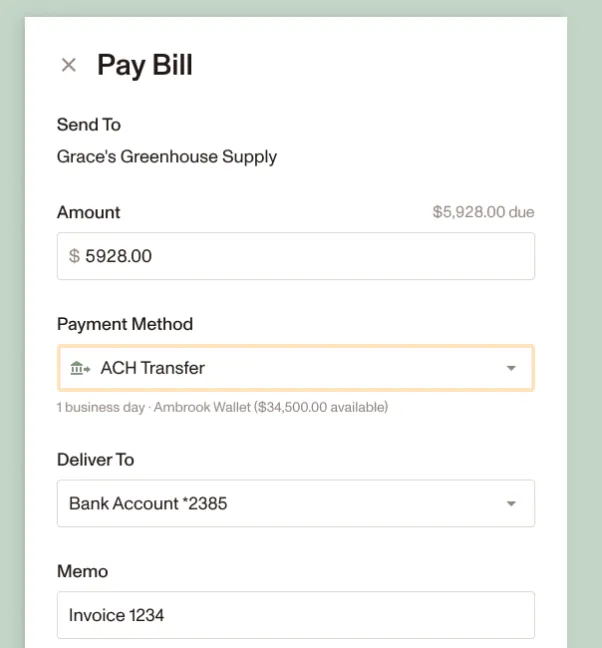
The bill pay tool handles bill imports and vendor management from a single dashboard. Payments can be scheduled or sent by ACH or mailed check, and the system includes due-date scheduling, a single view of what is due, and per-vendor payment history. Users can also fund their Ambrook Wallet in advance and schedule payments from that account. In September 2026, Ambrook launched bulk bill pay, which pays several vendors in one flow.
Source: Ambrook
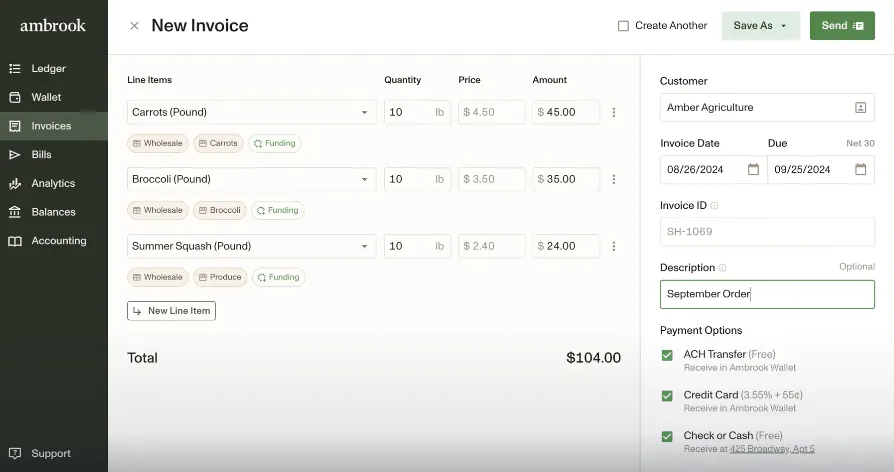
Users can issue invoices, manage customer directories, and track itemized goods or services. The invoice module is the home base for accounts receivable, where invoices are sorted by status, open invoices count toward accounts receivable, and every invoice carries an online payment link. Ambrook added recurring invoices in August 2026, which customers can pay by card, ACH, or check, and its estimates feature lets users send quotes, bids, or proposals from a phone and convert a signed estimate into an invoice.
Reports & Analytics
Source: Ambrook
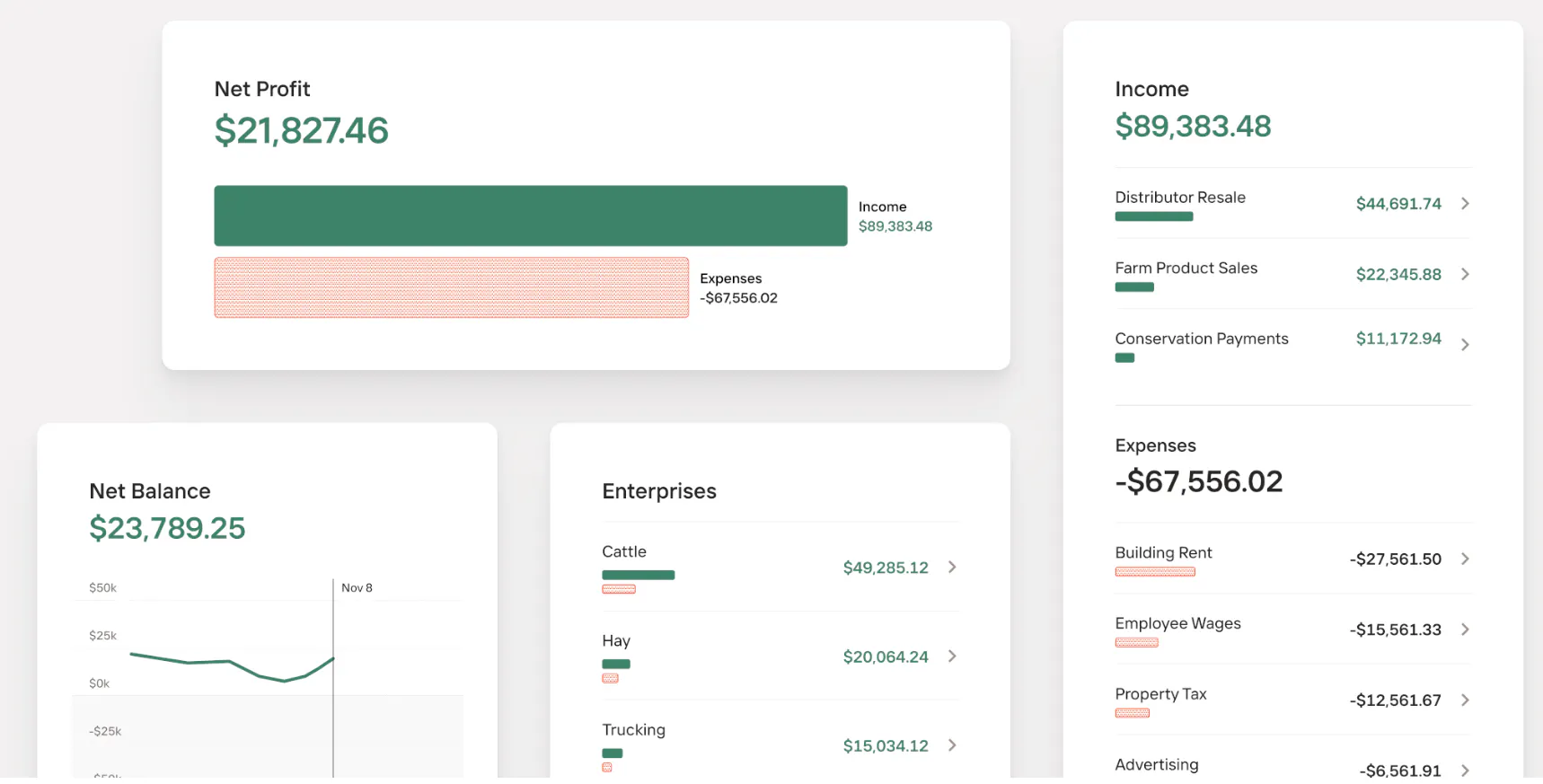
Ambrook's reports include live profit and loss statements, balance sheets, and cash flow, and clicking any amount opens the transactions behind it. Users can track profitability, return on investment, working capital, and per-unit metrics, compare performance by enterprise or location, build budgets, and monitor net income over time, which matters for a business whose income arrives in seasonal cycles. Reports roll up across entities and can be exported for lenders, grant applications, and tax filings.
Intelligence
Ambrook calls its automation layer Intelligence. Its AI features pre-fill tags on routine transactions for the user to confirm, flag unusual items, and answer questions about a business's books. As of October 2026, Ambrook also offered a read-only connection through the Model Context Protocol, an open standard for linking AI assistants to outside data, so that assistants such as ChatGPT or Claude can read a user's books without being able to change them.
Inventory
Source: Ambrook
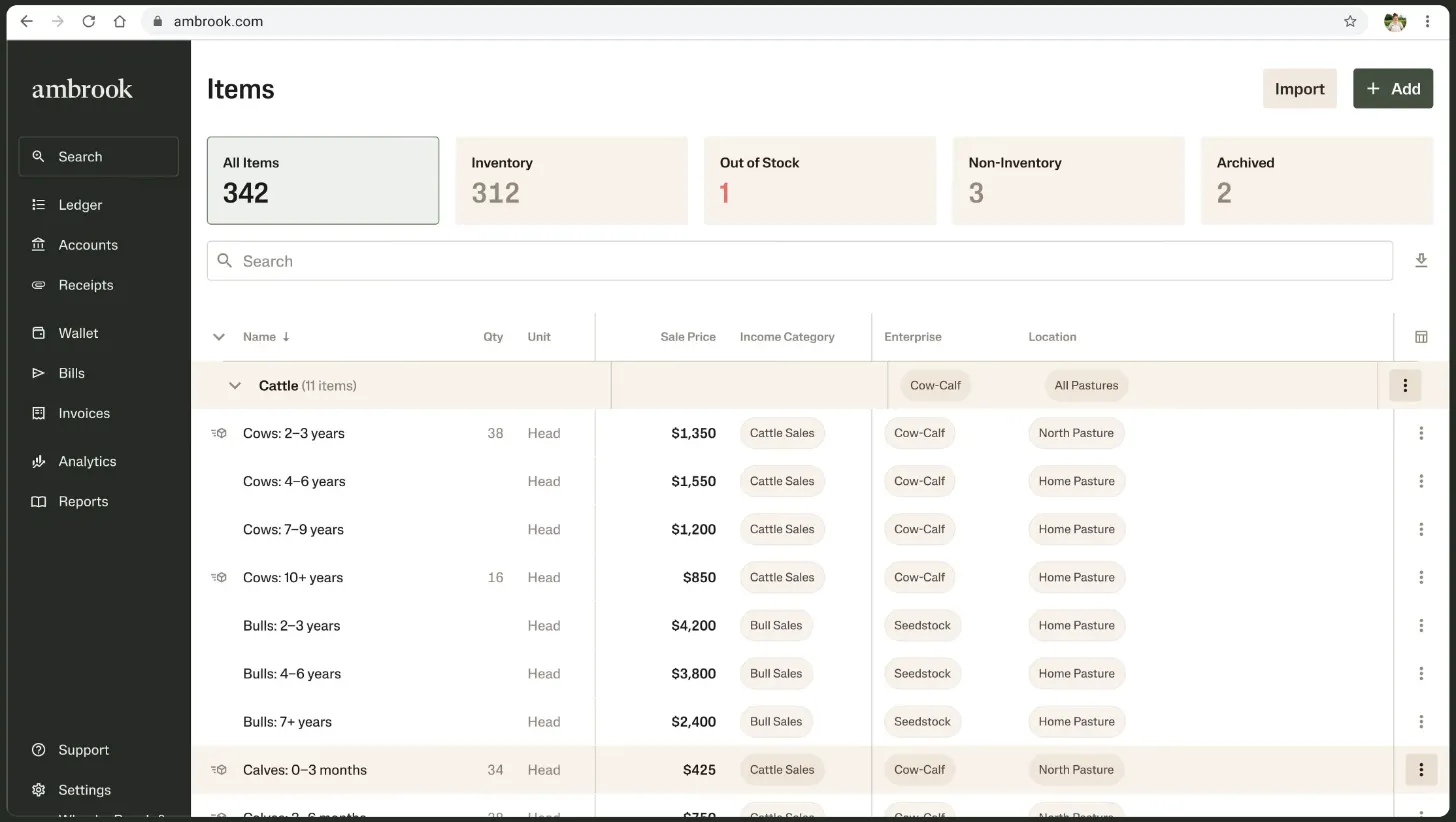
Ambrook launched Inventory in December 2025 for Pro customers. It tracks items such as livestock, feed, or hay using FIFO or weighted-average costing, can record the production value of raised goods like calves, and posts the cost of goods sold automatically. Its market value balance sheet shows book value and market value side by side. In the December 2025 launch post, Josh McKinney of McKinney Land & Cattle, an Oklahoma cattle operation, said the feature made his operation "really accurate on what it costs us to raise a calf."
Mobile App
Source: Ambrook
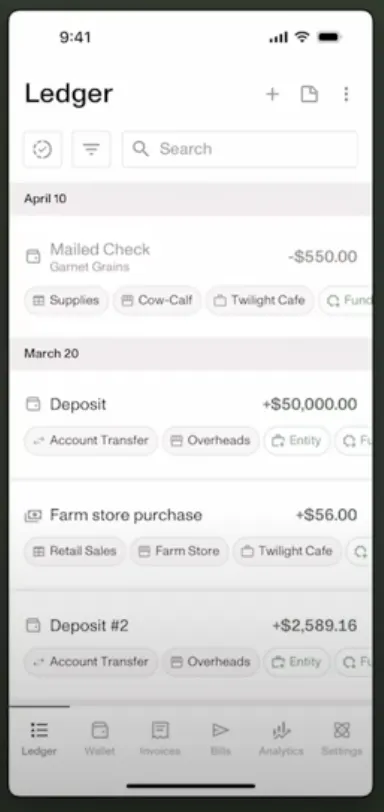
The mobile app lets users scan receipts and bills, tag transactions to a job or enterprise, and pay bills from the field. Users can also deposit checks into the Wallet from the app. By enabling real-time data entry from remote farm locations, the mobile app reduces the lag in financial reporting for farmers who are out in the field tracking inventory and negotiating contracts.
Services
Ambrook also sells services on top of the software. Full Service pairs the Pro plan with a dedicated account manager who handles monthly categorization and reconciliation and holds twice-yearly business reviews. Ambrook Tax & Advisory, delivered through partner Uprise, offers advisory sessions and personal and business tax filing. Ambrook also offers a funding library and advisors who help users find and apply for grants and loans, and it tracks grant reimbursements next to the books.
Industries
Ambrook started with farms and ranches. Some of its farm customers asked it to set up their non-farm businesses too, and as of October 2026, it offered versions of the platform for construction, contracting, property management, trucking, equestrian, and processing businesses. The offerings for other industries are slightly customized, such as profit per mile and per truck for trucking and job costing for construction, but the core functionality is the same.
Market
Customer
Ambrook's core customers are America's independent, family-run businesses, starting with farms and ranches. As of August 2026, Ambrook had over 8K business customers across the US, including over 1K trucking businesses and hundreds of general contractors and property managers. Ambrook does not disclose how its farm customers break down by size, but as of August 2026, Burnett said its software resonated with farms with up to about $20 million in annual sales, and the company planned to use its Series B to move up-market into bigger agricultural businesses and farms.
As of 2025, there were 1.9 million farms in the US. As of 2024, 86% of them, or about 1.6 million, were classified as small family farms, with less than $350K in gross cash farm income. Unlike large-scale family farms or industrial farms, small farms typically have less robust financial management systems and are less likely to have entrenched accounting software.
Small-farm households also rely on off-farm sources for most of their household income, which makes hiring accountants less feasible and often leaves farm owners with the task of financial management. Many customers rely on paper records or spreadsheets, like Jeremiah Burbach, a Kansas farmer who handed his accountant a box of receipts each year to file his Schedule F taxes. Ambrook's software is built to replace that process, with bank-synced transactions tagged to Schedule F lines as they happen.
Source: USDA
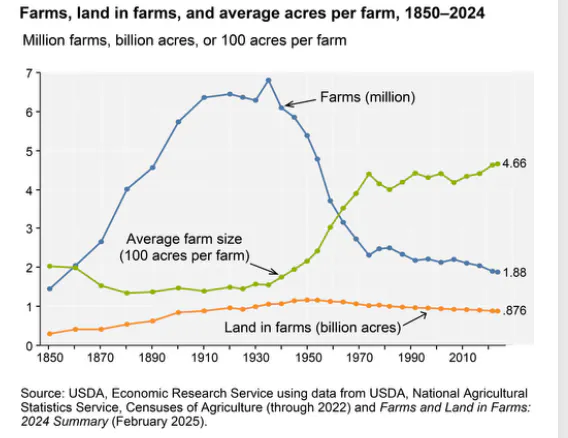
Small farms have lost ground to larger operations. Between 2017 and 2022, the number of farms under 10 acres fell 17%, the steepest decline of any size group. As of 2022, farms with sales of more than $5 million were fewer than 1% of all farms but accounted for 42% of all sales. Government support is also concentrated. In 2021, the top 10% of recipients received more than 80% of Price Loss Coverage payments.
Farms have been continuously consolidated. For example, from 2017 to 2022, the US lost 34% of its dairy farms, but the number of livestock stayed about the same. For crops, the large farms are taking over smaller farms as well. In 1987, 57% of cropland acres were operated by midsize farms, while large farms operated 15% of cropland. By 2017, the share of cropland operated by midsize farms had fallen to 33%, while the share operated by large farms had nearly tripled to 41%.
Source: McKinsey
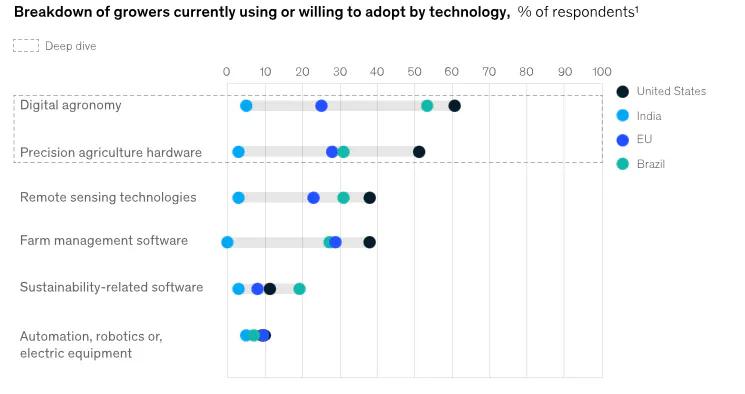
The challenge for Ambrook is that its customer base is fragmented. The roughly 1.6 million small family farms are spread across rural regions, and most US farms are owned by families or individuals, each with its own operating structure. Ambrook must tailor its go-to-market approach, overcome education barriers, and build long-term trust to scale. Farmers' interest in technology centers on tools that directly affect field operations rather than back-office functions. In a 2024 survey of farmers in nine countries, about 38% of US respondents were using or willing to adopt farm management software, behind digital agronomy at 61% and precision agriculture hardware at 51%.
Market Size
Agricultural technology is a large and diverse market, consisting of hardware such as sensors and connected devices for precision agriculture and software such as enterprise resource planning systems and imagery analysis. The global agtech market was estimated at $15.5 billion in 2023, and it was forecast to grow at a 15% CAGR from 2024 to 2032.
Farm management software, the part of that market that runs a farm's operations and records, was estimated at $2.9 billion in 2025. Agriculture accounting software, in particular, is a smaller part of it, estimated at $1.2 billion in 2025. Many farmers remain accustomed to manual record-keeping or basic spreadsheets, and the shift to accounting software is divided between general-purpose platforms like QuickBooks and ag-specific solutions like Ambrook.
For Ambrook, the base of its farm market is the roughly 1.6 million small family farms in the US. As of 2025, 45% of farms conducted business with non-agricultural websites. If that share of small family farms paid Ambrook's list price of $59 per month for its Build plan, the obtainable market would be about $510 million a year, before counting the midsize and larger family farms Ambrook also serves and the trucking, construction, and property-management businesses it added in 2025 and 2026. Growth in this market depends on farmers' willingness to adopt technology.
Competition
Looking across Ambrook’s customer base, there are three main ways for farmers to manage their finances: traditional pen, paper, or spreadsheets; general-purpose accounting tools such as QuickBooks; and farming-specific financial software. Pen and paper remained the majority method in a 2024 farmer survey, though its use had declined by 11%.
To win in this market, Ambrook needs to convince farmers to move away from their entrenched bookkeeping systems, and also compete with general-purpose accounting software and ag-specific alternatives. Ambrook's strategy for differentiation is building for its customer. Burnett said in a September 2025 podcast interview that "instead of building for the financial professional, we built for the business owner."
General-Purpose Accounting Tools
QuickBooks: Intuit's QuickBooks is accounting software for small and mid-sized businesses that supports invoicing, payments, payroll, and financial reporting in desktop and cloud versions. QuickBooks overlaps with Ambrook in essential accounting functions, and it offers mobile check deposit for QuickBooks Checking accounts and ACH payments to vendors through QuickBooks Bill Pay. Intuit began rolling out AI agents for bookkeeping and payments to US QuickBooks Online customers in July 2025, and in July 2026, it launched a business credit card whose account links directly to the QuickBooks bank feed.
QuickBooks is a generalist small-business platform with strong third-party integrations, and it diverges from Ambrook in focus. A Texas A&M extension guide recommends setting it up for a ranch with Schedule F expense accounts and a class for each production activity, and farms can also connect it to farm budgeting software such as Figured. It lacks embedded features like government funding discovery, which Ambrook builds into its vertically focused product.
Xero: Founded in 2006, Xero provides a cloud-based accounting platform for small and mid-sized businesses, with core tools for bank reconciliation, invoicing, expense tracking, and analytics. Xero listed on New Zealand's stock exchange in 2007, and investors including Valar Ventures (in 2010) and Accel and Matrix Capital Management (in 2015) invested after the listing. As of October 2026, Xero had a market cap of $7.9 billion. In October 2025, Xero completed its acquisition of Melio, a US small-business bill pay platform, for $2.5 billion.
Xero's farming offering extends its core accounting with third-party apps, including Figured for budgeting, forecasting, and production tracking and OnPay for agricultural payroll, including Form 943 filing and H-2A worker pay. Compared to Ambrook, Xero relies on third-party integrations for farm-specific analytics and budgeting, whereas Ambrook embeds comparable workflows directly within its core offering. Since the Melio acquisition, both offer their own bill pay.
Quicken: Intuit launched Quicken, now no longer owned by Intuit, in 1984 as one of the first personal finance tools. Intuit sold it to H.I.G. Capital in 2016, and Aquiline Capital Partners acquired a majority stake in 2021. In June 2026, Edward Jones made a minority investment in Quicken at an undisclosed valuation, with Aquiline remaining the majority owner. Quicken provides personal and small-business financial management, including budgeting, investment tracking, checkbook balancing, and rental or business expense tracking, and its Quicken Business & Personal product runs on web and mobile. Functionally, Quicken overlaps with Ambrook in expense categorization, budgeting, and check writing, but it is a generalist tool with no farm-specific capabilities and no built-in mobile check deposit tied to a business account.
Farming-Specific Accounting Tools
Bushel: Founded in 2017, Bushel makes software for the grain industry, including customer portals and payments for grain elevators and ag retailers, and the Bushel Farm app for growers. In February 2025, Bushel reported that its software powered over 3.5K grain and ag retail facilities and was used by over 100K farmers. That month it announced a digital wallet, an interest-bearing business account, payments, and access to lines of credit for farmers, to arrive in Bushel Farm that spring.
Bushel raised a $26 million round led by The Banc Funds in July 2023, and as of October 2026, it had raised $101.2 million in total from investors including Continental Grain, Cargill, and Lewis & Clark AgriFood, at an undisclosed valuation. Bushel competes with Ambrook's Wallet and payments, but it reaches farmers through the grain elevators and retailers they already sell to, while Ambrook sells to the operator directly.
Traction Ag: Founded in 2020, Traction Ag offers cloud-native farm accounting and field operations software from Auburn, Indiana, with real-time financial, payroll, and production tracking. In September 2022, it raised a $3 million seed round from Hageman Group, Allos Ventures, and Elevate Ventures, and in May 2024, it raised a $10 million Series A led by Cooperative Ventures. As of October 2026, Traction Ag had raised $19.5 million in total, at an undisclosed valuation. In November 2025, it acquired PcMars, a desktop farm accounting program used by over 7K farms.
Traction Ag describes itself as born in the Midwest rather than Silicon Valley and owned by farm investors. While Traction Ag overlaps with Ambrook on field-level cost tracking and real-time financial integration, it emphasizes field operations integration (for example, equipment cost attribution) and says it is "not built for construction, restaurants, or flower shops," whereas Ambrook focuses more on payments, banking, and funding and has expanded beyond farms.
FarmRaise: Founded in 2020, FarmRaise offers farm financial management software that combines transaction tracking and payroll with enrollment in government cost-share and conservation programs. In January 2022, FarmRaise closed a $7.2 million seed round led by Susa Ventures, and its CEO described grants as the starting point for a broader financial services business that could help farms land loans and buy equipment at bulk prices.
As of October 2026, FarmRaise had raised $7.2 million in total, at an undisclosed valuation, and reported serving 20K farmers and innovators. FarmRaise overlaps with Ambrook in core accounting and Schedule F tagging but distinguishes itself through its focus on grant discovery and program enrollment, including records for the 45Z clean fuel credit, while Ambrook offers more of its own banking and payment workflows.
Farmbrite: Founded in 2012 and operating from Hygiene, Colorado, Farmbrite offers a cloud-based farm management suite that includes multi-species livestock tracking, crop and task planning, integrated invoicing, and financial reporting. Farmbrite is entirely self-funded and, as of October 2026, reported over 7K farmers in more than 125 countries. Farmbrite overlaps with Ambrook on accounting and invoicing, but its broader toolset, including ecommerce, crop planning, livestock management, and offline task tracking, is oriented toward integrated operations rather than payments or funding services, making it more of a general farm operations system.
Business Model
Source: Ambrook
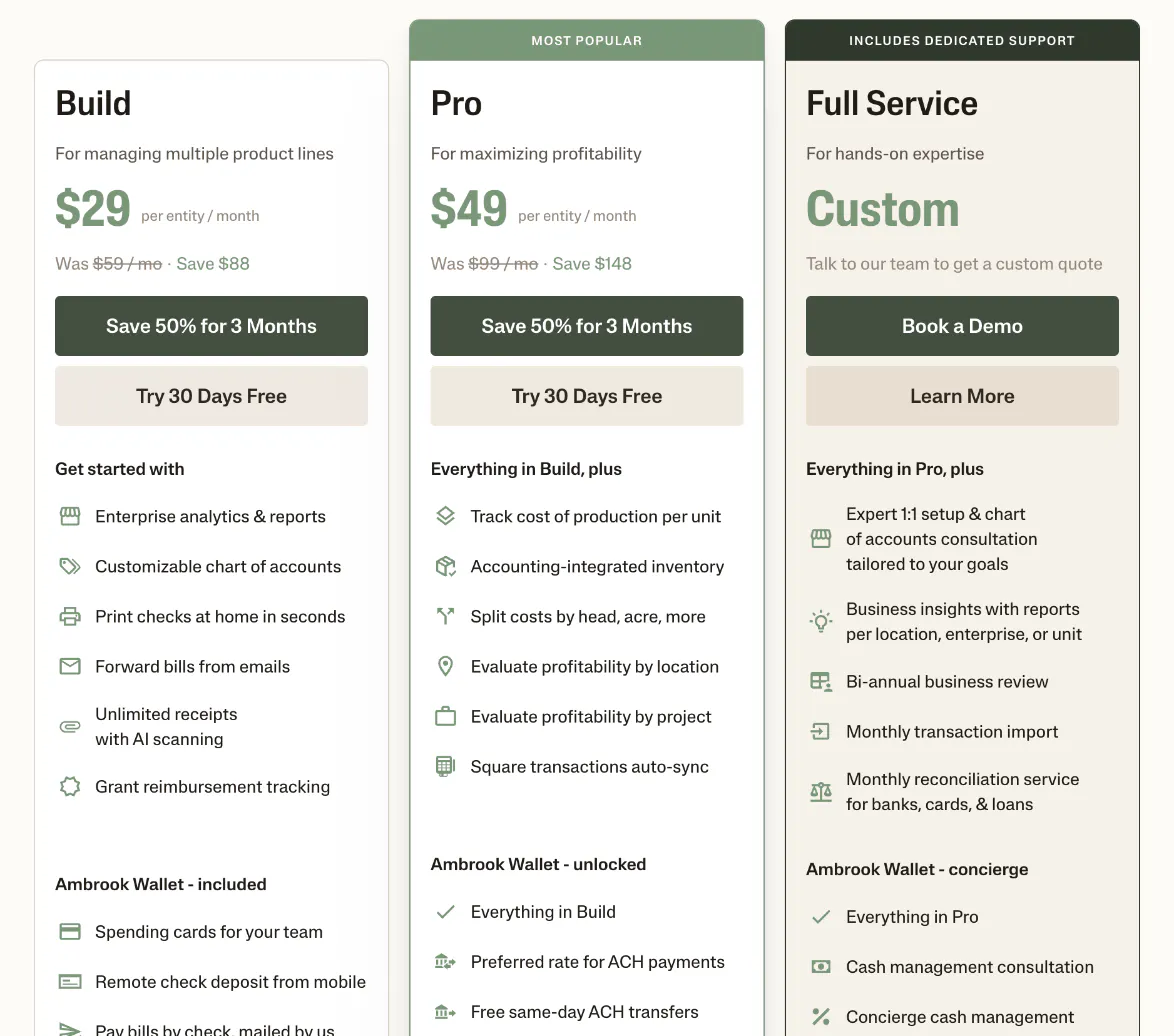
Ambrook generates revenue through tiered SaaS subscriptions, each priced per entity per month, and through services. As of October 2026, Ambrook's pricing page listed two software plans and a Full Service tier, having dropped the Start plan it offered in 2025:
Build plan: $59 per entity per month, which includes three users and three bank institutions
Pro plan: $99 per entity per month, which includes unlimited users and bank institutions, inventory, per-unit costing, and free same-day ACH
Full Service: priced by custom quote, which adds a dedicated account manager, monthly categorization and reconciliation, and twice-yearly business reviews
Yearly billing saves 10%, and as of October 2026, the pricing page also offered 50% off for the first three months. Ambrook also sells Tax & Advisory services through partner Uprise, billed separately from the software. As of May 2026, it charged $375 per quarter for advisory, $1K per year for personal tax filing, and $2K per year for business tax filing.
Ambrook is an asset-light software business, with employee salaries as the primary expense. With its 2025 Series A, Ambrook committed to more advanced financial workflows (multi-entity reporting, inventory management, and integrated payroll), AI for automated categorization and anomaly detection, and expanding Ambrook Pay nationwide. By October 2026, it had shipped multi-entity management and inventory but did not offer integrated payroll, which Burnett said in August 2026 the company would need to build to serve larger farms.
Traction
Source: Ambrook
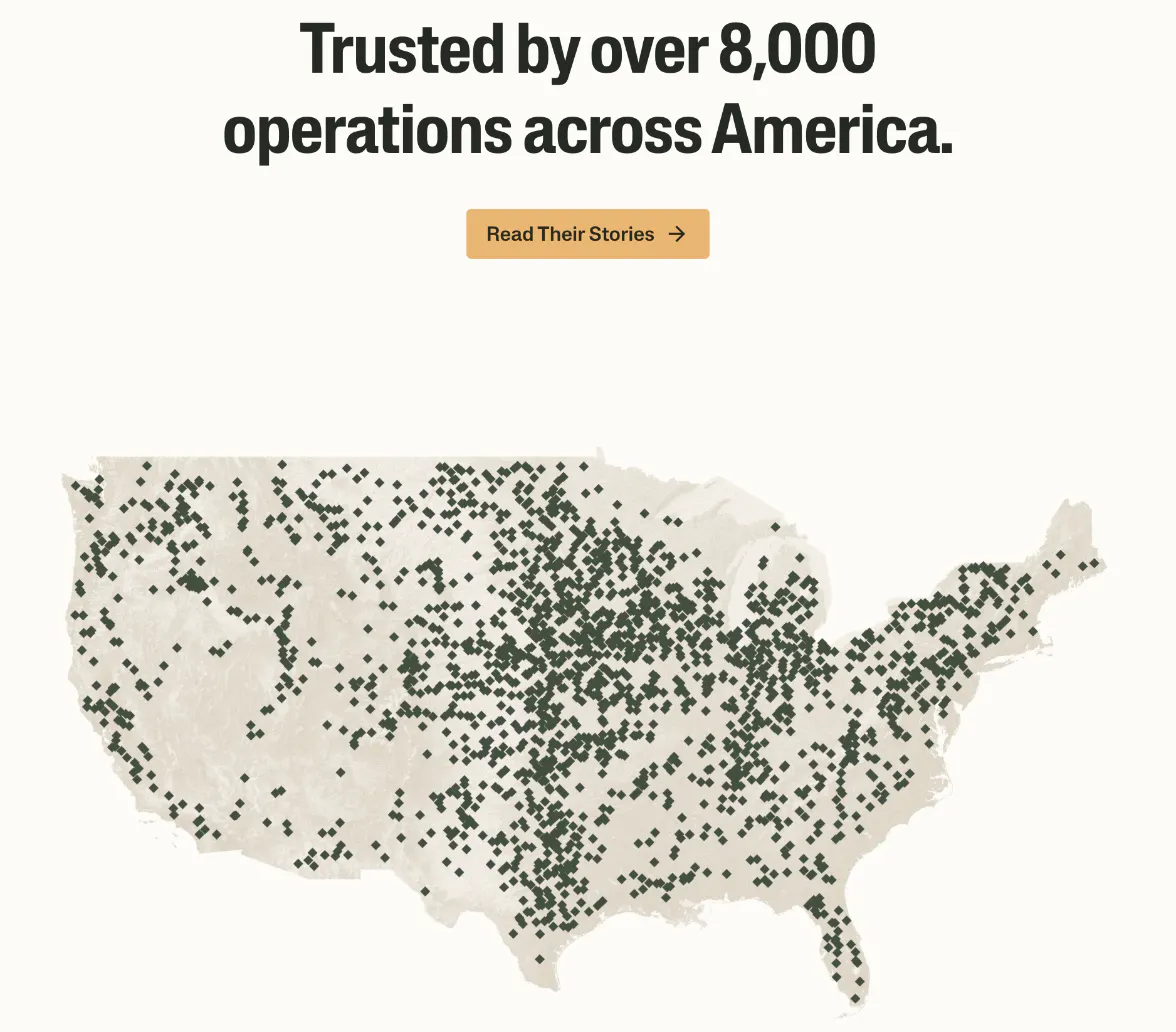
Ambrook's customer count more than tripled in the year to August 2026. In July 2025, Ambrook reported over 2.5K customer operations in all 50 states, which had spent and managed $1.6 billion through Ambrook and saved an estimated 75K hours of administrative work. In a June 2026 blog post, Ambrook said that its January 2026 customer signups were four times those of a year earlier. By August 2026, it reported over 8K business customers, including over 1K trucking businesses.
Customers range from cattle ranches in Missouri to hay farms in Oregon and a post-frame builder in Montana. In an Ambrook case study, the Montana builder, KB Building & Supply, reported tracking 28 jobs, managing 300 bills with bulk bill pay, and tagging over 1.2K transactions with AI suggestions.
Ambrook has also layered in financial services, growing from accounting software into a vertically integrated platform. In 2023, the company introduced mobile check deposit, allowing users to deposit paper checks directly into their Ambrook Wallet from the field. In June 2025, it launched its Full Service plan, combining software with dedicated bookkeeping and advisory support for more complex operations. On the infrastructure front, Ambrook partners with Stripe, Fifth Third Bank, and Celtic Bank to deliver embedded banking. Stripe provides money transmission and account services, Fifth Third holds Wallet funds, and Celtic Bank issues the Ambrook Visa Commercial cards.
Valuation
In August 2026, Ambrook raised a $30 million Series B led by Lachy Groom, with participation from Thomson Reuters Ventures, Thrive Capital, Field Ventures, and Cameron Ventures, at an undisclosed valuation. The round came 13 months after a $26.1 million Series A in July 2025, led by Thrive Capital and Dylan Field's Field Ventures, with participation from BoxGroup, Designer Fund, Mischief, Not Boring, and returning investor Homebrew, also at an undisclosed valuation. Ambrook's first round was a $2.9 million seed round in February 2021 led by Homebrew. As of October 2026, Ambrook had raised a total of $59 million.
The August 2026 Series B was only modestly larger than the July 2025 Series A, at $30 million compared to $26.1 million, even though Ambrook's reported customer count had more than tripled between the two rounds. It was also raised while listed accounting software companies were losing value. As of October 2026, for example, Intuit had a market cap of $91.8 billion, with its share price down 49% from a year earlier, and Xero had a market cap of $7.9 billion, with its share price down 54%. The fact that the market has been marking down small-business accounting and payments software, and SaaS as a category overall, likely explains the lack of funding growth over the same period for Ambrook, at least partially.
Key Opportunities
Broaden Financial Services Offerings
Ambrook has already expanded beyond its core accounting software into embedded financial infrastructure for agriculture. With the Wallet, mailed checks, ACH transfers, and Ambrook Pay, the company is building something closer to a vertically integrated fintech platform. That infrastructure could support two further products: lending and commodity risk management.
Lending and Credit Financing: Small and mid-sized farms often operate with seasonal cash flows and rely on short-term operating credit to cover seed, fertilizer, feed, or labor costs early in the season. In the second quarter of 2026, the average rate on farm loans of more than $100K was slightly less than 7%, and smaller loans averaged slightly above 7%. Ambrook's synced bank feeds and in-platform activity give it continuous visibility into users' income, expenses, and working capital, data it could use to underwrite working capital loans, buy-now-pay-later financing for inputs, or revenue-based financing. Others already offer farm credit, including FBN through its finance arm, and Bushel lets farmers access and repay lines of credit inside its farm app. Credit would add a revenue stream and embed Ambrook deeper in customers' cash flow, though it would also expose Ambrook to farm credit losses at a time of rising farm bankruptcies.
Commodity Hedging and Risk Management: In a 2024 global farmer survey, 30% of farmers, mainly in North America, ranked volatile commodity prices among their top risks, and those farmers were three times more likely to use hedges. Access to traditional hedging tools is often limited for smaller operators. Ambrook could address this gap with simpler hedging products, such as pooled forward contracts or price-lock tools, that let users lock in input or output prices without trading futures directly. Hedging products would add recurring value beyond bookkeeping and help users protect their margins.
Expansion Beyond Agriculture
Ambrook has already expanded outside mainstream farming into trucking, construction, and property management, and raised its August 2026 Series B in part to grow those businesses. Like many farms, trucking and construction businesses combine capital-intensive assets, uneven income, and owner-operators without modern financial management tools. Ambrook can continue to expand into similar industries that face accounting gaps and manual record-keeping challenges, such as forestry, where established software like SilvaPRO focuses on forest planning and wood procurement rather than day-to-day accounting for small operators. These industries mirror Ambrook's existing customer archetype of rural, under-digitized operators. With modest changes for each vertical, the platform's real-time transaction sync, tax reporting, and grant and document capture could extend to new rural sectors and make Ambrook a financial management tool for resource-based and other family-run businesses well beyond farms.
Sustainable Agriculture Modules
Sustainability fits Ambrook's origins in water and climate research. Ambrook has signaled interest in supporting regenerative and conservation practices, and the platform already includes funding discovery and grant reimbursement tracking, tools farmers use to find and apply for grants and loans. This creates a wedge into sustainability modules that help farmers access capital and document their practices for climate-linked programs.
Federal funding for that work has shrunk. In April 2025, USDA canceled its Partnerships for Climate-Smart Commodities program, and a June 2026 executive order backing regenerative agriculture added no new funding. Demand for farm-level records has grown elsewhere, and FarmRaise offers a product for documenting farm practices for the 45Z clean fuel credit and for buyers' emissions reporting. Ambrook could add carbon tracking, soil health metrics, and practice logging to its books, with exportable reports for these programs and for buyers seeking climate-resilient supply.
Key Risks
Shrinking Core Customer Base
Ambrook is primarily focused on serving small and mid-sized farming operations, segments that are increasingly under pressure. The farm economy adds near-term stress. USDA forecast 2026 net farm income at $158.4 billion, down 5.5% from 2025 after adjusting for inflation. In April 2026, 62 farms filed for Chapter 12 bankruptcy, the chapter reserved for family farmers, up 130% from a year earlier and the most since February 2020. Financially stressed farms may cut software spending or close, adding churn among the operations Ambrook serves.
Over the longer term, the number of US farms fell 8% from 2017 to 2024, to about 1.9 million, and consolidation has continued, with large farms making up 4% of US farms but controlling two-thirds of farmland. Larger farms typically have accounting software they have relied on for years, making them harder to win, and Ambrook planned to use its Series B to move up-market toward them. Unless that push and its expansion into trucking, construction, and other industries scale, the contraction of small, independent farms could constrain long-term growth.
High-Touch Sales to Rural Customers
Selling into the agricultural sector presents unique go-to-market challenges, because farmers tend to be less digitally native than other small-business owners. The average US farmer was 58.1 years old in 2022, and as of 2025, 85% of farms had internet access. As a result, Ambrook's sales likely require a high-touch, relationship-driven approach with longer sales cycles and more in-person education, and as of August 2026, Ambrook had commercial staff based in rural Montana alongside its offices in New York, San Francisco, and Denver. Onboarding customers onto a full-stack financial product also takes time, and after its Series B, Ambrook was hiring customer success managers and building a services function. This friction could raise customer acquisition and support costs as Ambrook moves into more traditional or risk-averse segments.
Incumbents Bundling Payments
While Ambrook differentiates through a farming-specific financial stack, many of its core features, like transaction tagging, bill pay, and mobile check deposit, overlap with legacy accounting tools that already reach farms through add-ons such as Figured. The bigger risk is that the incumbents are moving into the payments layer Ambrook uses to differentiate. Xero acquired the bill pay platform Melio in October 2025, and Intuit launched a business credit card tied to the QuickBooks bank feed in July 2026. With large existing user bases and entrenched relationships with accountants, incumbents could offer most of Ambrook's banking features inside a ledger farms already use, leaving Ambrook to compete on farm-specific workflows.
AI Assistants as the Bookkeeping Interface
Most of what Ambrook's accounting product does is structured work, such as categorizing transactions, reconciling accounts, and building financial statements from bank feeds. AI assistants are getting better at that work. Intuit began rolling out AI agents for bookkeeping and payments to QuickBooks Online customers in July 2025, and coverage of Ambrook's August 2026 Series B raised the question of what happens if Anthropic and OpenAI move deeper into small-business bookkeeping. If general-purpose assistants can keep a farm's books directly from its bank accounts, the farm-specific accounting layer Ambrook charges for becomes easier to replicate and harder to price.
Ambrook itself has opened its data to these assistants. As of October 2026, it offered a read-only connection through the Model Context Protocol, and Bread & Butter Farm in Vermont used it with Anthropic's Claude to manage its bookkeeping, which the farm said reduced its need for outside help. That connection could make the assistant the place where farmers do their work, with Ambrook's ledger as a data source underneath it. Burnett has argued that Ambrook's advantage lies in "economies of scale, network effects and proprietary data," which for Ambrook points to its payments and banking products more than its accounting software. If bookkeeping software commoditizes, those products would be responsible for more of the business.
Summary
Ambrook's core farm market is independent family farms, including the roughly 1.6 million small family farms in the US, a segment that comprises 86% of all farms and faces increasing pressure from consolidation and competition with larger industrial producers. Many of these farms lack formal accounting systems and struggle with cash flow management, tax filing, and access to government funding, which are all critical to a small independent farm's longevity.
Ambrook has created a product tailored to the accounting problems of independent farms, including bookkeeping, bill pay, grant applications, and embedded financial services. Its tools, designed for field use and customized for farm workflows, had reached over 8K business customers as of August 2026, more than triple the count a year earlier, and Ambrook has begun extending them to trucking, construction, and property management. The key question remains whether the company can keep growing in a fragmented and shrinking farm market, and in new industries, while competing with QuickBooks and Xero as both bundle payments into their ledgers.