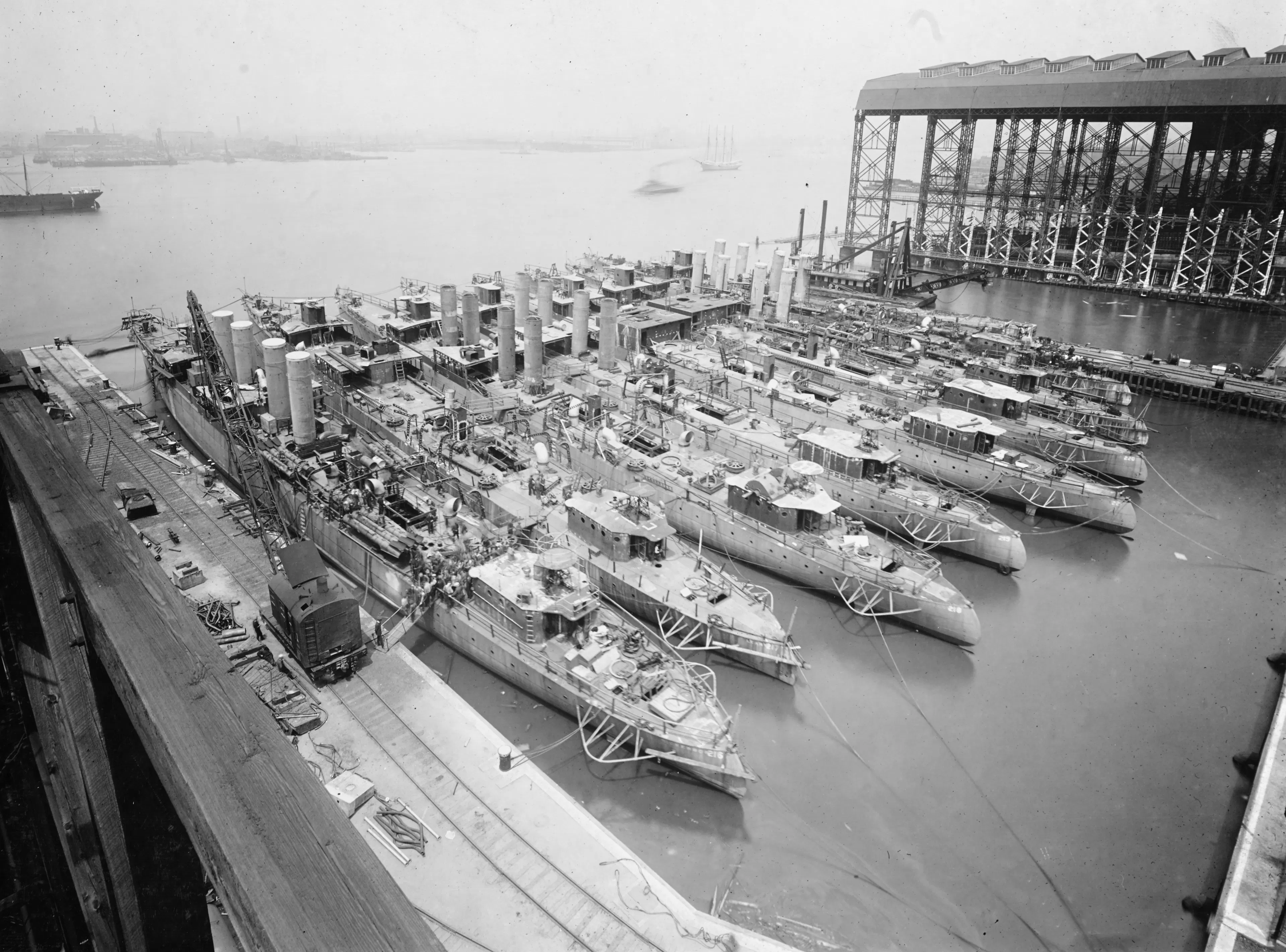
Most stories about American industrialism have turned from inspirational myths into cautionary tales. One such story is that of the New York Shipbuilding Corporation in Camden, New Jersey. Founded in 1899, New York Ship grew to become the largest shipyard in the world by 1917. World War I sparked such a shipbuilding boom that the War Department had to fund a new city — Yorkship Village — just to house the labor force for New York Ship; it was the first federally funded planned community.
This piece was originally published in Arena Magazine.
By the Second World War, New York Ship employed 47K across a 160-acre site along two miles of the Delaware River. What started as a factory had become an entire economy built to power the largest and most productive shipyard on Earth. New York Ship delivered 670 merchant and naval ships during its life, including three nuclear submarines and even the first nuclear-powered merchant ship.
By the end of WWII, America’s fleet represented 50 million deadweight tons — a measure of total carrying capacity — two-thirds of global tonnage. But after the war ended, the burden of upkeep for such a large fleet felt unnecessary, leading the US to immediately start mothballing and scrapping ships rather than maintaining them. The Cold War sustained demand for specialized naval work, like nuclear submarines and carriers, but that work concentrated in a select group of dedicated yards. Meanwhile, commercial shipbuilding migrated to lower-cost foreign yards. Caught between a shrinking commercial market and increasingly specialized naval contracts, New York Ship didn’t have the business to stay afloat. By 1968, it had shut its doors. Camden, the city that powered New York Ship, tracks an eerie road map for what happens when industrialism falters. The city lost a third of its population, including 30K manufacturing jobs. It now faces a poverty rate of 28.5% and has become one of the most dangerous cities in the country.
The New York Shipbuilding Corporation is just one of dozens of examples of the cost of assuming that America no longer needed a strong industrial base. Particularly in the 1980s, the US came to the conclusion that manufacturing and shipbuilding were commodity processes better suited for lower-cost labor markets in Asia. We’ve seen the same dynamic play out in semiconductors, batteries, mining, and pharmaceuticals. But shipbuilding represents a distinctly gnarly systems problem tangled between defense funding, policy, and a fading American manufacturing core.
This is an excerpt. The full piece is available in Arena Magazine.
Important Disclosures
This material has been distributed solely for informational and educational purposes only and is not a solicitation or an offer to buy any security or to participate in any trading strategy. All material presented is compiled from sources believed to be reliable, but accuracy, adequacy, or completeness cannot be guaranteed, and Contrary LLC (Contrary LLC, together with its affiliates, “Contrary”) makes no representation as to its accuracy, adequacy, or completeness.
The information herein is based on Contrary beliefs, as well as certain assumptions regarding future events based on information available to Contrary on a formal and informal basis as of the date of this publication. The material may include projections or other forward-looking statements regarding future events, targets or expectations. Past performance of a company is no guarantee of future results. There is no guarantee that any opinions, forecasts, projections, risk assumptions, or commentary discussed herein will be realized. Actual experience may not reflect all of these opinions, forecasts, projections, risk assumptions, or commentary.
Contrary shall have no responsibility for: (i) determining that any opinions, forecasts, projections, risk assumptions, or commentary discussed herein is suitable for any particular reader; (ii) monitoring whether any opinions, forecasts, projections, risk assumptions, or commentary discussed herein continues to be suitable for any reader; or (iii) tailoring any opinions, forecasts, projections, risk assumptions, or commentary discussed herein to any particular reader’s objectives, guidelines, or restrictions. Receipt of this material does not, by itself, imply that Contrary has an advisory agreement, oral or otherwise, with any reader.
Contrary is registered with the Securities and Exchange Commission as an investment adviser under the Investment Advisers Act of 1940. The registration of Contrary in no way implies a certain level of skill or expertise or that the SEC has endorsed Contrary. Investment decisions for Contrary clients are made by Contrary. Please note that, although Contrary manages assets on behalf of Contrary clients, Contrary clients may take any position (whether positive or negative) with respect to the company described in this material. The information provided in this material does not represent any investment strategy that Contrary manages on behalf of, or recommends to, its clients.
Different types of investments involve varying degrees of risk, and there can be no assurance that the future performance of any specific investment, investment strategy, company or product made reference to directly or indirectly in this material, will be profitable, equal any corresponding indicated performance level(s), or be suitable for your portfolio. Due to rapidly changing market conditions and the complexity of investment decisions, supplemental information and other sources may be required to make informed investment decisions based on your individual investment objectives and suitability specifications. All expressions of opinions are subject to change without notice. Investors should seek financial advice regarding the appropriateness of investing in any security of the company discussed in this presentation.
Please see www.contrary.com/legal for additional important information.